
Last updated: 9 June 2026
Key Highlights
- The Web3 gaming market was valued at an estimated $4.6 billion in 2023, projected to reach $65.7 billion by 2027.
- Axie Infinity, a pioneering play to earn game, reached a peak market capitalization of over $9 billion for its AXS token in November 2021.
- Digital ownership in Web3 gaming is primarily facilitated by non fungible tokens (NFTs), representing unique in game assets like characters, skins, or land.
- Over $760 million was invested into Web3 gaming and metaverse projects in Q1 2024, indicating continued venture capital interest.
- Approximately 40% of all blockchain activity in early 2024 was attributed to gaming applications, demonstrating significant user engagement.
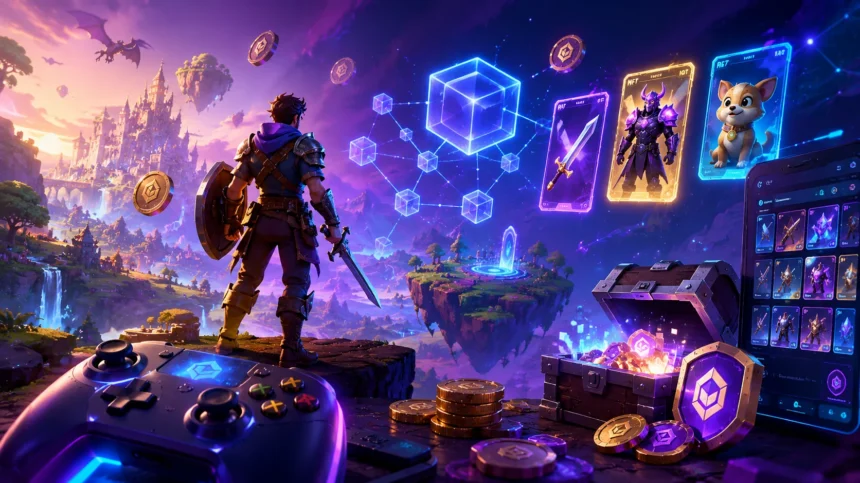
What is Web3 gaming, in essence, is a paradigm shift in how players interact with digital worlds, moving from mere consumers to empowered participants with true ownership over their in game assets and often a stake in the game’s economy. This new frontier, often called blockchain gaming or play to earn, fundamentally redefines the player developer relationship by integrating decentralized technologies like NFTs and cryptocurrencies directly into the gaming experience.
Traditional gaming has long operated on a centralized model where developers control all aspects of a game, including its assets and economy. Players might spend hundreds of dollars on skins or virtual items, but they never truly own them; these items remain tethered to the game’s servers and can be revoked or disappear if the game shuts down. Web3 gaming challenges this status quo by leveraging blockchain technology to grant players verifiable digital ownership.
Understanding Digital Ownership: NFTs in Gaming
The cornerstone of digital ownership in Web3 gaming is the non fungible token, or NFT. Unlike fungible cryptocurrencies such as Bitcoin or Ethereum, each NFT is unique and cannot be replaced by another. When a player acquires an NFT in a Web3 game, whether it is a character, a weapon, a plot of virtual land, or a cosmetic item, that asset is recorded on a public blockchain.
This blockchain record serves as an immutable proof of ownership. This means that even if a game’s servers go offline, the player still technically owns the NFT. They can trade it on open marketplaces like OpenSea or Magic Eden, transfer it to other wallets, or potentially even use it in other compatible games, depending on the interoperability design.
Consider the example of land ownership in virtual worlds like The Sandbox or Decentraland. Players purchase NFT parcels of land, which they can then develop, monetize, or rent out. This is a stark contrast to traditional games where virtual real estate, if it exists, is entirely controlled by the game publisher and holds no real world or transferable value outside that specific game’s ecosystem.
The Play to Earn Model: Rewards and Real Value
Beyond simple digital ownership, a major draw of Web3 gaming is the play to earn (P2E) model. This mechanism allows players to earn tangible cryptocurrency rewards and NFTs by engaging with the game. These rewards can then be sold on secondary markets for fiat currency or other cryptocurrencies, creating an economic incentive to play.
Axie Infinity, developed by Sky Mavis, famously popularized the P2E model during the COVID 19 pandemic, particularly in regions like the Philippines. Players earned Smooth Love Potion (SLP) tokens by battling and breeding digital creatures called Axies. At its peak in 2021, some players reported earning significant income, often exceeding local minimum wages, simply by playing the game.
However, the P2E model is not without its challenges. The sustainability of a game’s token economy is critical. If the influx of new players and capital does not keep pace with the supply of new tokens or NFTs being generated, the value of those assets can plummet. Axie Infinity’s SLP token, for instance, saw a dramatic price decline from its highs, impacting the earnings of many players and highlighting the speculative nature of early P2E economies.
From Centralized Control to Decentralized Economies
Traditional game publishers like Electronic Arts or Activision Blizzard maintain absolute control over their game economies. They set prices for in game items, dictate trade rules, and can ban players or alter item values without external input. This centralized power structure means players are always subject to the whims of the developer.
Web3 gaming, by contrast, aims for a more decentralized approach. Many Web3 games incorporate decentralized autonomous organizations (DAOs) where token holders, often players themselves, can vote on key decisions regarding game development, economic adjustments, and future features. This shifts some power from the developers to the community, fostering a sense of shared ownership and governance.
This decentralization extends to the game’s assets and currency. Since in game tokens and NFTs exist on a public blockchain, their supply, demand, and transferability are transparent and verifiable. This transparency reduces the risk of developers arbitrarily devaluing assets or manipulating markets, though it does not eliminate market volatility inherent to crypto assets.
Case Studies: Successes and Stumbles in Web3 Gaming
The journey of Web3 gaming has been marked by both impressive growth and significant hurdles. Axie Infinity’s meteoric rise and subsequent struggle with token sustainability serve as a crucial learning experience. While it demonstrated the immense potential of P2E, it also exposed the fragility of poorly designed tokenomics.
Other projects have pursued different strategies. Splinterlands, a collectible card game, has maintained a consistent player base by focusing on engaging gameplay and a robust tournament system, offering both P2E mechanics and traditional competitive elements. Its SPS token and DEC currency have shown more resilience through careful economic management.
Newer titles like Pixels, built on the Ronin blockchain, have gained traction by emphasizing social farming simulation gameplay alongside P2E elements. Pixels reported a peak of over 1.2 million unique active wallets in February 2024, demonstrating that compelling gameplay coupled with accessible tokenomics can attract a large audience. The game’s focus on onboarding new users with a simpler experience has been key to its recent growth.
However, many Web3 games have struggled to move beyond speculative interest to achieve genuine mass adoption. High entry costs for NFTs, complex wallet setups, and a lack of truly captivating gameplay have been common criticisms. Projects like Star Atlas, while visually ambitious, have faced delays and challenges in delivering a fully realized experience that justifies its high profile.
Challenges and the Road Ahead for Web3 Gaming
Despite the promise, Web3 gaming faces several significant challenges. User experience remains a major barrier. The process of setting up crypto wallets, managing seed phrases, understanding gas fees, and navigating NFT marketplaces is often daunting for traditional gamers unfamiliar with blockchain technology. Streamlining this onboarding process is crucial for broader adoption.
Scalability is another technical hurdle. Blockchains can become congested, leading to slow transaction times and high fees, which are detrimental to fast paced gaming experiences. Solutions like layer 2 networks (e.g., Polygon, Immutable X) and specialized gaming blockchains (e.g., Ronin, Oasys) are being developed to address these issues, offering faster and cheaper transactions.
Perhaps the most critical challenge is balancing economic incentives with genuine fun. Many early P2E games prioritized earning potential over engaging gameplay, leading to experiences that felt more like work than entertainment. The future of Web3 gaming hinges on developers creating games that are intrinsically enjoyable first, with play to earn mechanics serving as an added bonus rather than the sole motivation.
The industry is maturing, with a shift towards “play and earn” or “play to own” models that integrate blockchain elements more subtly and sustainably. Developers are increasingly focusing on high quality graphics, deep lore, and robust gameplay loops, understanding that a strong core game is essential for long term success. As venture capital continues to flow into the space, with over $760 million invested in Q1 2024 alone, we can expect more polished and innovative titles to emerge.
The TCB View
TCB believes Web3 gaming is poised for substantial growth, despite its early stumbles. We see the fundamental shift towards player ownership and decentralized economies as an irreversible trend that will redefine the gaming industry over the next decade. The winners in this space will be the studios that prioritize compelling gameplay experiences over pure speculative tokenomics, successfully bridging the gap between traditional gamers and blockchain enthusiasts.
Our read is that the primary risk lies in unsustainable token designs and the failure to simplify the user experience for the mainstream. Watch for a significant inflection point when a major, high quality Web3 title achieves widespread adoption comparable to a AAA traditional game, demonstrating that blockchain integration can enhance, not detract from, the fun factor.