
Last updated: 9 June 2026
Key Highlights
- Ethereum’s EIP 1559 upgrade, implemented on August 5, 2021, introduced a base fee burn mechanism, permanently removing ETH from circulation.
- Over 4.5 million ETH, valued at approximately $15 billion as of early 2024, has been burned since EIP 1559’s activation, contributing to Ethereum’s deflationary mechanics.
- During the Yuga Labs Otherside NFT mint on May 1, 2022, Ethereum gas fees surged to over 10,000 Gwei, costing some users thousands of dollars for a single transaction.
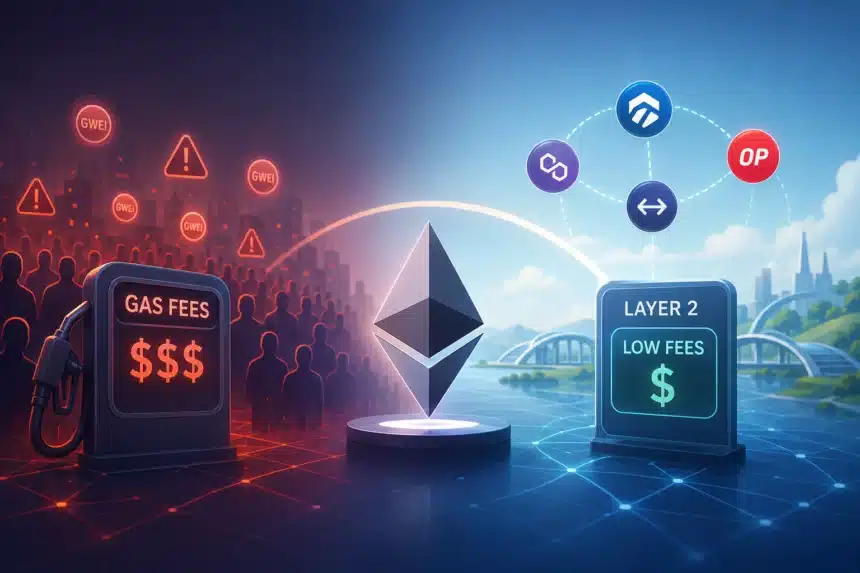
- Layer 2 solutions like Arbitrum and Optimism now offer transaction costs typically ranging from $0.01 to $0.50, significantly lower than Ethereum mainnet’s $5 to $20 average for simple transfers.
Understanding what are Ethereum gas fees is fundamental for anyone interacting with the network; they represent the computational cost required to execute transactions or smart contract operations, paid in Gwei, a small denomination of Ether (ETH).
Understanding What Are Ethereum Gas Fees
Ethereum gas fees are essentially the price of computation on the Ethereum blockchain. Every action, from sending ETH to interacting with a decentralized application (DApp) or minting an NFT, requires computational resources. Gas is the unit measuring this computational effort. The fee itself is paid in Gwei, a denomination of ETH, where 1 Gwei equals 0.000000001 ETH.
Before August 2021, gas fees operated on a simple auction mechanism. Users would bid a “gas price” they were willing to pay, and miners would prioritize transactions with higher bids. This often led to unpredictable and volatile fees, with users frequently overpaying or having transactions stuck in pending status.
The EIP 1559 upgrade, part of the London hard fork implemented on August 5, 2021, fundamentally changed this. It introduced a hybrid fee model comprising a “base fee” and an optional “priority fee.” This new structure aimed to make fees more predictable and improve user experience.
The base fee is dynamically adjusted by the network based on congestion, increasing when the network is busy and decreasing when it is less used. This portion of the fee is burned, meaning it is permanently removed from circulation, making ETH a deflationary asset. The priority fee, or “tip,” is an optional extra payment to validators to incentivize them to include a transaction faster, especially during periods of high demand.
The Mechanics of EIP 1559 and the Burn Mechanism
EIP 1559 revolutionized Ethereum’s fee market. Rather than a simple first price auction, the protocol now manages a fluctuating base fee that rises or falls by up to 12.5% per block, depending on whether the network’s block utilization exceeds or falls below its target of 50%. This dynamic adjustment helps stabilize gas prices by reacting to real time network demand.
The most significant change is the base fee burn. Instead of going to validators, this portion of the transaction fee is destroyed. This mechanism has a deflationary effect on ETH, as a portion of the supply is constantly removed from circulation. As of early 2024, over 4.5 million ETH, valued at approximately $15 billion, has been burned since EIP 1559’s activation, a tangible impact on Ethereum’s economic model.
Users still specify a “max fee” they are willing to pay for a transaction. This max fee covers both the base fee and the priority fee. Any difference between the max fee and the actual base fee plus priority fee is refunded to the user. This design provides users with greater certainty about the maximum cost of their transaction, reducing the risk of overpaying.
The priority fee, while optional, remains crucial for users who need their transactions processed quickly during periods of high network congestion. It acts as a direct incentive for validators to include a specific transaction in the next block. Without a sufficient priority fee, a transaction might be delayed if validators prioritize others offering a higher tip.
Why Ethereum Gas Fees Spike: Congestion Triggers
Gas fee spikes are a direct consequence of high network demand exceeding available block space. When many users simultaneously try to execute transactions, the competition for inclusion in the next block intensifies, driving up both the base fee and the priority fee needed to secure a timely confirmation. Several common scenarios consistently trigger these surges.
Major NFT mints are notorious gas guzzlers. Projects with high anticipation can see tens of thousands of users attempting to mint tokens within minutes or even seconds. A prime example is the Yuga Labs Otherside NFT mint on May 1, 2022, which saw gas fees surge to over 10,000 Gwei. Users reported paying hundreds or thousands of dollars in gas alone for a single mint, leading to significant user frustration and failed transactions for many.
DeFi activity, particularly during market volatility, also causes spikes. Events like large liquidations on lending protocols, arbitrage opportunities across decentralized exchanges (DEXs), or sudden shifts in stablecoin liquidity can generate a flood of transactions. Bots often compete aggressively, bidding up gas prices to secure profitable trades or prevent liquidations, pushing fees higher for everyone.
Other triggers include major token launches, especially those employing fair launch mechanisms or initial DEX offerings (IDOs), and even general market excitement. When the price of ETH or other tokens sees rapid movement, it often correlates with increased on chain activity, as users move funds, take profits, or rebalance portfolios, all contributing to network congestion and elevated gas fees.
Pre and Post Merge Fee Dynamics
The Ethereum Merge, which occurred on September 15, 2022, was a monumental shift that transitioned the network from a Proof of Work (PoW) consensus mechanism to Proof of Stake (PoS). While a critical upgrade for energy efficiency and security, it did not directly reduce gas fees. This is a common misconception that needs clarity.
The Merge changed how new blocks are created and validated, replacing energy intensive mining with staking. It did not, however, increase the network’s transaction throughput or expand its block space. Therefore, the fundamental supply and demand dynamics that drive gas fees remained largely unchanged post Merge.
The EIP 1559 fee mechanism, with its base fee burn and priority fee, was implemented a year prior to the Merge and continues to govern how gas fees are calculated and paid on the PoS network. So, while the Merge marked a significant technological evolution for Ethereum, users still encounter similar gas fee experiences as they did before, dictated by network congestion rather than the consensus mechanism itself.
Future upgrades, not the Merge, are designed to address scalability and reduce gas fees directly. These include sharding and various Layer 2 scaling solutions, which aim to increase the network’s capacity to process transactions. The Merge laid the groundwork for these future scaling improvements by making the network more sustainable and stable.
The Layer 2 Solution: A Path to Cheaper Transactions
Recognizing the persistent challenge of high gas fees on the Ethereum mainnet, Layer 2 (L2) scaling solutions have emerged as a vital pathway to cheaper and faster transactions. L2s are separate blockchains or protocols built on top of Ethereum, designed to process transactions off chain and then periodically batch and settle them on the mainnet.
Prominent L2s include Arbitrum, Optimism, zkSync, and Polygon. These networks employ different technologies, such as optimistic rollups and zero knowledge (ZK) rollups, to achieve significant scalability improvements. For instance, Arbitrum and Optimism use optimistic rollups, which assume transactions are valid by default and provide a challenge period for fraud proofs. ZK rollups, on the other hand, use cryptographic proofs to verify transactions off chain, offering immediate finality on the mainnet.
The impact on fees is dramatic. While a simple ETH transfer on the mainnet might cost between $5 and $20 during moderate congestion, the same transaction on an L2 like Arbitrum or Optimism typically costs between $0.01 and $0.50. This massive reduction makes DApps and microtransactions economically viable for a much broader user base, opening up new possibilities for gaming, social media, and everyday payments.
As the Ethereum ecosystem matures, the adoption of L2s is rapidly increasing. Many popular DApps and protocols have already deployed on multiple L2s, encouraging users to bridge their assets and take advantage of the lower costs. This shift is crucial for Ethereum’s long term vision of becoming a global, scalable settlement layer.
The Future of Ethereum Gas: Proto Danksharding and Beyond
While Layer 2 solutions offer immediate relief, Ethereum’s core developers are also working on further scaling improvements for the mainnet that will indirectly benefit L2s. One of the most anticipated upgrades is EIP 4844, also known as Proto Danksharding. This upgrade is a precursor to full sharding, designed to significantly reduce the cost of data availability for rollups.
Proto Danksharding introduces a new transaction type called “blob carrying transactions.” These transactions allow L2s to post large chunks of data (blobs) to the Ethereum mainnet at a much lower cost than traditional calldata. This is because blobs are stored separately from normal transactions and are automatically deleted after a short period, reducing the permanent storage burden on the mainnet.
By making data availability cheaper, Proto Danksharding will directly translate into even lower transaction fees on Layer 2 networks. Analysts predict fee reductions of 10x or more for rollups once EIP 4844 is fully implemented. This will further solidify L2s as the primary execution layer for most Ethereum users, making the ecosystem even more accessible and efficient.
Beyond Proto Danksharding, the long term roadmap for Ethereum includes full sharding, which will break the mainnet into multiple parallel chains (shards) to process transactions concurrently, dramatically increasing throughput. While full sharding is still several years away, the continuous development of L2s and incremental mainnet upgrades demonstrates a clear commitment to tackling the scalability challenge and ensuring Ethereum remains the leading smart contract platform.
The TCB View
TCB believes gas fees remain a critical friction point for mainstream Ethereum adoption, despite significant scaling efforts. The primary opportunity lies in the burgeoning Layer 2 ecosystem, where transactions are orders of magnitude cheaper, attracting new users and DApp development. Traditional mainnet users, especially those with smaller transaction sizes, continue to bear the brunt of high fees, effectively pricing them out during peak congestion, while whales and arbitrage bots often benefit from the ability to pay higher priority fees to ensure their transactions execute. We see the continued maturation of Layer 2s, particularly with the implementation of EIP 4844 (Proto Danksharding), as the key metric to watch for widespread fee reduction. Watch for Layer 2 transaction volume to consistently exceed mainnet volume by a significant margin as a sign of true scalability and a more equitable fee structure.