
Last updated: 27 June 2026
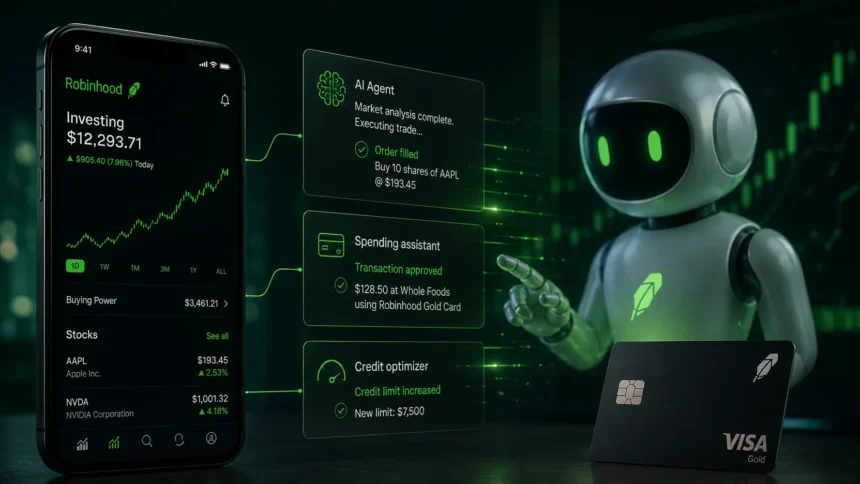
Robinhood’s recent announcement to open its platform to AI agents for stock trading and credit card spending marks a significant inflection point for retail finance, fundamentally shifting how individual investors and consumers interact with their money and potentially democratizing advanced algorithmic strategies previously reserved for institutional players.
Key Highlights
- On May 27, 2026, Robinhood confirmed plans to integrate third party AI agent access across its brokerage and credit card offerings.
- The new API capabilities will initially support automated stock trade execution and intelligent credit card spending optimization, as detailed in Robinhood’s official announcement.
- This move allows AI agents to directly manage user portfolios and spending habits, moving beyond simple advisory tools into active financial management.
- Robinhood’s credit card, the Robinhood Gold Card, will see AI agents potentially optimizing rewards, managing payments, and identifying spending patterns for users.
AI Agents Democratizing Sophisticated Strategies
The decision by Robinhood to open its platform to AI agents for automated trading and financial management extends its historical mission of democratizing finance. For years, sophisticated algorithmic trading was the exclusive domain of hedge funds and high frequency trading firms, requiring immense computational power and specialized expertise. Now, the average Robinhood user, or more likely, a developer building for them, can deploy AI agents to execute complex strategies like dynamic rebalancing, arbitrage, or even sentiment based trading.
This development is not merely an upgrade to robo advisors. While robo advisors offer automated portfolio management based on predefined risk profiles, AI agents possess a much higher degree of autonomy and adaptability. They can learn from market data in real time, adjust strategies on the fly, and execute decisions without human intervention. This could level the playing field, giving retail investors access to tools that were once out of reach, but it also introduces a new layer of complexity and risk.
The Competitive Landscape and Revenue Implications
By allowing third party AI agents, Robinhood aims to carve out a unique position in a crowded brokerage market. Traditional brokers like Fidelity or Charles Schwab, while offering advanced tools, have largely shied away from such direct AI integration for autonomous execution. This move could attract a new generation of tech savvy investors and developers who are building the next wave of financial applications.
For Robinhood, the revenue implications are multifaceted. Increased trading volume driven by AI agents could boost transaction based revenue. Beyond that, the platform could become a hub for AI driven financial innovation, potentially leading to new subscription tiers or partnerships with AI solution providers. The integration with the Robinhood Gold Card also hints at deeper engagement, turning the card into an intelligent financial assistant that optimizes spending and rewards, thereby increasing user stickiness and potentially payment processing fees. This bold step positions Robinhood not just as a brokerage, but as an infrastructure provider for autonomous finance.
However, this strategy also carries significant risks. The performance of AI agents will be under intense scrutiny. Negative outcomes, such as algorithmic errors leading to substantial losses, could severely damage user trust and invite regulatory backlash. The success hinges on robust API security, clear liability frameworks, and transparent communication about the capabilities and limitations of AI driven financial tools.
Navigating Regulatory and Ethical Minefields
The introduction of AI agents directly controlling financial transactions raises a host of regulatory and ethical questions. Securities regulators like the SEC will undoubtedly scrutinize how these autonomous agents operate. Key concerns include market manipulation, algorithmic bias, and investor protection. Who is liable when an AI agent makes a poor investment decision or mismanages credit card spending? Is it the user, the AI developer, or Robinhood as the platform provider?
The potential for flash crashes or unintended market volatility due to interconnected AI agents is a legitimate worry. Regulators will need to establish clear guidelines for testing, auditing, and disclosing the behavior of these AI systems. Beyond that, the ethical implications of AI agents making personal financial decisions, potentially without full user comprehension, cannot be overstated. Ensuring transparency and user control will be paramount to building public trust and avoiding a regulatory crackdown. The broader implications for financial advice and fiduciary duty will also need careful consideration.
The TCB View
Robinhood’s decision to open its platform to AI agents is a forward looking, yet inherently risky, play that could redefine retail finance. While it promises to democratize sophisticated financial tools, the unaddressed questions of liability, algorithmic governance, and market stability loom large. We predict a period of intense regulatory scrutiny and potential initial volatility as early AI agents learn and adapt to real world market dynamics. The critical metric to watch will be the percentage of Robinhood’s daily trading volume attributed to AI agents within the next 18 months, alongside any significant enforcement actions from financial regulators stemming from AI agent related incidents.