
Last updated: 21 July 2026
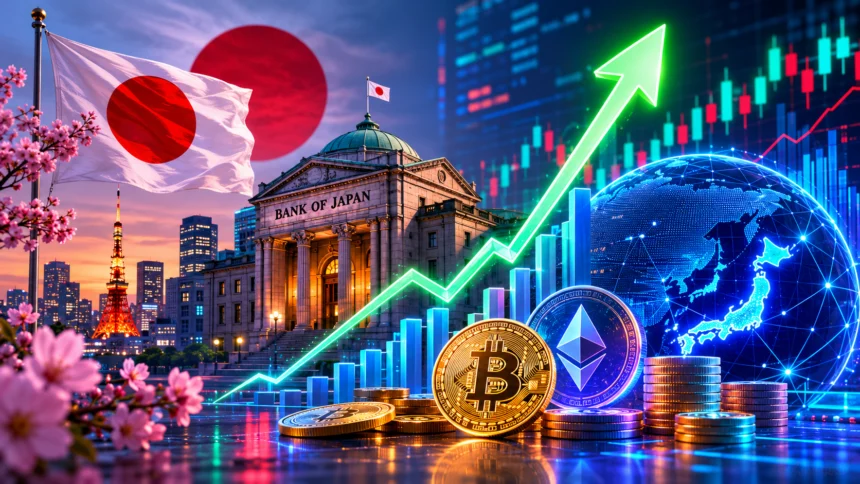
Japan set: Japan’s central bank prepares to elevate its benchmark interest rate, marking a potential return to normal monetary policy for the first time in thirty years. This decisive economic shift unfolds amid significant leadership uncertainty within the nation’s political market, creating complex signals for global investors.
While traditional markets brace for potential turbulence, the total crypto market cap recently pointed out an impressive $31.16 billion over a single twenty four hour period. This surge suggests digital assets might be charting their own course amidst the macro environment’s looming questions. (via CoinGecko)
Key Highlights
- Japan’s central bank is set to consider its first interest rate hike in three decades.
- The move signals an end to an era of ultra loose monetary policy that has persisted since the 1990s.
- Political leadership faces internal challenges, potentially complicating the economic transition.
- Global financial markets are closely watching for carry trade unwinding and capital flow shifts.
- The total crypto market cap gained $31.16 billion in the last twenty four hours.
Japan’s central Monetary Shift
The Bank of Japan stands at a historical crossroads, likely to abandon its decades old negative interest rate policy. For years, the institution maintained interest rates below zero, an unique stance among major global economies. This extraordinary measure aimed to stimulate an economy battling deflationary pressures and stagnant growth.
Recent domestic economic data, still, indicates a key turning point. Wage growth has shown surprising strength, and consumer inflation persistently hovers above the Bank of Japan’s 2 percent target. These indicators provide the central bank with the necessary justification to normalize monetary conditions. It’s a significant policy pivot.
Analysts anticipate the central bank will likely increase the benchmark rate to a positive figure, potentially ending its yield curve control measures. This action could trigger substantial ripple effects across international bond markets and currency valuations, particularly the Yen. Investors are adjusting strategies.
Political Headwinds and Economic Uncertainty
The impending monetary shift doesn’t occur in a vacuum; it converges with a period of notable political instability within Japan’s leadership. Unspecified turmoil has created an additional layer of complexity for policymakers navigating this critical economic transition. Such internal political divisions could make it harder to communicate an unified economic vision.
Leadership challenges frequently cast shadows of doubt over a nation’s ability to execute complex reforms effectively. Investor confidence can waver notably. This situation creates a hard backdrop for an economy embarking on such a fundamental policy change. A steady hand is most important.
Any perceived weakening of political will or policy incoherence might amplify market volatility, both domestically and internationally. Stakeholders are watching closely for signs of consensus or continued friction. The outcome isn’t just about rates; it’s about governance.
Global Repercussions and Crypto’s Countermove
Japan’s ultra loose monetary policy underpinned the global carry trade for decades, with investors borrowing low cost Yen to invest in higher yielding assets abroad. A rate hike, particularly one of this magnitude, risks an unwinding of these trades. This could lead to a repatriation of capital, potentially tightening global liquidity and impacting asset prices worldwide. Traditional finance faces a test.
Amidst these traditional financial anxieties, the crypto market has shown notable resilience. The total market capitalization experienced a $31.16 billion increase over twenty four hours, demonstrating considerable buying pressure. This move suggests that some capital may be seeking alternative avenues during a period of macroeconomic uncertainty.
Decentralized finance protocols, monitored by tools like the TCB DEFI PULSE, often react to shifts in global liquidity and investor sentiment. A potential flight from traditional asset classes into digital ones could bolster activity in the DeFi sector. This isn’t just about Bitcoin; it’s about the broader market finding its footing.
Web3 and AI in a Changing Macro Climate
The impact of Japan’s policy shift extend to the new but rapidly growing Web3 and AI sectors. Tighter global liquidity, driven by higher interest rates, might impact venture capital funding for innovative blockchain and artificial intelligence startups. Capital becomes more expensive. Investment thresholds rise.
Crypto mining operations, a cornerstone of many Web3 ecosystems, are particularly sensitive to energy costs and capital availability. Higher borrowing costs for infrastructure development or electricity hedging could affect profitability. Our TCB MINER STRESS SCORE provides critical insights into the health of this sector. It tracks multiple inputs.
Yet, a narrative of digital assets as a hedge against traditional market instability might gain traction. As global central banks tighten policy, some investors could view certain cryptocurrencies as a form of “digital gold” or a noncorrelated asset. The robustness observed in the market’s $31.16 billion gain, even with global financial jitters, hints at this evolving perception. The TCB MINER STRESS SCORE will be a critical monitor for sector health.
Frequently Asked Questions (FAQs)
What is happening with interest rates in Japan?
Japan’s central bank is getting ready to raise its benchmark interest rate, which would be the first time in 30 years. This move signals an end to their long standing ultra loose monetary policy.
How does Japan’s interest rate change affect global investors?
Global investors are closely watching Japan’s interest rate hike because it could lead to carry trade unwinding and shifts in capital flow. This creates complex signals for traditional markets.
What is the political situation in Japan right now?
Japan is facing significant leadership uncertainty within its political market. These internal challenges could complicate the country’s economic transition as the central bank adjusts its monetary policy.
How is the crypto market reacting to Japan’s economic news?
Interestingly, while traditional markets are bracing for potential turbulence, the total crypto market cap recently saw an impressive $31.16 billion gain in a single 24 hour period. This suggests digital assets might be charting their own course despite the macro economic questions.
The TCB View
Our read: Japan’s imminent rate hike is far more than a local economic story; it’s a tectonic shift capable of rerouting global capital. The $31.16 billion crypto market expansion over twenty four hours isn’t a coincidence; it’s an early indicator of where some investors are placing their bets. The concrete risk lies in an uncontrolled unwinding of the carry trade, potentially causing widespread market distress and triggering liquidity squeezes across traditional assets.
But a significant opportunity exists for Web3 assets to solidify their narrative as uncorrelated or even counter cyclical investments. The signal to track: the persistent volume and price action within decentralized exchanges compared to major equity indices.