
Last updated: 29 May 2026
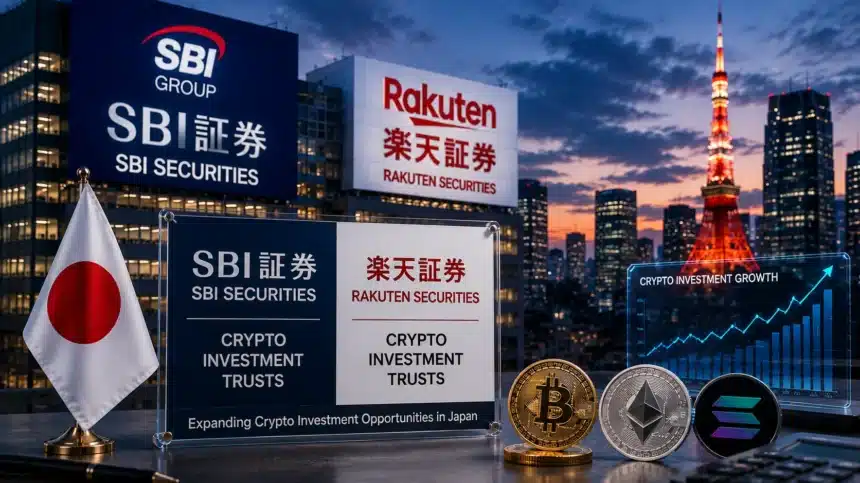
Japan’s financial giants, including SBI Securities and Rakuten Securities, are strategically moving into crypto investment trusts now to capitalize on a maturing regulatory environment and increasing institutional demand. This push signals a significant shift in how traditional finance views digital assets, positioning Japan as a potential leader in regulated crypto offerings within Asia. The global crypto market cap stands at $2.68 trillion as of 2026.05.17 16:00 UTC, demonstrating persistent investor interest despite a slight 24 hour dip of 0.1 percent.
- SBI Securities and Rakuten Securities plan to launch crypto investment trusts, according to Cointelegraph.
- This move reflects Japan’s proactive regulatory stance on digital assets, building institutional confidence.
- Bitcoin trades at $78,011.00, with overall market sentiment indicating Fear at 27/100.
- The expansion into crypto trusts could set a precedent for broader institutional adoption across Asia.
Japan’s Strategic Embrace of Digital Assets
The news, reported by Cointelegraph, indicates that major players like SBI, Rakuten, and Nomura are preparing to introduce crypto investment trusts. This development is a turning point for Japan crypto investment trusts, moving beyond mere speculation into structured financial products. These trusts offer a regulated pathway for institutional and retail investors to gain exposure to digital assets without direct ownership complications.
This strategic timing aligns with a period of significant regulatory clarity emerging in Japan. Japan recently reclassified crypto as a financial instrument, a foundational shift that now gives its securities firms the legal basis to offer trust products to retail clients. Unlike some Western jurisdictions grappling with fragmented approaches, Japan has progressively established a framework for digital asset services, including licensing requirements for exchanges and well built anti money laundering protocols.
Global Regulatory Context and Japan’s Edge
Globally, the regulatory landscape for crypto remains diverse. In the United States, the path for custody-abu-dhabi/”>spot Bitcoin ETFs was long and arduous, with Morgan Stanley’s MSBT hitting $100 million in its first week only after years of regulatory back-and-forth. Japan, however, has often been a first mover in recognizing and regulating digital currencies. This proactive stance provides its financial institutions a competitive advantage in developing compliant products ahead of US and EU peers who are still waiting on the CLARITY Act to pass.
The current market sentiment, as indicated by the Fear & Greed Index at 27/100, suggests a period of caution. However, institutional moves like these often occur during such phases, allowing for strategic entry before potential market upswings. Bitcoin, a bellwether for the market, trades at $78,011.00 as of 2026.05.17 16:00 UTC, showing resilience despite a 0.25 percent dip in 24 hours. BlackRock’s IBIT now moves more Bitcoin daily than Coinbase, a data point that shows how much institutional appetite already exists for compliant crypto exposure.
Potential Ripple Effects Across Asia
Japan’s institutional foray into crypto investment trusts could have serious ripple effects across other Asian markets. South Korean fintech giant Toss is already building its own blockchain, and Hong Kong has been aggressively positioning itself as a regulated crypto hub. Hong Kong’s Web3 festival drew Vitalik Buterin and BlackRock in the same week Japan’s trust plans surfaced, signaling a coordinated regional push toward institutional legitimacy. A successful launch and adoption in Japan may be the catalyst that pushes Seoul and Singapore regulators to move faster on equivalent frameworks.
The move by SBI and Rakuten also highlights a broader trend: the convergence of traditional finance with the digital asset space. Real world asset tokenization has already hit $27.6 billion, and institutional investors are actively seeking compliant on-ramps. Japan’s trust vehicle is one of the cleanest structures yet for delivering that on-ramp to retail participants at scale.
What This Means for Retail Investors
For everyday Japanese investors, the arrival of crypto investment trusts from household-name brokerages like SBI and Rakuten removes one of the largest barriers to entry: complexity. Purchasing a trust through an established brokerage interface is far simpler than self-custodying a hardware wallet or navigating a decentralized exchange. Tax treatment, custody, and compliance are handled at the institutional level.
This accessibility effect could draw a wave of first-time crypto participants from Japan’s large retail investor base, many of whom already hold brokerage accounts with SBI or Rakuten. If the pattern holds, Japan’s institutional adoption curve may prove steeper than most analysts currently model. The parallel in the US is instructive: the stablecoin market crossed $320 billion largely on the back of institutional demand that retail platforms then made accessible.
The TCB View
Japan keeps doing what most markets talk about: building regulated infrastructure before the next bull cycle peaks, not after. The FSA’s deliberate, framework-first approach has been criticized as slow, but it now gives Japanese institutions a compliance runway that US and EU counterparts are still scrambling to secure. The GENIUS Act’s stablecoin provisions and the CLARITY Act are still moving through Congress while SBI and Rakuten are already in product development.
Watch SBI and Rakuten’s AUM numbers in Q3 2026. If retail uptake is strong, expect South Korea and Singapore to fast-follow with similar products within six months. Japan’s crypto trust launch is less a market story and more a regulatory template that the rest of Asia is about to copy.