
Last updated: 19 July 2026
Key Highlights
- The Hong Kong Web3 Festival 2026 ran from April 20-23 with over 200 speakers and 100 institutional partners.
- The event featured 20 thematic sessions, with tokenization of real-world assets as a dominant agenda item.
- Notable examples of enterprise adoption included Stripe’s Tempo stablecoin settlement product and DoorDash’s blockchain payment pilot.
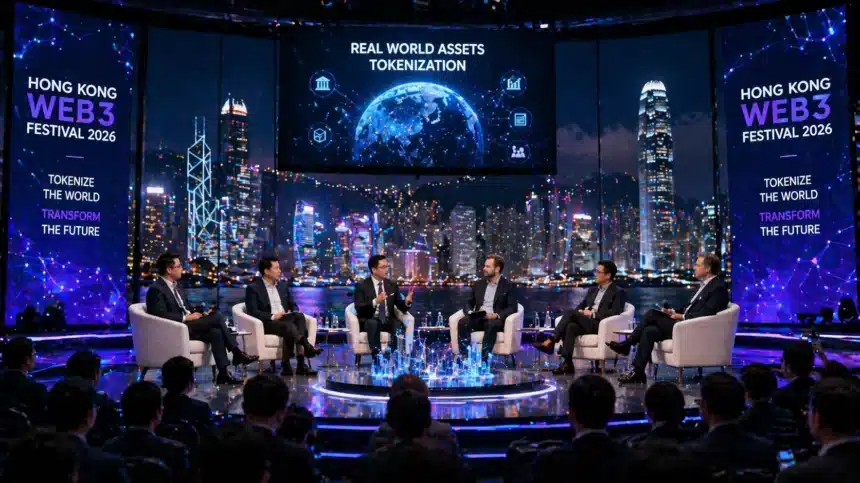
The Hong Kong Web3 Festival 2026 wrapped April 23 after four days at the Hong Kong Convention and Exhibition Centre. More than 200 speakers. Over 100 institutional partners. Twenty thematic sessions. The conversations inside looked different from the same event three years ago, not just in vocabulary but in what the big players were actually announcing versus what they were hoping someone else might build.
Key Highlights
- The Hong Kong Web3 Festival 2026 ran April 20-23 with more than 200 speakers and 100 institutional partners across 20 thematic sessions
- Tokenization of real world assets dominated the agenda: government bond tokenization, fund share settlement, and trade finance instruments on live programs, not planned ones
- Stripe’s Tempo stablecoin settlement product and DoorDash’s blockchain payment pilot were cited repeatedly as evidence that enterprise adoption has moved past proof of concept
- Zetrix’s cross border trade finance infrastructure deals and Switzerland’s Crypto Valley partnerships signal global institutional infrastructure buildout
- Hong Kong’s Securities and Futures Commission has a more explicit digital asset framework than the US currently does. Panelists noted this is attracting capital and development talent.
- AI blockchain integration sessions were standing room across all four days, with specific focus on agentic finance and on chain AI identity standards
Tokenization moved from roadmap to deployment
The shift was noticeable. In 2023 and early 2024, tokenization panels at these events described programs in development. This year the sessions covered live deployments. Hong Kong’s government bond tokenization program under the Securities and Futures Commission’s digital asset framework. Fund share tokenization for cross border settlement on institutional networks. Trade finance instruments running on Zetrix’s infrastructure connecting Hong Kong and mainland China.
Larry Fink’s public statements in early April framed tokenization as potentially modernizing capital markets the way the internet disrupted traditional finance. That framing, coming from the head of the world’s largest asset manager, changes what investment committee risk assessments at Asian institutional firms are allowed to consider. BlackRock’s staked Ethereum ETF is the first step in a tokenized asset program that has been building since 2023. The Hong Kong festival was where the infrastructure partners announced they are ready to support the next phase.
Stripe and DoorDash: why enterprise payments matter here
Stripe’s Tempo product, which processes merchant settlements in USDC, came up in multiple sessions as an example of stablecoin infrastructure that looks like payments technology rather than crypto speculation. That distinction matters for the regulatory conversation. If Stripe can route merchant settlement through stablecoins at scale with Visa and Mastercard settlement fees as the cost comparison, the argument for a blanket stablecoin yield ban in the US becomes harder to sustain. The Senate yield ban debate landed differently in Hong Kong than in Washington. Here, the question was how to integrate stablecoin settlement infrastructure efficiently. In Washington, the question is whether stablecoins should exist as yield bearing instruments at all.
DoorDash confirmed a blockchain payment pilot around April 22. Large consumer platforms testing on chain settlement are not doing it for ideological reasons. Reduced settlement times and lower card network fees are the commercial rationale. Those use cases do not require any belief in decentralization or token price appreciation. That is the kind of enterprise adoption that survives regulatory uncertainty because the cost savings are concrete and the implementation path is clear.
AI integration sessions filled every room
The AI blockchain convergence sessions were standing room across all four days. ERC 8004’s January deployment gave technical speakers a concrete implementation to discuss rather than a theoretical architecture. Agentic finance was the dominant sub theme: AI agents managing DeFi positions, routing cross chain liquidity autonomously, or executing procurement workflows without human sign off at each step.
The security question came up in every agentic session. Reasonably so. The week that KelpDAO and Volo were being exploited overlapped directly with this festival. Autonomous agents executing transactions on protocols that lost hundreds of millions of dollars in the same week is not a comfortable combination to discuss publicly. Several sessions covered AI powered exploit detection specifically as a countermeasure, with Cyvers and Blockaid both presenting their forensics tooling. The defensive case for AI in DeFi security is at least as strong as the offensive case.
The regulatory gap that nobody said out loud
Nobody said it in a public panel. In hallway conversations it was less subtle. Hong Kong’s Securities and Futures Commission framework for digital assets is more explicit than what the US has right now. Licensed exchange requirements, custody standards, retail investor protections: all documented, all in force. The Senate Banking Committee still has not scheduled a markup on the CLARITY Act. The 100-plus firm coalition sent their letter April 23, the last day of this festival. The timing was not accidental.
Switzerland’s Crypto Valley partnerships and Zetrix’s trade finance expansion both reflect the same underlying decision: build where the rules are clear. Hong Kong’s framework is not perfect. It is specific. For institutions with compliance teams and risk committees that need written regulatory guidance before committing capital, specific beats aspirational every time. Capital and development talent follow clarity. The yield ban, the CLARITY Act delay, and the ongoing SEC jurisdiction debates are all reasons for that talent to locate elsewhere.
What the next twelve months looks like from here
The institutional attendees at this festival are not speculating on token prices. They are building custody infrastructure, settlement networks, and compliance frameworks. That work happens on timelines measured in quarters. The tokenization programs announced this week will show first results in late 2026. The AI agent finance products discussed in the sessions are twelve to eighteen months from meaningful commercial deployment.
The gap between what is technically possible and what is legally permitted is still wide in most jurisdictions. The DeFi security losses in April 2026 made the argument for regulated institutional infrastructure more compelling. Every $292 million KelpDAO level event is a reminder of what unregulated infrastructure costs when something goes wrong. Regulated infrastructure with explicit frameworks costs something else: speed and flexibility. For the institutions at this festival, that is a trade they are willing to make.
The TCB View
The Hong Kong Web3 Festival in 2026 is no longer a speculative event. The companies that showed up came to announce programs they are already running. That shift from aspiration to deployment is the most significant development in institutional crypto adoption in the past eighteen months. What has not shifted: the US is still deciding what rules apply. Until that changes, capital and development talent will keep gravitating toward jurisdictions that have already decided. Hong Kong is one. The EU under MiCA is another. Washington is still scheduling meetings.