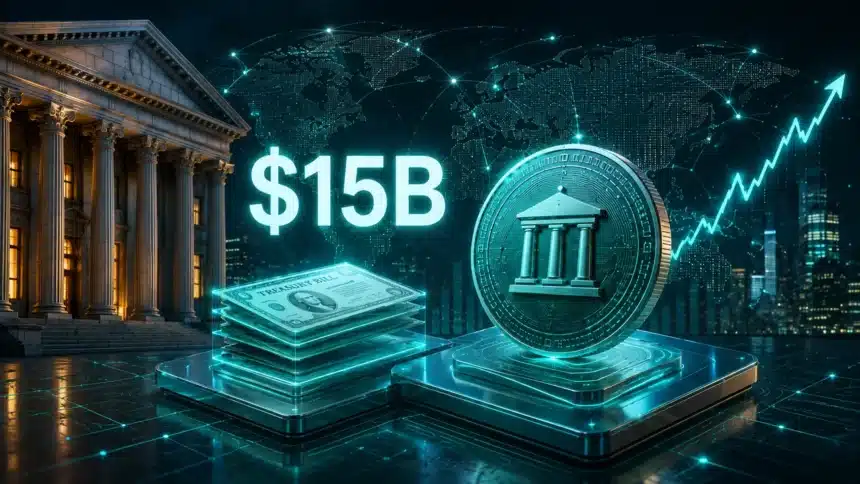
The total value of tokenized US Treasury securities held on public blockchains crossed $15 billion on May 13, 2026, a record that took 18 months to reach from the $1 billion milestone hit in late 2024. The pace of growth tells a more important story than the total alone. Institutional capital is moving onto blockchain settlement infrastructure not because of ideological conviction about decentralization but because tokenized Treasuries offer faster settlement, programmable yield distribution, 24-hour liquidity, and lower operational overhead than their traditional counterparts. That combination of practical advantages is what $15 billion of institutional money has voted for with actual capital at risk.
- Total tokenized Treasury market: $15 billion as of May 13, 2026
- BlackRock BUIDL: $2.8 billion, the single largest tokenized money market product
- Ondo Finance OUSG and USDY: Combined $850 million across two products
- Franklin Templeton BENJI: $450 million on Stellar and Polygon
- Primary blockchains: Ethereum leads with approximately 60 percent of total TVL, followed by Stellar, Polygon, and Aptos
- Growth rate: $15 billion from $1 billion in 18 months, a 15x increase
- Institutional participants: BlackRock, Franklin Templeton, Fidelity, WisdomTree, and multiple regional banks via white label products
What Tokenized Treasuries Actually Are
A tokenized Treasury product is a blockchain based token that represents ownership of an underlying US Treasury security or a money market fund holding primarily Treasuries. The token holder has a legal claim on the underlying asset, which is held in custody by a regulated entity, typically a bank or trust company. The token itself can be transferred on chain, used as collateral in DeFi protocols, or held in a digital wallet alongside other blockchain assets.
The mechanism is conceptually similar to an ETF. Just as an ETF share is a claim on a basket of underlying securities held by the ETF issuer, a tokenized Treasury token is a claim on underlying securities held by the product’s issuer. The difference is in the settlement and transfer infrastructure. ETF shares settle through DTCC on a two day settlement cycle. Tokenized Treasury tokens settle on chain in seconds. ETF shares can only be transferred during market hours. Tokenized tokens can move at any time on any day. ETF shares cannot be used directly as collateral in financial applications. Tokenized tokens can be posted as collateral in smart contracts without the token ever leaving the blockchain.
Those operational differences are why institutions are building real infrastructure around tokenized Treasuries rather than just holding traditional ETFs. As TCB covered when analyzing the XRP Ledger tokenized Treasury pilot involving JPMorgan, Ondo, and Mastercard, the settlement speed and programmability of tokenized assets is what drives institutional interest, not the blockchain technology itself for its own sake.
BlackRock BUIDL: From Zero to $2.8 Billion in 14 Months
BlackRock launched its USD Institutional Digital Liquidity Fund, known as BUIDL, on Ethereum in March 2024. Fourteen months later, it holds $2.8 billion in assets, making it the largest single tokenized money market product by a substantial margin.
BUIDL’s growth reflects BlackRock’s distribution advantages more than any specific product innovation. When BlackRock offers a tokenized money market fund, the institutional clients who already use BlackRock for traditional asset management can access it within their existing relationship. They do not need to onboard to a new custodian, open a new account at a crypto platform, or navigate a new compliance framework. The friction of adoption is near zero for an existing BlackRock institutional client.
The integration of BUIDL into DeFi protocols as a yield bearing collateral asset is a more recent development with significant implications. Protocols like Aave and Morpho have added BUIDL as an accepted collateral type, meaning that institutional holders of BUIDL can borrow against their position in DeFi lending markets without selling their Treasury exposure. That integration creates a bridge between traditional fixed income investing and DeFi capital markets that simply did not exist 18 months ago.
A new credit facility announced this week allows instant redemptions from BUIDL into stablecoins, reducing the settlement timeline from the standard T plus one day that applies even to money market fund redemptions under traditional infrastructure. As TCB reported in its analysis of tokenized Treasuries reaching $8 billion on Ethereum, the combination of instant settlement and DeFi composability is what makes the product structurally superior to its traditional analog rather than just a digital replica of the same thing.
The Ondo Finance Model: Protocol Level Tokenization
Ondo Finance has taken a different approach to tokenized Treasuries than the asset manager model represented by BlackRock. Rather than packaging a proprietary fund into a token, Ondo operates as a protocol that issues tokens against Treasuries held in regulated custody. Its OUSG product provides exposure to short duration US Treasuries and has accumulated $600 million in TVL. Its USDY product is a yield bearing stablecoin backed by Treasuries and bank deposits, with $250 million in TVL.
The Ondo model is more composable within the DeFi ecosystem because the protocol is designed from the ground up for blockchain native use rather than being a traditional fund that has been adapted for on chain distribution. OUSG and USDY are accepted as collateral across a wider range of DeFi protocols than BUIDL, in part because the token standards and smart contract interfaces are more standardized for DeFi composability.
The tradeoff is regulatory. Ondo’s products are currently available only to accredited investors, limiting their addressable market to institutions and high net worth individuals. Expanding to retail would require a different regulatory structure than the current setup. As the CLARITY Act’s provisions on digital commodity classification and DeFi oversight take effect, the regulatory pathway for broader retail access to tokenized yield products will become clearer. As TCB covered in its analysis of the CLARITY Act’s implications for Ethereum’s DeFi ecosystem, the developer liability shield and decentralized protocol framework in the bill are directly relevant to how protocols like Ondo will be regulated going forward.
Why $15 Billion Is an Inflection Point
Financial markets tend to have tipping points where a new product category crosses from experimental to mainstream. Tokenized Treasuries are approaching that threshold. At $15 billion, the market is large enough that it cannot be dismissed as a niche experiment. It is comparable in scale to mid sized ETF product categories that institutional allocators take seriously as part of their standard toolkit.
The comparison to the early ETF market is instructive. When the first ETFs launched in the 1990s, institutional skepticism was high. The products were novel, the regulatory framework was being developed in real time, and the infrastructure for custody, settlement, and distribution was being built alongside the products themselves. By the time ETF AUM crossed $100 billion, the category had proven its utility and institutional adoption became self reinforcing. Tokenized Treasuries appear to be on a similar trajectory at a faster pace, driven by the additional advantage of blockchain native settlement capabilities that traditional ETFs lack entirely.
The institutional infrastructure being built around tokenized assets is also self reinforcing in a different way: the more capital flows into tokenized products, the more protocols are built to use those products as components, the more use cases emerge that justify further capital allocation. That flywheel has been turning since early 2025 and appears to be accelerating in 2026 as the CLARITY Act creates a clearer regulatory environment for the products and their supporting infrastructure.
The Blockchain Competition for RWA Dominance
Ethereum holds approximately 60 percent of total tokenized Treasury TVL, driven largely by BUIDL’s $2.8 billion and the concentration of DeFi infrastructure that makes tokenized assets most composable on the network. But competing blockchains are making meaningful inroads.
Stellar hosts Franklin Templeton’s BENJI product, which was one of the earliest tokenized fund products and continues to grow. Polygon has attracted several smaller tokenized Treasury products due to lower transaction costs. Aptos and Solana have both announced institutional partnerships targeting the RWA category. Ethereum’s dominance in RWA is not guaranteed in the same way its dominance in DeFi TVL is, because RWA products are primarily driven by institutional distribution relationships rather than composability within an existing DeFi ecosystem.
The upcoming Glamsterdam upgrade, which TCB is covering separately today as Ethereum’s most significant execution layer improvement since the Merge, is directly relevant to the RWA competition. Higher throughput and lower settlement costs make Ethereum more attractive for large value institutional transactions that currently run on competing chains partly because of Ethereum’s gas cost volatility. As TCB covered in detail in its explainer on Layer 2 scaling solutions, the relationship between base layer capacity and institutional adoption runs in both directions: better base layer performance attracts institutional use cases that generate the transaction volume that justifies the base layer investment.
The TCB View
The $15 billion tokenized Treasury milestone means that blockchain is now real financial infrastructure for a meaningful fraction of institutional capital management. The technology has moved from a speculative bet on future utility to a proven settlement layer for some of the most conservative assets in the world, US government debt.
That shift has cascading implications. The same institutions that have moved Treasury exposure onto blockchains will use the same infrastructure for other asset types: equities, corporate bonds, private credit, and real estate. The tokenized Treasury market is not its own endpoint. It is the proof of concept phase for a much larger transformation of how financial assets are issued, held, and transferred. At $15 billion, that proof of concept is no longer theoretical. The question for the next 18 months is how fast the expansion into other asset classes follows the path that Treasuries have opened.
Free Daily Briefing
Get the Daily Briefing
Crypto, AI, and Web3 intelligence. Free, every day.
The Daily Brief by TCB
Crypto, AI & finance intelligence in 5 minutes. Every weekday morning. Free.