
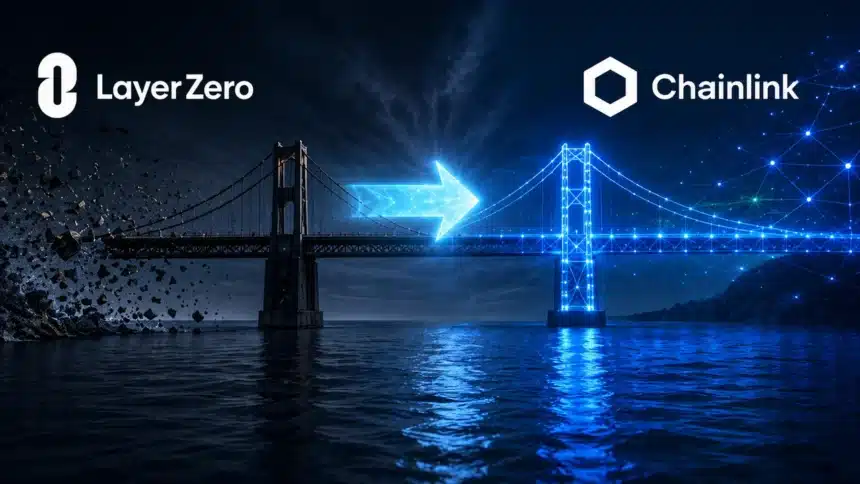
Kraken, one of the largest cryptocurrency exchanges by volume, announced that it is migrating over $3 billion in total value locked from LayerZero to Chainlink’s Cross Chain Interoperability Protocol, known as CCIP. The migration follows a $292 million exploit targeting a LayerZero powered bridge involving the Kelp protocol, making it one of the largest DeFi security incidents of 2026. Kraken’s decision to switch bridge providers is not just a vendor change. It is a statement about what institutional grade bridge infrastructure looks like in a market where cross chain exploits have collectively exceeded $2 billion in losses over the past 18 months.
- Migration scale: Over $3 billion in total value locked moving from LayerZero to Chainlink CCIP
- Trigger event: $292 million LayerZero powered bridge exploit involving Kelp protocol, May 2026
- Chainlink CCIP weekly volume: Over $1.3 billion as of May 2026
- Context: The Kelp exploit set the record for the largest DeFi hack of 2026, surpassing the $285 million Drift exploit on April 1
- Kraken’s stated reason: Chainlink’s decentralized oracle network provides stronger security guarantees than LayerZero’s message passing architecture
- Timeline: Migration expected to complete in phases over 60 days
What Happened to the LayerZero Bridge
The $292 million exploit that triggered Kraken’s decision targeted a bridge between Ethereum and a secondary chain that was powered by LayerZero’s messaging protocol, with Kelp protocol’s infrastructure as the specific attack surface. The exploit took advantage of a vulnerability in how message validation was handled across the bridge’s components, allowing the attacker to submit fraudulent cross chain messages that appeared to the bridge’s validation system as legitimate transfer requests.
Bridge exploits are the most costly category of DeFi security incident because bridges hold custody of assets from multiple blockchains simultaneously. Unlike a protocol exploit that drains a single pool, a bridge exploit can drain everything held in custody on all connected chains in a single coordinated attack. The $292 million Kelp exploit followed the $285 million Drift exploit on April 1, making the first half of 2026 one of the worst periods for DeFi security losses on record.
LayerZero’s architecture relies on a message passing model where cross chain messages are validated by a combination of the Oracle and Relayer components specified by each application using the protocol. The flexibility of this model, allowing applications to choose their own validators, is also its security weakness: an application that makes poor choices about validators or that has a vulnerability in how it processes LayerZero messages creates an attack surface that can be exploited at bridge scale. As TCB covered in its analysis of how DeFi protocols create and manage financial risk, the gap between security model and security guarantee is the most persistent challenge in decentralized finance infrastructure.
Why Kraken Chose Chainlink CCIP
Chainlink’s Cross Chain Interoperability Protocol takes a different approach to bridge security than LayerZero. CCIP uses Chainlink’s existing Decentralized Oracle Network infrastructure for message validation, which means that cross chain messages must be validated by the same network of independent node operators that currently secures over $20 trillion in on chain transaction value through Chainlink’s price feeds and other data products.
That architecture has several security properties that LayerZero’s more flexible model lacks. The Chainlink oracle network is independently operated by dozens of node operators with established reputations and economic incentives to behave honestly, because their staking deposits are slashed for malfeasance. No single party controls the validation process. The network’s track record of uptime and accurate data delivery is verifiable on chain across years of operation across multiple blockchains.
CCIP also includes a secondary validation layer called the Risk Management Network, which independently monitors all CCIP transactions and can block suspicious activity even after the primary validation has passed. That redundant validation is specifically designed to catch the kinds of anomalous large value transfers that characterize bridge exploits. The combination of the primary oracle network and the Risk Management Network creates a defense in depth architecture that is more resistant to the attack patterns that have succeeded against other bridge designs.
Chainlink’s weekly CCIP volume of $1.3 billion as of May 2026 is itself a security signal. A bridge processing $1.3 billion per week is also absorbing $1.3 billion in attempted exploits per week across the full threat landscape. The fact that CCIP has processed that volume without a significant exploit is evidence that the security architecture is holding against real adversarial pressure, not just theoretical attack models.
The DeFi Bridge Security Landscape in 2026
Cross chain bridges have been the most targeted category of DeFi infrastructure since 2022. The Ronin Network bridge lost $625 million. The Wormhole bridge lost $320 million. The Nomad bridge lost $190 million. The Harmony Horizon bridge lost $100 million. The pattern in every major bridge exploit is similar: a validation mechanism that was sound at small scale had a vulnerability that became catastrophic at the scale of hundreds of millions in custody.
The industry has responded with several different security approaches. Some protocols have moved toward trust minimized bridge designs that use zero knowledge proofs to validate cross chain state transitions cryptographically rather than relying on any external validator set. zkBridge and Succinct’s SP1-based bridge are examples of this approach. Others have moved toward using established oracle networks with long track records, which is the path Kraken is taking with Chainlink. Still others have restricted bridge functionality, reducing the attack surface by limiting the types of messages and assets that can cross the bridge.
Kraken’s choice of the oracle network approach over the zero knowledge proof approach reflects a practical tradeoff at the current stage of technology. ZK proof generation for cross chain state is computationally intensive and adds latency to cross chain transactions. For an exchange managing $3 billion in TVL across multiple chains, latency and operational reliability are priority constraints. Chainlink’s oracle based CCIP has a proven operational track record at institutional scale, while ZK bridge technology, though mathematically superior in its trust assumptions, is still being hardened through deployment at smaller scales.
Implications for LayerZero
Kraken’s migration is a significant reputational and commercial blow to LayerZero. The protocol has been one of the most widely adopted cross chain messaging systems in DeFi, with over 50 chains integrated and hundreds of protocols built on top of it. The Kelp exploit and Kraken’s subsequent decision to migrate $3 billion away will put pressure on other large LayerZero integrations to reassess their security posture.
LayerZero Labs has stated that the Kelp exploit was a vulnerability in Kelp’s implementation rather than in the LayerZero protocol itself. That distinction is technically defensible but practically difficult to maintain as a reputational argument. When $292 million is lost through a bridge that uses your messaging infrastructure, institutional counterparties will scrutinize the architecture regardless of where the specific vulnerability sat.
The incident also highlights a structural tension in LayerZero’s design philosophy. The protocol’s flexibility, its most appealing feature for developers who want to customize their bridge security model, is also what creates the attack surface. An application using LayerZero can configure its validators poorly. An application using Chainlink CCIP cannot make the equivalent configuration mistake because the validator set is fixed at the protocol level. For institutional grade deployments managing large amounts of customer assets, the loss of configuration flexibility is a worthwhile tradeoff for the gain in security predictability. As TCB covered in its analysis of the security tradeoffs between different custody models, institutional security choices consistently favor predictable security over flexible security.
What This Means for the Cross Chain Interoperability Market
Chainlink’s CCIP was always designed as enterprise grade infrastructure, with a deliberate focus on the security and auditability requirements of institutional deployments rather than the lowest friction path for DeFi protocol integration. The Kraken migration is the kind of deployment that validates that positioning in a way that competitive marketing cannot.
The broader cross chain interoperability market is consolidating around a smaller number of providers with proven security track records, which is a healthy development after a period of proliferation that saw dozens of bridging protocols competing primarily on speed of deployment and integration breadth rather than security depth. As TCB reported in its coverage of Layer 2 infrastructure and cross chain interoperability, the next phase of the multi chain ecosystem’s development requires bridges that institutional grade DeFi can depend on at scale, not just bridges that move tokens cheaply between chains.
The TCB View
Kraken’s migration is a market signal with weight behind it. When an exchange managing $3 billion in TVL publicly replaces a bridge provider after a $292 million exploit, it forces every other operator with significant bridge exposure to defend or justify their current infrastructure choice. The defensive answers will all look different depending on the specific bridge architecture in use, but the underlying question is the same: if a $292 million exploit happened on this architecture, what is the reason to believe it cannot happen here?
The answer to that question, for most bridges operating in DeFi today, is less compelling than the operators would like to admit. Bridge security in DeFi has been a gap that the industry has talked about addressing since 2022 and has addressed only partially through better auditing and some architectural improvements. The Kelp exploit in 2026 is evidence that the gap has not been closed. Kraken’s move to Chainlink CCIP is one serious institution’s answer to that gap. Other serious institutions holding significant TVL in cross chain infrastructure should be asking themselves the same question this week.
Free Daily Briefing
Get the Daily Briefing
Crypto, AI, and Web3 intelligence. Free, every day.
The Daily Brief by TCB
Crypto, AI & finance intelligence in 5 minutes. Every weekday morning. Free.