
Last updated: 21 June 2026
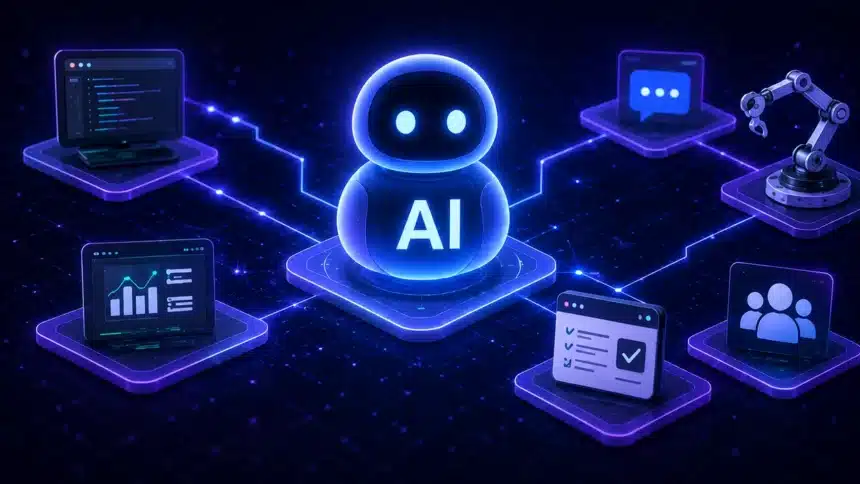
Seven distinct moves by the major AI labs in May 2026 together describe a single transition that has been approaching for two years and is now arriving in real products, real deployments, and real enterprise contracts: AI agents are replacing traditional software. Not augmenting it. Not assisting with it. Replacing it, at the workflow layer, for a growing set of tasks that currently require dedicated software applications. The speed and scale of this transition in May 2026 is worth documenting precisely, because the individual moves are easy to dismiss in isolation and much harder to dismiss when seen as a coordinated market shift.
Key Highlights
- OpenAI: Exploring AI first devices that eliminate traditional app interfaces entirely
- Anthropic: Mythos model identifying decades old vulnerabilities in legacy financial systems at scale
- Anthropic: $200 billion infrastructure commitment with Google Cloud, reporting 80x usage growth
- Anthropic Claude: Enterprise expansion into Blackstone and Goldman Sachs with deep system integration
- Google: Shut down internal Mariner agent project, consolidated all agent capabilities into Gemini ecosystem
- Microsoft and others: Agreed to government pre release testing frameworks for new models before public launch
- Industry wide: AI autonomously writing code, managing workflows, and making operational decisions across enterprise deployments
OpenAI’s Device Strategy: The App Free Interface
The most structurally disruptive development in May 2026 is OpenAI’s exploration of AI first devices that eliminate traditional application interfaces altogether. The concept is a device that operates through a conversational or ambient AI layer that handles tasks like booking, searching, comparing options, and managing communications without the user navigating between discrete applications. The user states an intent. The AI executes it. There is no app to open, no interface to navigate, no workflow to learn.
This is not a voice assistant. Voice assistants like Siri and Alexa were wrappers around existing applications that translated voice commands into application actions. What OpenAI is building is a fundamentally different architecture where the AI is the operating layer rather than an interface layer on top of existing operating systems. The applications are replaced, not wrapped.
The implications for the software industry are significant. If AI first devices capture meaningful market share, the addressable market for traditional consumer and productivity SaaS shrinks. Why pay a monthly subscription for a note taking app if your AI device captures, organizes, and retrieves notes as a native capability without a separate application? Why pay for a scheduling app if your AI device manages calendar, invitations, and rescheduling autonomously? The software categories most exposed are the ones performing single function automation that AI agents can perform as general capabilities without specialized training.
Anthropic Mythos: AI as an Enterprise Security Auditor
Anthropic’s advanced reasoning model, internally referred to as Mythos, has been deployed in enterprise security contexts where it has identified critical vulnerabilities in legacy financial system infrastructure that had gone undetected for decades. The specific finding involves decades old bugs in financial system code that expose banking and infrastructure systems to potential exploitation. The bugs were present in code that has not been meaningfully reviewed in years because the systems work and no one had the time or incentive to audit legacy code that is not actively causing problems.
The AI as security auditor use case is one of the clearest demonstrations of where AI agents provide value that traditional software cannot replicate. A legacy code audit requires reading millions of lines of code, understanding the context in which each function operates, identifying edge cases in control flow that could be exploited, and prioritizing findings by severity. Human security teams can do this at small scale at high cost. AI models with strong reasoning capabilities and large context windows can do it at enterprise scale at dramatically lower cost.
The enterprise security findings are also evidence that Anthropic‘s models have reached a capability threshold for reasoning about complex legacy systems. Identifying a decades old bug requires not just reading code but understanding the original design intent well enough to recognize where the implementation diverges from intent in an exploitable way. That level of reasoning about code context and intent is qualitatively more demanding than code generation, which many models handle well. Mythos level reasoning at enterprise security scale is a different capability frontier.
The $200 Billion Infrastructure Commitment
Anthropic’s commitment to $200 billion in cloud infrastructure and chips, in collaboration with Google Cloud, is the capacity signal that underlies all of the company’s product moves. Reporting 80x usage growth, the infrastructure investment is an acknowledgment that current compute capacity is the binding constraint on how many enterprise customers can be served and at what inference speed.
The scale of the commitment also signals something about the competitive dynamics of the AI model market. Building and operating AI inference infrastructure at the scale required to serve enterprise customers with low latency is a capability that requires capital commitments in the tens of billions, minimum. That requirement effectively limits the serious competition at the frontier of enterprise AI to the handful of companies that can either raise that capital or partner with a hyperscaler that already has it. Anthropic’s Google Cloud partnership puts it in the same tier as Microsoft and OpenAI’s Azure relationship in terms of infrastructure backing.
Claude in Finance: Blackstone and Goldman Sachs
Claude’s expansion into Blackstone and Goldman Sachs with deep system integration represents the highest value enterprise AI deployment that Anthropic has disclosed publicly. Financial institutions at the scale of Blackstone and Goldman do not add AI dependencies into core workflows on an experimental basis. Their procurement, compliance, and integration processes require demonstrated reliability and security at enterprise standards. The fact that both firms have expanded their Claude usage to the point of deep system integration, where Claude is embedded in workflow automation rather than operating as a standalone chat interface, is evidence that the model has passed those institutional bars.
The enterprise adoption pattern at financial institutions is also relevant for crypto market context. The same institutions that are integrating AI into their operational workflows are also building digital asset infrastructure, tokenized product offerings, and blockchain settlement capabilities. As TCB covered in its analysis of the tokenized Treasury market reaching $15 billion, the financial institutions leading in digital asset adoption are the same ones that are most actively expanding their AI capabilities. Those two technology adoption tracks are converging toward institutions that operate AI optimized workflows on blockchain settled infrastructure, a combination that is more powerful than either technology provides independently.
Google’s Consolidation: Mariner Dies, Gemini Absorbs Everything
Google’s shutdown of its internal Mariner agent project and consolidation of all agent capabilities into the Gemini ecosystem is the clearest signal yet that the first phase of AI agent development, characterized by proliferation of experimental projects and internal competition, is giving way to a second phase characterized by focused execution on a single unified platform.
Mariner was Google’s attempt to build a specialized web browsing and task execution agent independently from the Gemini product line. The shutdown suggests that Google concluded the advantages of a specialized agent were outweighed by the coordination costs of maintaining separate agent infrastructure from its primary AI product. Consolidating into Gemini means that all of Google’s agent capabilities, including computer use, web browsing, code execution, and task management, will be available through a single interface and API rather than requiring developers to choose between different Google agent products.
For developers building on Google’s AI stack, the consolidation reduces integration complexity. For enterprises evaluating AI agent platforms, it means Google is presenting a unified capability surface rather than a product matrix that requires expertise to navigate. The Google I/O announcements anticipated in the coming weeks will likely reveal how comprehensively the Gemini ecosystem has absorbed the capabilities from Mariner and other discontinued internal projects.
The Government Pre Release Testing Shift
The agreement by Microsoft, xAI, Anthropic, OpenAI, Google, and other major AI companies to provide early model access to government regulators before public launch is a structural shift in how the AI industry relates to government oversight. The parallel to pharmaceutical regulatory frameworks is explicit in how regulators are describing the arrangement: test before deployment, verify safety properties before public release.
The practical implication is a slowdown in public deployment timelines for frontier models, balanced against the regulatory legitimacy that pre release testing provides. For enterprises building AI powered products, the testing requirement adds a step between model availability and the ability to incorporate new capabilities into production systems. But it also creates a paper trail of safety verification that enterprise procurement teams can reference when justifying AI adoption to their compliance and legal functions. That legitimacy is worth the timeline cost for serious enterprise applications.
The TCB View
The seven moves in May 2026 are not independent events. They are different expressions of the same underlying shift: AI agents are moving from demos and experiments into the production workflows that run consequential processes at major institutions. The shift is happening faster in software intensive industries, finance, legal, engineering, and operations, than in physical world industries where AI capability must be combined with different hardware and process constraints.
For anyone building software products in 2026, the question is not whether AI agents will eventually affect your addressable market. The question is how quickly they will, and which parts of your product are performing functions that a sufficiently capable AI agent will handle as a native capability. The answer is arriving in real deployments faster than most incumbents have planned for. The seven moves in May 2026 are not the beginning of this story. They are the moment when anyone still treating the story as theoretical runs out of justifications for doing so.