
Last updated: 29 July 2026
Hong
Key Highlights
- The Hong Kong Monetary Authority has formed a Tokenised Bond Expert Group of 21 institutions to accelerate the city’s digital bond market.
- Members include JPMorgan Securities, HSBC, Standard Chartered, UBS, Bank of China (Hong Kong), Ant Digital Technologies, and HashKey Group.
- The group held its first discussions in May 2026, focusing on Hong Kong’s legal and regulatory framework for tokenized bond issuance and trading.
- Hong Kong has issued more than $1.3 billion in digital bonds to date and is positioning itself as the regional hub for tokenized assets.
HKMA Forms a 21-Institution Expert Group
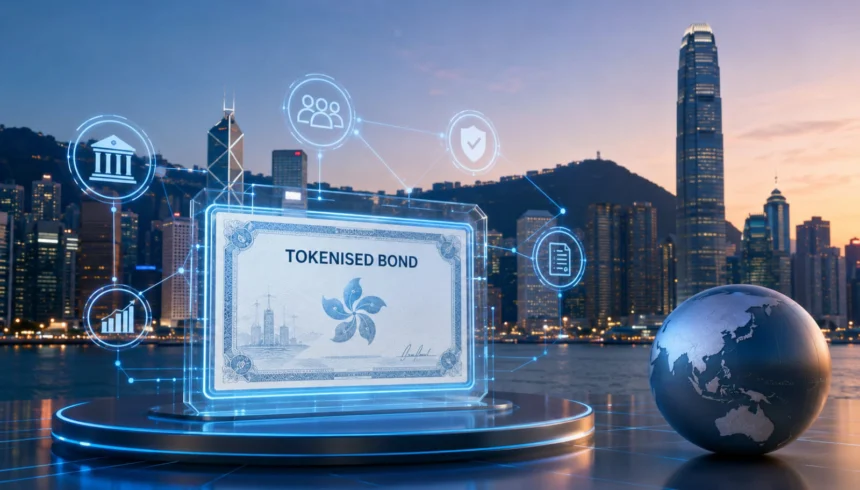
The Hong Kong Monetary Authority has established a Tokenised Bond Expert Group comprising 21 institutions to support the development of the city’s tokenized bond market. The group brings together major banks, law firms, market infrastructure operators, and digital asset companies to examine what regulatory, legal, and technical changes are needed for tokenized bonds to move from pilot projects to mainstream market activity.
Members include JPMorgan Securities, HSBC, Standard Chartered, UBS, and Bank of China (Hong Kong) on the banking side. Law firms include A&O Shearman, Clifford Chance, and Linklaters. Digital asset representation comes from Ant Digital Technologies, HashKey Group, and market infrastructure operator CMU OmniClear. The breadth of the group signals that the HKMA is treating tokenized bonds as an infrastructure question, not a technology experiment.
The group held its first round of discussions in May 2026, with an initial focus on Hong Kong’s existing legal framework and how it applies to the issuance and trading of tokenized bonds. That starting point reflects the practical reality: Hong Kong has a well-developed bond market, and any tokenized version of it needs to operate within, not around, the existing regulatory architecture.
What the Group Is Trying to Solve
Tokenized bonds offer genuine efficiency gains in issuance, settlement, and secondary trading. Issuance can happen faster with fewer intermediaries. Settlement can move from the standard two-day window to near-instant. Secondary market liquidity can improve if bonds are tradeable on platforms accessible to a wider range of buyers. These benefits have been demonstrated in Hong Kong’s own pilot programs, including several tokenized government bond issuances that settled faster than conventional equivalents.
The obstacles are regulatory and structural rather than technical. Existing rules around clearing and settlement, custody, and disclosure were written for conventional bond markets. Applying them to tokenized instruments requires either legislative amendments or regulatory guidance clarifying how current rules should be read. The expert group’s mandate includes identifying exactly which rules need updating and recommending changes that preserve investor protection while enabling a functioning market.
Infrastructure interoperability is a separate challenge. Tokenized bonds issued on one platform need to be tradeable and settleable with instruments issued on other platforms. The presence of CMU OmniClear, which operates Hong Kong’s central securities depository infrastructure, is significant here. If the expert group can define interoperability standards, it creates the foundation for a secondary market rather than a collection of isolated issuances.
Hong Kong’s Digital Asset Strategy
The Tokenised Bond Expert Group is part of a broader push by Hong Kong to establish itself as Asia’s leading center for digital assets and tokenized finance. The city has issued more than $1.3 billion in digital bonds since 2023, including sovereign tokenized green bonds that were among the first government-issued tokenized securities globally.
Hong Kong’s approach has been regulatory-first. Rather than tolerating a gray market and regulating it afterward, the HKMA and the Securities and Futures Commission have moved to build a licensing framework for digital asset exchanges, create clear rules for tokenized product issuance, and develop the legal infrastructure before significant institutional capital commits to the market. The expert group fits this pattern.
The timing also reflects competitive pressure. Singapore has been building digital asset infrastructure in parallel, and jurisdictions in the Middle East are making significant investments in tokenized finance. Hong Kong’s response has been to move faster on regulatory clarity. A well-defined framework for tokenized bonds, developed with input from the institutions that will actually use it, is a competitive advantage for attracting issuers and investors from across the region.
The TCB View
Hong Kong has been more deliberate about tokenized finance than most financial centers. Forming a 21-institution expert group with genuine market participants, law firms, and infrastructure operators is a more serious approach than issuing a consultation paper and waiting for responses. The inclusion of HashKey and Ant Digital alongside the major Western banks signals that the HKMA wants a framework that works for both traditional finance and the digital asset industry, not just an extension of existing bond market rules. The open question is whether the recommendations this group produces will translate into regulatory changes fast enough to matter. Hong Kong’s bond market competes with Singapore, London, and New York. If the expert group moves quickly and the HKMA acts on its recommendations within a year, the competitive window stays open. If the process takes two or three years, other jurisdictions will have moved first.