
Last updated: 27 June 2026
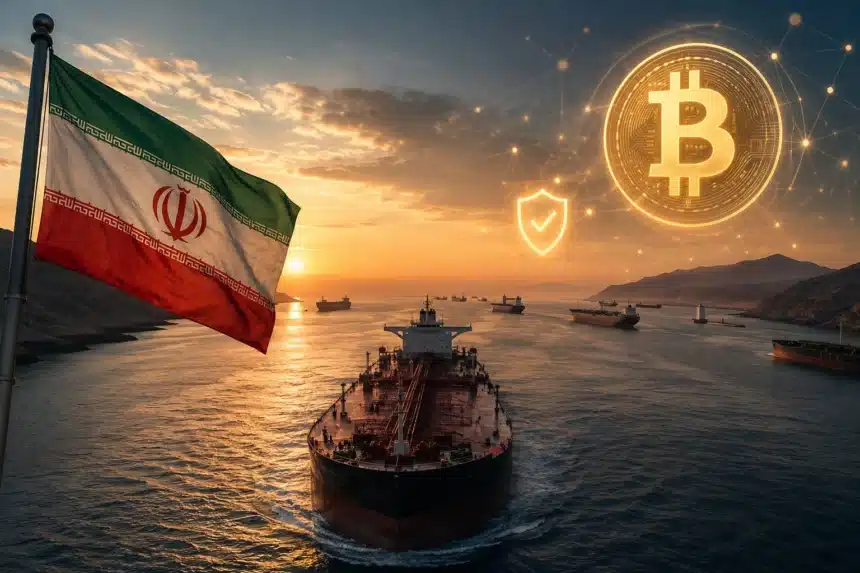
Iran launched “Hormuz Safe,” a new Bitcoin settled shipping insurance platform for Strait of Hormuz transit. This service, targeting cargo owners and shipping firms, projects over $10 billion in revenue for the Islamic Republic while directly circumventing US sanctions. BeInCrypto and Bitcoin Magazine both reported on the launch in May 2026, confirming Iran’s Ministry of Economy and Financial Affairs as the platform’s developer.
Key Highlights
- “Hormuz Safe” is Iran’s new Bitcoin settled maritime insurance platform.
- The platform targets cargo owners and shipping companies operating through the Strait of Hormuz and Persian Gulf.
- Iran projects the service will generate over $10 billion in revenue.
- Bitcoin payments are designed to bypass comprehensive US Treasury sanctions.
- Iran’s Ministry of Economy and Financial Affairs developed and backs the platform.
Sanction Proof Financial Mechanism
The “Hormuz Safe” website describes its service as offering “fast, verifiable digital insurance, paid via bitcoin and settled at the speed of blockchain.” Coverage includes risks from vessel inspection, detention, and confiscation. War damage claims are excluded from the proposed scheme.
Iran’s Ministry of Economy and Financial Affairs has developed this framework since April 2026, according to documents obtained by Fars News Agency and cited by Bloomberg. The move formalizes financial mechanisms Iran has been building around the critical waterway for months.
Bitcoin’s resistance to seizure or freezing is a critical feature for Tehran. “No one can freeze it,” said Sam Lyman, research director at the Bitcoin Policy Institute, regarding Iran’s calculus. The development builds on a broader global pattern of sanctioned states turning to crypto to insulate financial operations from Western pressure, a trend that has accelerated through 2025 and into 2026.
Strait of Hormuz Control and Revenue
This initiative builds on the Strait of Hormuz Management Plan, a law passed by Iran’s parliament in March 2026. This law codified a transit toll system the Islamic Revolutionary Guard Corps (IRGC) has operated since mid March.
Under this framework, the IRGC extracts fees from vessels seeking passage. Operators must submit vessel ownership details, cargo type, destination, and crew information to an IRGC linked intermediary before receiving a permit code. Fees vary by vessel size and cargo sensitivity. Tankers carrying oil have reportedly faced the highest tariffs, with some operators describing informal payments running into the hundreds of thousands of dollars per voyage.
The Strait of Hormuz is one of the world’s most critical shipping chokepoints. Roughly 20 percent of global oil trade and a significant share of liquefied natural gas transits through this 33 kilometer wide waterway daily. Iran’s ability to monetize passage through it, even at a fraction of its theoretical capacity, is a structurally significant revenue stream. Earlier reporting confirmed that Hormuz Safe is explicitly designed to capture that revenue in a form the US cannot touch.
Washington’s Sanctions Dilemma
Iran’s move to integrate Bitcoin into its maritime insurance scheme presents a direct challenge to Washington’s long standing sanctions architecture. Traditional financial sanctions work by cutting off access to dollar denominated systems, correspondent banking, and SWIFT messaging. Bitcoin operates outside all three.
The US Treasury’s Office of Foreign Assets Control has designated Iranian entities and individuals, but enforcement against Bitcoin wallets requires identifying real world actors behind addresses, which Iran is clearly structuring to avoid. Unlike central bank digital currencies or bank accounts, Bitcoin holdings cannot be frozen by executive order.
Analysts note that this is not Iran acting alone. The broader geopolitical context includes multiple state actors exploring crypto as a sanctions bypass tool. Observers watching the regulatory tailwinds and headwinds around Bitcoin point out that state level adoption of this kind cuts both ways: it validates Bitcoin’s utility while simultaneously drawing regulatory attention from the US and European Union.
What This Means for Global Shipping Companies
For cargo operators and shipping firms, “Hormuz Safe” creates a difficult choice. Paying into the scheme provides operational security for passage through the Strait, but doing so could expose non-Iranian companies to secondary sanctions risk from the US Treasury.
The dilemma is especially acute for Asian operators, particularly Chinese and South Korean firms that regularly transit the Strait and maintain dollar denominated banking relationships. Accepting Bitcoin denominated insurance from an IRGC linked platform is precisely the kind of transaction that Treasury’s secondary sanctions are designed to deter.
That said, some operators in jurisdictions with weaker compliance frameworks may find the insurance product genuinely useful, particularly as geopolitical tensions have made traditional marine insurers reluctant to cover Hormuz transit at any price. This pressure comes as the crypto market also faces scrutiny, with Bitcoin ETF flows showing significant volatility and institutional investors reassessing their exposure to regulatory risk.
The TCB View
Iran’s “Hormuz Safe” is more than a sanctions workaround. It is a proof of concept for state level financial sovereignty using Bitcoin. Tehran is not using this platform to speculate. It is using it to run an economy around the edges of a system specifically designed to contain it.
The more interesting question is not whether the US can stop Hormuz Safe specifically. It probably cannot, at least not through financial mechanisms alone. The real question is what happens when this model works well enough that other sanctioned or semi-sanctioned states replicate it. That is when the rules of engagement for the global sanctions regime genuinely change. The legislative debate in Washington around crypto is moving fast, but it is largely focused on domestic markets. The geopolitical use case Iran is building is a different problem entirely, and it may be further along than Western policymakers are prepared to admit.