
Last updated: 3 July 2026
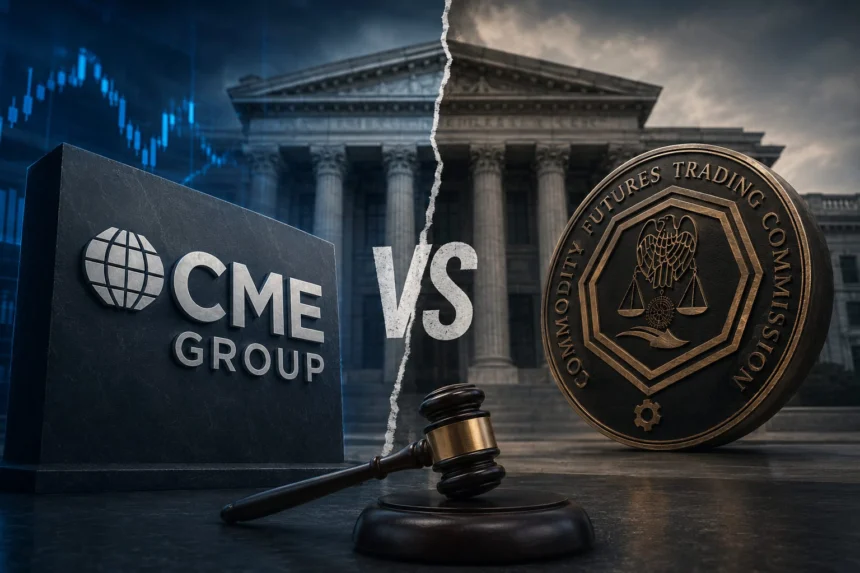
CME Group announced its intention to sue the Commodity Futures Trading Commission. CEO Terry Duffy disclosed the lawsuit plans to CNBC on Thursday, May 30, following the agency’s green light for certain perpetual futures offerings. This move signals a brewing battle over the regulatory future of crypto derivatives in the United States. (via SEC)
Key Highlights
- CME Group, a major derivatives exchange, plans to file a lawsuit against the CFTC.
- The dispute centers on the CFTC’s recent approval of perpetual futures products, which CME views as problematic.
- CEO Terry Duffy publicly stated the company’s legal intent during a CNBC interview on May 30.
- The total cryptocurrency market cap shed approximately $120 billion within the week leading up to the announcement.
- CME already offers regulated Bitcoin and Ether futures, placing it in direct competition with unregulated perpetual futures platforms.
The Lawsuit Takes Shape
Terry Duffy, the top executive at CME Group, made it clear his company is preparing to take legal action against the federal regulator. His remarks to CNBC on May 30 unveiled a direct challenge to the Commodity Futures Trading Commission.
The core of CME’s complaint stems from the CFTC’s decision to approve, or perhaps not challenge, certain perpetual futures products. These agreements allow traders to bet on asset prices without an expiry date, a characteristic that sets them apart from traditional futures contracts traded on CME.
Details about the specific perpetual futures offering that prompted the lawsuit remain somewhat scarce. But the move highlights a growing friction point between established financial institutions and the evolving space of digital asset trading.
Understanding Perpetual Futures and Their Conflict
Perpetual futures are a type of derivative popular within cryptocurrency markets. Unlike traditional futures that have a set expiration, perpetuals continue indefinitely, allowing traders to hold positions for as long as they wish. They maintain price alignment through a funding rate mechanism, where traders periodically pay or receive small amounts.
These products gained immense popularity on offshore crypto exchanges, often operating outside strict regulatory oversight. CME Group, on the other hand, operates within the fully regulated framework of the United States, offering cash settled Bitcoin and Ether futures contracts.
The conflict arises from the differing regulatory treatment. CME’s regulated products face rigorous compliance and oversight. Unregulated or lightly regulated perpetual futures, even if offered by entities with some US presence or access, could pose a competitive disadvantage or regulatory arbitrage concern for exchanges like CME.
Regulatory Scrutiny Intensifies
The planned lawsuit introduces a significant layer of complexity to an already tangled regulatory environment for digital assets. For years, policymakers have grappled with how to oversee crypto products, with the CFTC claiming jurisdiction over commodities and the Securities and Exchange Commission over securities.
CME’s action suggests it believes the CFTC’s recent stance on perpetual futures either oversteps its authority or creates an unfair playing field. The exchange’s leadership likely views certain perpetual contracts as falling under the same oversight as its own regulated products, demanding consistent application of rules.
Such a legal battle could reshape how crypto derivatives are offered and traded domestically. It’s a clash between innovation in a new market and established regulatory structures designed for traditional finance. The outcome will set precedents.
Market Reaction and Uncertainty
The broader cryptocurrency market experienced significant outflows in the days leading up to Duffy’s announcement. Total crypto market capitalization shed approximately $120 billion during the week of the disclosure, signaling investor jitters.
Uncertainty in regulatory environments often translates to market volatility. Investors and traders frequently react to news of potential legal battles between major players and government bodies. This specific dispute pits a long standing, regulated exchange against a primary commodities regulator over a popular crypto product.
This situation adds to a period of heightened regulatory focus on digital assets across global jurisdictions. The legal challenge from CME could either pave the way for clearer regulatory frameworks or further entrench existing ambiguities, impacting market confidence.
Frequently Asked Questions (FAQs)
why is cme group suing cftc
CME Group is suing the CFTC because they disagree with the agency’s recent approval of certain perpetual futures products. CME, a major derivatives exchange, believes these products are problematic and pose a challenge to their existing regulated offerings.
what are perpetual futures
Perpetual futures are a type of agreement that lets traders bet on asset prices without an expiry date. Unlike traditional futures contracts, they don’t have a set end date, allowing positions to be held indefinitely.
who is terry duffy
Terry Duffy is the CEO of CME Group. He publicly announced the company’s intention to sue the CFTC during an interview with CNBC on May 30.
what is the cftc
The CFTC stands for the Commodity Futures Trading Commission, a federal regulator in the United States. They are responsible for overseeing the derivatives markets, including the recent approval of perpetual futures that CME Group is challenging.
The TCB View
Our read: CME Group isn’t just suing; it’s drawing a line in the sand for crypto regulation. Terry Duffy’s public statements on CNBC were a deliberate escalation. This isn’t about protecting consumers, it’s about protecting market share and ensuring regulatory parity for CME’s multi billion dollar derivatives business.
The concrete risk here’s prolonged legal uncertainty, which could chill institutional adoption of crypto derivatives. The opportunity, but is a potential forcing function for the CFTC to provide definitive guidance on perpetual futures products. The signal to track: the specific legal arguments CME presents against the CFTC’s approval framework.