
Last updated: 3 July 2026
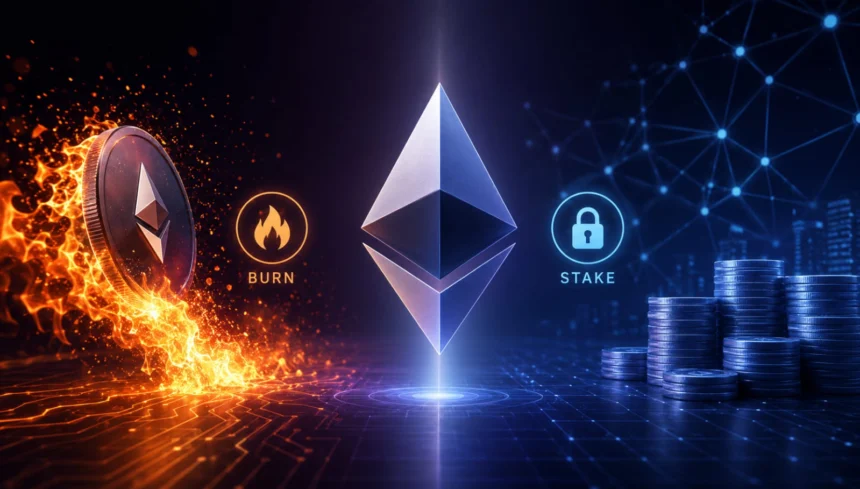
Ethereum became deflationary because a crucial upgrade, EIP 1559, began burning a portion of its transaction fees on August 5, 2021. This mechanism, combined with the later transition to a proof of stake consensus, permanently altered its supply schedule. Network activity directly removes Ether from circulation. This fundamental shift reshaped the economic model for the second largest cryptocurrency.
Key Highlights
- The EIP 1559 upgrade launched on August 5, 2021, introducing a base transaction fee burn.
- This base fee automatically adjusts with network congestion and is permanently removed from circulation.
- The burning mechanism means more network usage directly leads to a greater reduction in Ether supply.
- The Merge, Ethereum’s shift to proof of stake, drastically cut new Ether issuance, complementing the burn.
- These two major changes fundamentally altered Ether’s supply dynamics from inflationary to potentially deflationary.
Burning Mechanism: The EIP 1559 Impact
The EIP 1559 upgrade, also known as the London hard fork, fundamentally changed how transaction fees operate on the Ethereum network. Before this development, users engaged in a bidding war, sending ‘gas prices’ directly to miners. This system often led to wildly unpredictable costs, especially during periods of high demand for block space.
Users faced high uncertainty.
With EIP 1559, a new ‘base fee’ was introduced. This fee is automatically calculated and adjusted by the protocol itself, responding to network congestion levels. A percentage of this base fee is then permanently destroyed. It’s not paid to validators. This process removes Ether from the total supply with every processed transaction.
Supply contracts with activity.
Beyond the base fee, users can still include an optional ‘priority fee’ or ‘tip’ to incentivize validators to include their transactions faster. This tip goes directly to the validator who mines the block. Still, the critical part for supply economics remains the base fee, which exits circulation forever, irrespective of who processes the transaction.
This fee reduction is permanent.
The burning mechanism means that as more transactions occur on the network, a greater amount of Ether is removed from the supply. High traffic events, such as popular nonfungible token mints or significant decentralized finance activity, accelerate this burn rate. This design introduces a scarcity element directly tied to network utility.
Utility drives scarcity for Ether.
The Merge: A Supply Reduction Event
While EIP 1559 laid the groundwork for Ether’s supply changes, The Merge was the second and equally important piece of the puzzle. This momentous upgrade, which occurred in September 2022, transitioned Ethereum from a proof of work consensus mechanism to a proof of stake system. This was a critical architectural overhaul, moving away from energy intensive mining.
Proof of work was abandoned.
Under the old proof of work model, miners received newly minted Ether as block rewards for securing the network. This issuance of new Ether meant a constant inflationary pressure on the supply. The system was designed to continuously expand the total Ether supply, paying miners for their computational power and energy expenditure.
New coins were always arriving.
The Merge eliminated mining rewards entirely. Instead, the network is now secured by validators who ‘stake’ their existing Ether as collateral. These validators receive a much smaller amount of newly minted Ether as a reward for their work. The decrease in new issuance was dramatic, often referred to as a “triple halving” by enthusiasts, highlighting its significant effect compared to Bitcoin’s periodic supply cuts.
Issuance dropped steeply.
The combination of zero mining rewards and greatly reduced staking rewards means that the rate of new Ether entering circulation plummeted. When network usage is high enough to generate significant base fee burns, the total amount of Ether burned can exceed the amount of new Ether issued. This creates a net negative change in the overall supply.
Less Ether enters circulation.
Why Ethereum Is Deflationary: The Combined Effect
Why Ethereum is deflationary boils down to the powerful interaction between EIP 1559’s burning mechanism and The Merge’s drastically reduced new supply. Prior to these changes, Ether’s supply grew by approximately 4.3 percent annually. This made it a perpetually inflationary asset, similar to many fiat currencies experiencing monetary expansion. The constant creation of new coins diluted the value of existing ones.
Supply always kept growing.
The EIP 1559 upgrade introduced a mechanism to destroy Ether, while The Merge meaningfully cut the creation of new Ether. The resulting net effect is that if enough transactions occur, the destruction of Ether through burning can surpass the amount of new Ether issued to validators. This situation flips the script, moving Ether from a consistent inflationary asset to one that shrinks over time.
Supply can now truly shrink.
Think of it as a dynamic balance: on one side, new Ether is born to reward network security; on the other, existing Ether is consumed by network activity. When the consumption side is greater, the total number of Ether tokens in existence goes down. This makes Ether a scarce digital commodity, its supply potentially decreasing, contrasting sharply with its previous model.
It’s now truly scarce.
This “ultra sound money” narrative, popular among its supporters, suggests that Ether’s design makes it a superior form of digital value storage due to its scarcity and predictability. While the precise annual deflation rate varies with network demand, the fundamental change from an expanding supply to a potentially contracting one is a major economic development. This directly affects its value proposition for long term holders.
Its scarcity holds value.
Economic Reverberations and Market Perception
The shift to a deflationary or near deflationary supply model has profound economic implications for Ether. Reduced supply, assuming constant or increasing demand, naturally points towards upward price pressure over the long range. Investors who understand this dynamic may view Ether as an appealing asset for wealth preservation, similar to how some view precious metals or Bitcoin, but with the noted utility of powering a global computation layer.
Price pressure could build.
Decentralized application developers and users also feel these effects. A more stable, potentially increasing value for Ether makes network participation more predictable. Projects built on Ethereum can rely on a sounder monetary base. This encourages more innovation and investment into the broader Web3 sphere built upon Ethereum, strengthening the network’s central position.
The network grows stronger.
still, the deflationary outcome isn’t guaranteed at all times. If network usage sharply declines, the amount of Ether burned might fall below the issuance rate for validators. In such a scenario, the supply could become mildly inflationary again. The model’s success hinges on sustained or growing activity on the network, demonstrating its utility and adoption for various uses like DeFi, NFTs, and enterprise applications.
Activity is always key.
This evolving monetary policy is a significant departure from traditional fiat systems and even other cryptocurrencies with fixed, but not decreasing, supplies. The experimental nature of this monetary policy means continuous monitoring of supply metrics is essential for market participants and anyone interested in the future of digital assets. It’s a new chapter in digital money theory.
New money rules apply.
Frequently Asked Questions (FAQs)
Why is Ethereum deflationary now
Ethereum became deflationary because of two major upgrades. First, EIP 1559 started burning a portion of transaction fees, and then the Merge drastically cut the issuance of new Ether, permanently altering its supply schedule.
What is EIP 1559 Ethereum
EIP 1559 is an Ethereum upgrade that launched on August 5, 2021, introducing a base transaction fee that is automatically burned and removed from circulation. This mechanism means that more network usage directly leads to a greater reduction in Ether supply.
How does burning Ether work
The burning mechanism introduced by EIP 1559 means that a portion of the transaction fees, called the base fee, is permanently removed from circulation. This base fee adjusts with network congestion, so higher network activity directly leads to more Ether being burned.
What is the Merge Ethereum
The Merge was Ethereum’s shift to a proof of stake consensus mechanism. This significant change drastically cut the issuance of new Ether, complementing the burning mechanism from EIP 1559 and further contributing to its deflationary potential.
The TCB View
Our read: The transition to a deflationary supply schedule for Ether isn’t just a technical footnote; it’s a bold economic experiment with significant ramifications. The combined power of EIP 1559, implemented August 5, 2021, and The Merge, fundamentally alters Ether’s long range value proposition. The risk is that a prolonged period of low network activity could revert the supply to a mild inflation, hard the “ultra sound money” thesis.
Yet, the opportunity for Ether to cement its position as a truly scarce digital asset, fueling the decentralized internet, is immense. The signal to track: the net issuance rate of Ether, hour by hour.