
Last updated: 21 July 2026
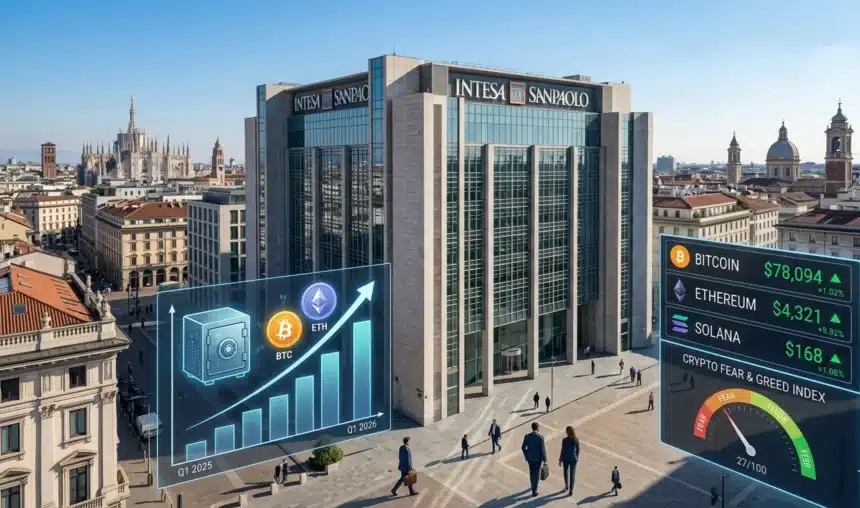
Italy’s largest bank, Intesa Sanpaolo, has more than doubled its crypto holdings to $235 million in the first quarter of 2026, according to a recent report, as Bitcoin’s price hovers around $78,094 and traditional financial institutions continue to explore cryptocurrency’s potential, signaling a growing trend in the sector.
Key Highlights
- Intesa Sanpaolo, Italy’s largest bank, has more than doubled its crypto holdings to $235 million in the first quarter of 2026.
- The bank’s increased investment in digital assets comes as Bitcoin’s price hovers around $78,094, up 0.11% in the past 24 hours.
- The move signals a growing trend of traditional financial institutions exploring the potential of cryptocurrency, with Ethereum and Solana also experiencing gains of 0.69% and 0.71% respectively in the past day.
Italy’s largest bank doubles crypto holdings in a significant move that highlights the growing interest of traditional financial institutions in digital assets. As of May 17, 2026, Intesa Sanpaolo’s crypto portfolio has surged to $235 million, more than doubling its previous holdings. This development comes at a time when the cryptocurrency market is experiencing a period of fear, with the fear and greed index standing at 27/100.
What This Means for Institutional Crypto Adoption
The increased investment by Intesa Sanpaolo is a notable development in the Italian banking sector. The bank’s decision to more than double its crypto holdings suggests growing confidence in digital assets as a portfolio diversification tool. With Bitcoin holding relatively stable at $78,094 and other major cryptocurrencies such as Ethereum and Solana posting gains, the bank’s move may be seen as a strategic decision timed to broader market stabilisation.
The fear and greed index, which measures market sentiment, sits at 27/100, indicating a state of fear. Yet the block height of the Bitcoin network, currently at 949,781 with fees at just 1 sat/vB, signals a healthy network. For an institution the size of Intesa Sanpaolo, entering during a fear cycle rather than a greed cycle is a considered move, not a momentum trade.
The implications extend well beyond Italy. The move may encourage other traditional financial institutions to explore the cryptocurrency market, accelerating mainstream adoption across European banking. The regulatory environment for cryptocurrencies in Italy is still evolving, with no specific framework in place yet. The increased investment by Intesa Sanpaolo may prompt regulators to reexamine the current framework and consider introducing new rules. The Italian government has expressed willingness to explore the potential of digital assets, and this move by its largest bank may accelerate that conversation significantly.
European Regulatory Context: MiCA and What It Means for Intesa
Intesa Sanpaolo’s move comes just as the European Union’s Markets in Crypto Assets (MiCA) regulation enters full force. MiCA, which became fully applicable in December 2024, provides the first comprehensive regulatory framework for digital assets across EU member states. For Italian banks, MiCA removes the ambiguity that previously made large-scale crypto investment legally complex. Under MiCA, licensed crypto asset service providers operating in Italy and the broader EU now operate under clear capital requirements, custody rules, and disclosure standards.
For Intesa Sanpaolo, this regulatory clarity is likely a prerequisite rather than a bonus. A bank of its size operating under the European Central Bank’s direct supervision cannot take speculative positions without a defensible legal framework. MiCA provides exactly that. The doubling of crypto holdings to $235 million suggests the bank’s risk committee has cleared digital assets as a legitimate asset class, not a speculative bet. As other major European banks watch the outcome, Intesa Sanpaolo may have effectively made the first move in what becomes a broader European banking realignment toward digital assets.
The TCB View
TCB is cautiously bullish on Intesa Sanpaolo’s decision to increase its crypto holdings. We see this move as a strategic decision to diversify the bank’s portfolio and explore the potential of digital assets. The increased investment in crypto assets may lead to greater mainstream adoption, but it also poses significant risks, including market volatility and regulatory uncertainty. The winners in this scenario are likely to be the bank’s shareholders, who may benefit from the potential long term gains of investing in cryptocurrencies. The losers may be those who are slow to adapt to the changing regulatory environment, which may become more stringent as the market evolves. Watch for the Italian government’s response to the growing interest in cryptocurrencies, and the potential introduction of new regulations to govern the use of digital assets, which may be a key trigger for the next phase of market growth.