
Last updated: 20 July 2026
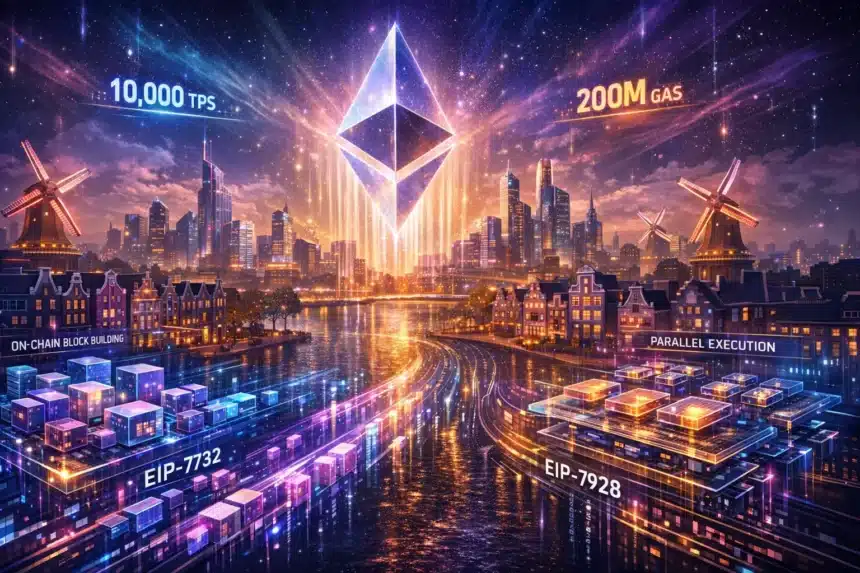
Ethereum’s next hard fork, known as Glamsterdam, continues to evolve as of 2026. As the Ethereum community awaits this significant update, the two confirmed headline EIPs, EIP-7732 and EIP-7928, are expected to bring substantial changes to the network. Alongside a planned gas limit increase, the upgrade aims to achieve approximately 10,000 transactions per second on the base layer, a significant improvement from the current rate. This is an L1 upgrade, a distinction that holds considerable importance in the context of Ethereum’s development.
This upgrade is part of Ethereum’s ongoing effort to enhance its capabilities and address existing limitations. The distinction between L1 and L2 upgrades matters more than most coverage suggests, as it underscores the complexity and multi-layered nature of Ethereum’s architecture.
Key Highlights
Key Highlights
- EIP-7732 moves proposer builder separation into the Ethereum protocol, removing a centralization risk that has existed since the introduction of MEV boost
- EIP-7928 introduces Block Level Access Lists, enabling parallel transaction execution for the first time on Ethereum
- The gas limit is targeted to increase, aiming for a substantial boost in transactions per second, with a theoretical ceiling of 10,000 TPS
- The 10,000 TPS target is a theoretical ceiling, and real-world throughput post-upgrade will be materially lower during the adoption phase (figures as of publication)
- Glamsterdam does not touch sharding or data availability, which is scoped for the Hegota fork later in the development roadmap
What EIP-7732 Actually Does
Proposer builder separation describes the division between the validator that proposes a block and the specialized actor that assembles its transaction contents for maximum extractable value. Since the introduction of MEV boost, this separation has existed as an off-chain arrangement, with MEV boost handling the builder market outside the Ethereum protocol itself.
EIP-7732 moves this separation into the protocol, where builders no longer rely on third-party relay infrastructure that Ethereum cannot audit, slash, or govern. The protocol validates builder commitments directly, removing a trust assumption that has been a quiet systemic risk in Ethereum’s block production.
The practical change for users is less dramatic: lower MEV exposure, more predictable transaction inclusion, and reduced gas fee volatility during high traffic periods. For protocol security researchers, it is significant, as it removes a concentration risk that has been present in the network.
What EIP-7928 Actually Does
Block Level Access Lists specify in advance which accounts and storage slots a block’s transactions will read or write during execution. This is the precondition for parallel transaction processing.
Currently, the Ethereum EVM executes transactions sequentially, as each transaction might touch any state slot, and the EVM cannot safely run two transactions simultaneously without knowing in advance that they do not share state. BALs solve this issue by declaring state access upfront, allowing the EVM to know which transactions can run in parallel without conflicts.
The gas limit increase only delivers its capacity if execution can keep pace. EIP-7928 makes this throughput realizable rather than theoretical. Without it, increasing the gas limit would triple the validation burden without tripling actual throughput.
The Gas Limit Change: Context Matters
The Ethereum gas limit is not set by the protocol but is a parameter validators adjust block by block within a range. The current de facto limit was reached through a series of validator votes.
The Glamsterdam upgrade raises the ceiling, with the goal of increasing the gas limit as an immediate target, and a medium-term objective as BAL adoption by block builders matures. This means the upgrade arrives in phases driven by validator coordination rather than a single switch. Users should not expect the full gas limit increase on activation day.
What Glamsterdam Does Not Change
Glamsterdam does not touch sharding or data availability in any meaningful way. Danksharding, which will expand blob throughput for L2s, is scoped for the Hegota fork later in the development roadmap. The two upgrades address different parts of the stack.
Glamsterdam also does not solve MEV at the application layer. EIP-7732 removes the relay trust assumption, but the economic incentive to front run and reorder transactions remains. MEV will continue as long as profitable ordering exists.
The 10,000 TPS target is a theoretical ceiling under optimal conditions. Real-world throughput after Glamsterdam, with typical transaction mixes and BAL adoption curves, will be materially lower.
The L1 upgrade also arrives into an L2 consolidation already underway. Of the numerous rollups that have launched, many are inactive. Glamsterdam’s throughput improvements will reshape the economics for the survivors.
Ethereum’s protocol health is now a yield variable, with products tied to staking rewards. How this evolves will be crucial for the network’s overall health and attractiveness to investors.
Implications for Ethereum’s Ecosystem
The Glamsterdam upgrade has significant implications for Ethereum’s ecosystem, particularly in terms of its impact on the network’s scalability and usability. As the upgrade enables parallel transaction execution and increases the gas limit, it is expected to attract more users and applications to the network. This, in turn, could lead to increased adoption and a more robust ecosystem. Furthermore, the removal of centralization risks and the introduction of more predictable transaction inclusion are likely to enhance the overall security and reliability of the network.
Long-Term Effects on Ethereum’s Competitiveness
The Glamsterdam upgrade is a crucial step in Ethereum’s ongoing effort to enhance its competitiveness in the blockchain space. By improving the network’s scalability and usability, Ethereum is better positioned to attract and retain users, developers, and investors. The upgrade’s impact on the network’s security and reliability will also be closely watched by regulators and institutional investors, who are increasingly looking for stable and secure blockchain platforms to build upon. As the blockchain landscape continues to evolve, Ethereum’s ability to adapt and improve will be critical to its long-term success. The Glamsterdam upgrade is a significant milestone in this process, and its effects will be felt for months and years to come. Additionally, the upgrade’s focus on L1 improvements will also have a ripple effect on the L2 ecosystem, as rollups and other scaling solutions adapt to the new landscape. This, in turn, will lead to a more complex and interconnected ecosystem, with Ethereum at its core.