
Last updated: 9 June 2026
Key Highlights
- Casey Rodarmor launched the Bitcoin Ordinals protocol in January 2023, enabling data inscription on individual satoshis.
- By Q4 2025, over 65 million unique inscriptions had been recorded on the Bitcoin blockchain, diversifying its utility beyond simple transactions.
- BRC 20 tokens, built using the Ordinals protocol, generated over $1.5 billion in trading volume during 2025.
- The surge in Ordinals activity in Q2 2025 pushed average Bitcoin transaction fees above $30 for several weeks, sparking debate over network congestion.
- The total market capitalization for Ordinals and BRC 20 assets surpassed $5 billion by early 2026, indicating significant investor interest.
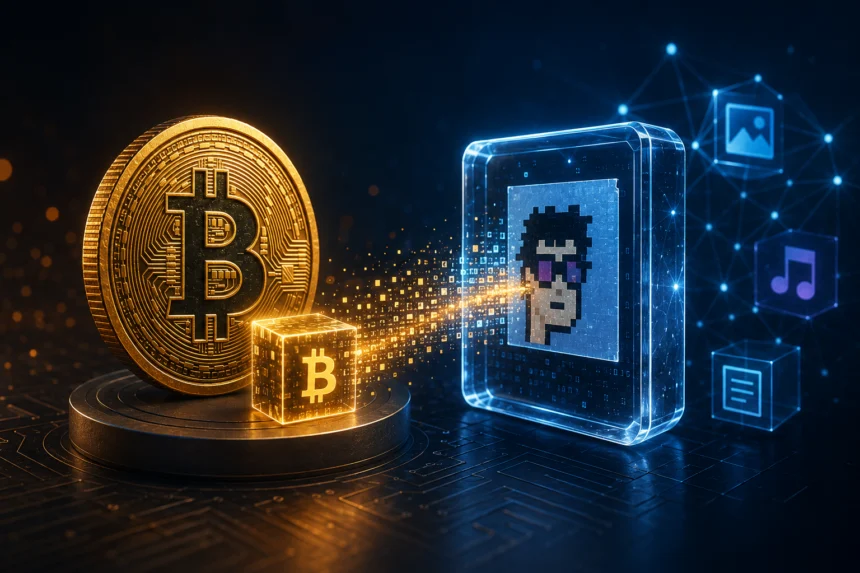
Bitcoin Ordinals explained simply: they are digital artifacts, akin to unique items or collectibles, directly inscribed onto the smallest units of Bitcoin, known as satoshis. This innovation, introduced by software engineer Casey Rodarmor in January 2023, fundamentally expanded Bitcoin’s capabilities, allowing for the creation of non fungible tokens NFTs and other data directly on the base layer of the world’s oldest and most secure blockchain.
What Are Bitcoin Ordinals?
At its core, the Ordinals protocol assigns a unique serial number to each satoshi, the smallest denomination of Bitcoin (one hundred millionth of a BTC). This numbering system, called “ordinal theory,” tracks satoshis from their mining to their transaction. When a satoshi is “inscribed,” it means arbitrary data like images, text, audio, or even video is attached to it, making that specific satoshi unique and traceable.
The process of inscribing data leverages Bitcoin’s Taproot upgrade, implemented in November 2021. Taproot significantly increased the amount of data that could be included in a single transaction witness, a critical enabler for Ordinals. This allows for the permanent storage of digital content on the Bitcoin blockchain, inheriting its unparalleled security and immutability.
Unlike traditional NFTs on other blockchains that often store metadata on external servers, Bitcoin inscriptions are entirely self contained on chain. This distinction is crucial, as it means the digital artifact’s integrity and existence are directly tied to the Bitcoin blockchain itself, eliminating reliance on third party storage solutions and their associated risks of data loss or censorship.
Inscriptions vs. NFTs: A Crucial Distinction
While often compared to NFTs, Bitcoin inscriptions possess fundamental differences that set them apart. Traditional NFTs, particularly those on Ethereum or Solana, typically point to external media files stored on platforms like IPFS or Arweave. The NFT itself is essentially a token on the blockchain that serves as a pointer and a record of ownership.
Bitcoin inscriptions, by contrast, are the digital content itself, directly embedded within the transaction data of a satoshi. This means the artwork, image, or text is part of the Bitcoin blockchain’s history, not merely referenced by it. This “on chain” purity provides a higher degree of permanence and censorship resistance compared to most off chain NFT implementations.
This technical difference has significant implications for long term preservation and ownership. An inscribed satoshi truly carries its digital payload. This makes inscriptions more akin to digital “artifacts” rather than just tokens representing ownership. Proponents argue this makes them more robust and authentic forms of digital collectibles, less susceptible to broken links or lost data over time.
The Rise of BRC 20 Tokens
Building on the foundation of Ordinals, the BRC 20 token standard emerged in March 2023, pioneered by an anonymous developer known as “Domo.” This experimental standard allows for the deployment, minting, and transfer of fungible tokens on the Bitcoin blockchain using Ordinal inscriptions. Essentially, BRC 20 tokens are JSON JavaScript Object Notation text files inscribed onto satoshis, defining token properties and transfer rules.
The introduction of BRC 20s sparked a speculative frenzy, demonstrating a new utility for Bitcoin beyond its traditional role as digital gold. By Q4 2025, various BRC 20 tokens collectively generated over $1.5 billion in trading volume, with some individual tokens like ORDI reaching market capitalizations in the hundreds of millions. This innovation opened the door for decentralized finance DeFi and other token based applications directly on Bitcoin.
Despite their success, BRC 20 tokens remain largely experimental and face scalability challenges inherent to Bitcoin’s design. Their reliance on inscription technology means every token operation consumes block space, contributing to network congestion and higher transaction fees. Developers are actively exploring more efficient ways to manage and scale fungible tokens on Bitcoin, including layer 2 solutions.
The “Bloat” Debate: Transaction Fees and Blockchain Size
The emergence of Ordinals and BRC 20s has not been without controversy. Critics argue that these inscriptions “bloat” the Bitcoin blockchain, increasing its size and potentially making it harder for full nodes to sync and operate. The influx of inscription related transactions, particularly during peak periods in Q2 2025, led to significant spikes in transaction fees, sometimes exceeding $30 per transaction for several weeks.
This fee surge created a barrier for users making smaller, routine Bitcoin transactions, diverting block space to what some purists consider non essential data. Opponents, often proponents of Bitcoin’s original vision as a peer to peer electronic cash system, contend that Ordinals detract from this primary purpose and introduce unnecessary congestion.
Conversely, proponents highlight the benefits. The increased transaction fees directly compensate Bitcoin miners, incentivizing network security and potentially extending Bitcoin’s long term viability as block rewards diminish. They also argue that any data placed on the blockchain, as long as it adheres to consensus rules, is a valid use case. Beyond that, they point to the innovation and developer interest Ordinals have brought to Bitcoin, attracting new users and capital into the ecosystem.
The Ordinals Market: Current Landscape in 2026
As of early 2026, the Ordinals market has matured significantly from its initial speculative boom. Major marketplaces like Magic Eden and UniSat have integrated Ordinals and BRC 20s, offering robust trading platforms for these assets. The total market capitalization for all Ordinals and BRC 20 assets collectively exceeded $5 billion, with a growing number of institutional investors exploring this nascent sector.
Notable collections, often leveraging high quality digital art, have commanded premium prices. For instance, the “Ordinal Punks” collection, an early inscription project, saw individual pieces trade for hundreds of thousands of dollars. Beyond art, the utility of inscriptions is expanding, with developers experimenting with on chain gaming assets, domain names, and identity solutions directly on Bitcoin.
The market continues to evolve, with ongoing efforts to improve infrastructure, indexing, and user experience. While volatility remains a characteristic, the sustained interest and development activity suggest that Ordinals and BRC 20s are carving out a permanent niche within the broader Bitcoin ecosystem, pushing the boundaries of what is possible on the original blockchain.
The TCB View
TCB believes Bitcoin Ordinals represent a cautious but significant expansion of Bitcoin’s utility, transforming it from a pure store of value into a platform for diverse digital assets. The primary opportunity lies in attracting new developer talent and capital to the Bitcoin ecosystem, evidenced by the $5 billion market cap for Ordinals and BRC 20s by early 2026. However, the risk of network congestion and fee volatility is real, primarily impacting users seeking low cost transactions and potentially alienating Bitcoin purists. We see Bitcoin miners as clear winners from increased fee revenue, while ordinary users sensitive to transaction costs may face challenges. Our read is that this innovation will persist and evolve. Watch for the development of effective layer 2 scaling solutions specifically designed for Ordinals, which could mitigate congestion and unlock further adoption without compromising Bitcoin’s core principles.