
Last updated: 9 June 2026
Key Highlights
-
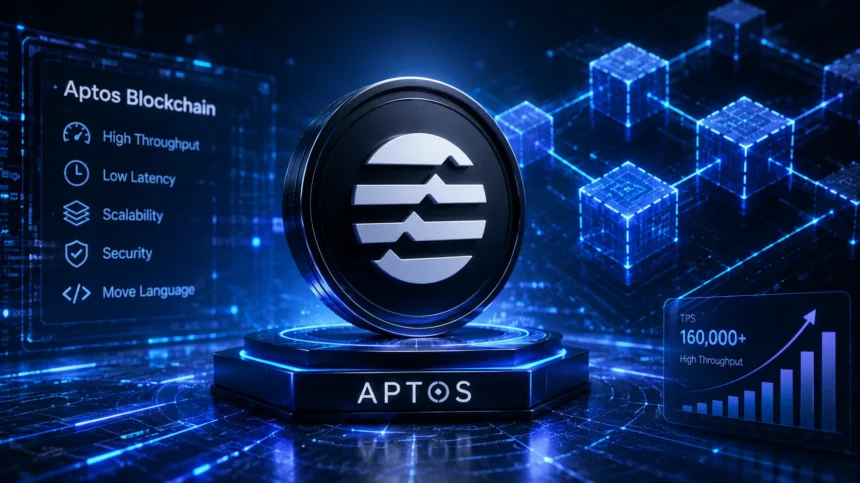
Aptos Blockchain launched its mainnet in October 2022, with a peak throughput of 160,000 transactions per second.
-
The network uses the Move programming language, which provides a safe and flexible way to create smart contracts.
-
Aptos’s parallel execution engine allows for the processing of multiple transactions simultaneously, significantly increasing the network’s overall throughput.
-
As of January 2023, the Aptos network has over 100 nodes operating worldwide, with a growing developer community.
The question of what is Aptos blockchain has been on the minds of many in the crypto space, especially given its claims of high throughput and scalability. At its core, Aptos is a layer 1 blockchain that aims to solve the scalability issues plaguing many existing networks. By utilizing a novel combination of the Move programming language and a parallel execution engine, Aptos achieves transaction throughputs that significantly surpass those of its competitors. This article will look into the details of Aptos’s technology, providing a deeper understanding of how it works and what it means for the future of blockchain.
Introduction to Move Language
The Move language is a key component of the Aptos blockchain, designed to provide a safe and flexible way to create smart contracts. Developed by the Aptos team, Move is a programming language that prioritizes security and ease of use. Its design allows developers to create complex smart contracts with ease, while also ensuring that these contracts are secure and resistant to common errors.
One of the unique features of the Move language is its ability to handle assets in a secure and decentralized manner. This is achieved through the use of a concept called “resources,” which are essentially programmable assets that can be created, stored, and transferred on the Aptos network.
Parallel Execution Engine
Aptos’s parallel execution engine is another critical component of its high throughput architecture. By allowing the network to process multiple transactions simultaneously, the engine significantly increases the overall throughput of the network. This is achieved through the use of a novel consensus algorithm, which enables the network to process transactions in parallel without compromising security.
The parallel execution engine is designed to take advantage of the Move language’s ability to handle assets in a secure and decentralized manner. By processing transactions in parallel, the engine can handle a large volume of transactions per second, making it ideal for applications that require high scalability.
Network Architecture
The Aptos network is designed to be highly scalable and secure, with a architecture that is optimized for high throughput transactions. The network consists of a network of nodes, each of which is responsible for validating and processing transactions. The nodes are connected through a peer to peer network, which allows them to communicate and coordinate with each other in real time.
The network also features a novel consensus algorithm, which is designed to provide a high level of security and decentralization. The algorithm uses a combination of proof of stake and Byzantine Fault Tolerance to ensure that the network is resistant to common attacks and errors.
Use Cases and Applications
The Aptos blockchain has a wide range of potential use cases and applications, from decentralized finance (DeFi) to gaming and social media. The network’s high throughput architecture and secure smart contract platform make it an ideal choice for applications that require high scalability and security.
One of the most promising use cases for Aptos is in the area of DeFi, where the network’s high throughput architecture can be used to create scalable and secure decentralized applications. The network’s Move language and parallel execution engine also make it an attractive choice for developers who want to create complex smart contracts and decentralized applications.
Conclusion and Future Outlook
Putting this together, the what is Aptos blockchain question is one that is complex and multifaceted. By providing a deep dive into the details of Aptos’s technology, we can gain a better understanding of how the network works and what it means for the future of blockchain. With its high throughput architecture and secure smart contract platform, Aptos is well positioned to become a major player in the blockchain space.
As the Aptos network continues to grow and evolve, it will be interesting to see how it develops and what new use cases and applications emerge. With its strong focus on security, scalability, and decentralization, Aptos has the potential to become a leading blockchain platform for a wide range of applications.
The TCB View
TCB believes that Aptos blockchain has the potential to be a game changer in the crypto space, with its high throughput architecture and secure smart contract platform making it an attractive choice for developers and users alike. We see the network’s Move language and parallel execution engine as a major advantage, allowing for the creation of complex smart contracts and decentralized applications. However, we also note that the network’s relatively low adoption rate and lack of major partnerships may pose a risk to its long term success. Watch for the network’s upcoming updates and developments, including the planned integration of new use cases and applications, which could trigger a significant increase in adoption and price. With a focus on security, scalability, and decentralization, Aptos is definitely a network to watch in the coming months and years.