Last updated: 29 July 2026
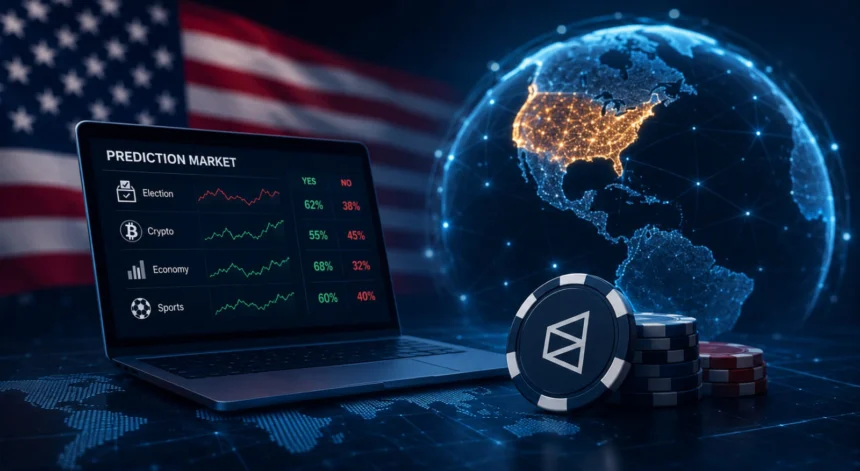
Us traders: US based traders account for a significant portion of activity on offshore prediction markets, making up 25 percent of the total volume tracked for the leading platform since January 1. This amounts to $55.6 million in wagers placed by American users, despite explicit geographical blocks designed to comply with local regulations.
These figures reveal persistent demand from a market where such platforms often operate in a legal gray area. Regulators face an ongoing battle to enforce restrictions as users employ various methods to bypass them. (via CoinGecko)
Key Highlights
- Offshore prediction markets have processed over $421 million in tracked volume globally since the start of the year.
- Polymarket leads the sector, responsible for $222.4 million of that total, and is based in the Cayman Islands.
- Despite Polymarket‘s efforts to block access, American users contribute 25 percent of its overall transaction volume.
- The US Commodity Futures Trading Commission issued a cease and desist order to Polymarket in 2022, resulting in a substantial fine and a pledge to stop serving US customers.
- A complex and inconsistent global regulatory environment complicates oversight of these smart contract driven wagering platforms.
A Growing Global Market with Local Hurdles
The total volume transacted across offshore prediction markets has reached $421.4 million since January 1. These platforms leverage smart contracts to enable wagering on future events, from political outcomes to cryptocurrency price movements. Polymarket, a dominant force in this niche, has processed $222.4 million of that tracked volume. The protocol operates out of the Cayman Islands, a strategic location for many crypto enterprises seeking clearer regulatory frameworks.
Despite its global reach, Polymarket implements strict geographical blocks. Users in the United States, United Kingdom, Canada, and several other regions are technically barred from participation. This measure is intended to align with the varying local regulations surrounding online wagering and financial instruments. The service tries hard to respect the law.
American Demand Defies Blocks
Even with substantial geographical blocking measures, US traffic continues to drive a substantial portion of Polymarket’s business. American traders, using tools like virtual private networks, collectively represent 25 percent of the protocol’s total transaction volume. This significant contribution totals $55.6 million in wagers from United States participants since the beginning of the year. The numbers are a signal of the challenges regulators face in a decentralized digital industry.
The Commodity Futures Trading Commission previously moved against Polymarket in 2022. The agency issued a cease and desist order, arguing the service offered illegal unregistered off exchange commodity options and swaps to US customers. Polymarket ultimately paid a $1.4 million fine. The team also agreed to discontinue offering markets to American users. Yet, the current volume figures clearly show many Americans still find ways to engage.
The Regulatory Tightrope
Prediction markets navigate a complex and often contradictory global regulatory market. Their structure, which uses smart contracts for event specific wagering, draws comparisons to both traditional gambling products and sophisticated information discovery tools. This dual nature creates significant uncertainty for governing bodies. The entire decentralized finance sector is currently under increased scrutiny, mirroring the broader unease about emerging digital financial instruments.
The decentralized nature of many of these markets presents unique enforcement challenges for regulators. They frequently operate without central authorities, making it difficult to pinpoint responsible parties for compliance. Participants often maintain pseudonymity, complicating identity verification and anti money laundering efforts. This tension between innovation and oversight defines the ongoing struggle for regulatory clarity. For a deeper look at the market forces, readers can consult The TCB DEFI PULSE.
Election Bets and Beyond
Multiple factors fuel the intense activity on prediction markets, with the upcoming US presidential election serving as a major catalyst. Enthusiasts are betting on everything from candidate performance to specific policy outcomes. Beyond politics, significant interest exists in crypto prices, interest rates, sports results, and the speed of artificial intelligence advancements. These diverse categories highlight the wide appeal of making predictions on future events.
The persistent volume figures, especially from US users, show a significant global demand for these wagering platforms. People want to bet on the future. This strong user engagement further emphasizes the difficulty regulators encounter when attempting to impose geographical restrictions on borderless digital systems. Market sentiment, an essential driver for both these markets and the crypto market, is also tracked by resources like The TCB MINER STRESS SCORE.
Frequently Asked Questions (FAQs)
What are offshore prediction markets?
Offshore prediction markets are platforms where people can bet on future events, like elections or economic trends. They operate outside the direct regulatory oversight of many countries, often in places like the Cayman Islands, which creates a legal gray area.
Are US traders allowed to use prediction markets?
Technically, no. Platforms like Polymarket have geographical blocks in place and have been ordered by US regulators, like the CFTC, to stop serving American customers. However, US traders are still finding ways to access these markets, making up a significant portion of the volume.
How much money are US traders putting into these markets?
Despite the restrictions, US based traders have placed $55.6 million in wagers on the leading offshore prediction market platform since January 1. This represents 25 percent of that platform’s total tracked volume.
Why is it hard for regulators to stop US traders from using these platforms?
Regulators face a tough battle because users employ various methods to bypass geographical blocks. Plus, the global regulatory environment for these smart contract driven wagering platforms is complex and inconsistent, making oversight difficult.
The TCB View
Our read: US traders are clearly demonstrating a determined will to participate in offshore prediction markets, directly circumventing geographical blocks and regulatory warnings. The $55.6 million in volume from American users on Polymarket alone makes clear this. A concrete risk is that regulators could implement more aggressive enforcement against individuals or even the technological tools enabling circumvention.
A concrete opportunity lies in prediction markets evolving into valuable real time indicators of collective public sentiment, perhaps even serving as an alternative to traditional polling. The signal to track: future innovation in anonymous access technologies versus new regulatory countermeasures.