
Last updated: 26 May 2026
Key Highlights
Key Highlights
- Creation is now easy. Anyone can turn written descriptions into high quality movies. No expensive equipment or technical skills are needed.
- Artificial intelligence has learned real world rules. Movements, shadows and physics look natural and lifelike.
- Tools are now partners. They understand the tone and specific artistic style you want. Just talk to them like a friend.
- Safety and honesty are built in. Invisible watermarks label computer made videos to protect against misinformation.
- Imagination is the limit. These tools empower businesses, teachers and families to visualize ideas that were previously impossible to film.
If you could take a picture of your dreams and then watch it come to life as a movie what would you see? Not ago making a video required expensive cameras, a team of experts and weeks of hard work.
As of April 2026 that has all changed. We have entered a world where your words are the paintbrush and the screen is your canvas. Today’s video making tools are no longer just smart. They feel like partners. They understand not just what we say. How we feel.
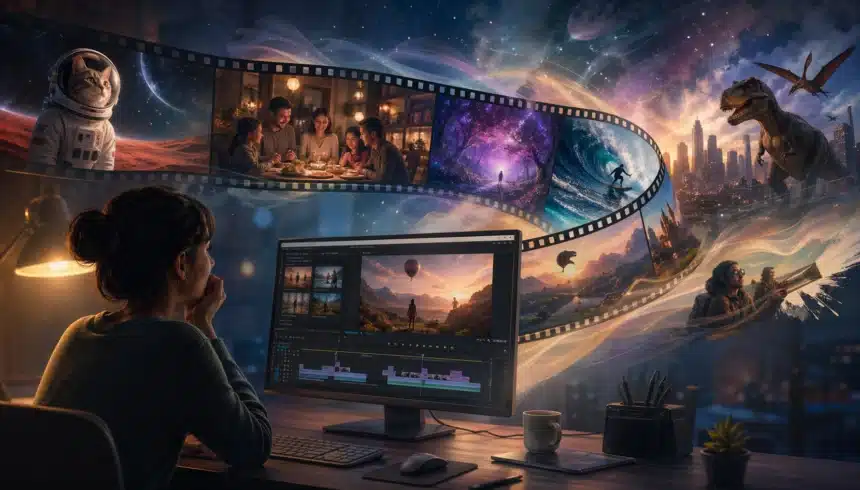
You want to see a cat wearing a space suit on Mars?
A heartwarming family dinner in a cozy cottage? These tools can build it for you in a heartbeat.
The Big Shift: From Robots to Artists. In the past videos made by computers often looked a bit off. People looked fake. Trees might wave in a way that didn’t quite match the wind.
By 2026 those glitches had mostly vanished. The newest tools, like Google’s Veo 3.1 and OpenAI’s Sora 2 have learned the rules of our world. They know that if a glass falls it should shatter. They understand that if a person walks into the sunlight their shadow should follow them naturally.
This makes the videos feel real even if the subject is completely imaginary. The real magic isn’t just, in the realism; it’s in the understanding. You no longer need to say computer. You can just talk to these tools like you’re talking to a friend. They understand you. They get what you want. Your imagination is the camera.
Meet the Stars of 2026
If you’re looking to dive into this new world, there are a few names you’ll hear everywhere. Each one has its own “personality”:
1. The Storyteller: Sora 2
OpenAI has refined Sora into a tool that loves stories. If you describe a scene with a beginning, middle, and end, Sora 2 builds it with cinematic beauty. It’s like having a Hollywood director living inside your laptop. It’s perfect for people who want to make short films or see their book ideas come to life.
2. The Reliable Friend: Veo 3.1
Google’s latest tool is the one you go to when you need things to be just right. It is incredibly good at following instructions. If you ask for a “blue truck with three wheels and a golden retriever in the back,” that is exactly what you get no surprises, just high quality results.
3. The Physics Expert: Kling 3.0
Kling has become a fan favorite for anything involving movement. Whether it’s water splashing, hair blowing in the breeze, or a chef flipping a pancake, Kling understands the weight and motion of objects better than almost anyone else.
4. The Creative Lab: Runway Gen-4.5
The runway is for the explorers. It doesn’t just make videos from scratch; it lets you take a video you already have and change it entirely. Want to turn your backyard video into a scene from a hand painted oil painting? Runway can do that in SEConds.
How It Works (The Simple Way)
You might be wondering, “How do I actually use this?” It’s easier than sending a text message. In 2026, the process usually follows three simple steps:
- The Spark: You type a description or upload a photo. For example: “A peaceful forest where the leaves are made of glowing purple light.”
- The Guidance: Many tools now let you “direct.” You can click on the screen to say, “The camera should move left here,” or “Make that tree taller.”
- The Birth: You hit a button, and within a minute or two, your video appears.
One of the coolest features we see this April is Multi Input. This means you can give the AI a photo of your dog, a song you like, and a written description, and it will combine all three into a music video starring your pup.
Why This Matters for Everyone
This technology isn’t just for movie studios anymore. It’s changing how we live and work:
- For Small Businesses: A local bakery can now make a professional looking commercial for their new cupcakes without hiring a film crew.
- For Teachers: A history teacher can “show” students what a Roman market looked like, making the lesson feel like a time traveling adventure.
- For Families: Imagine taking an old, blurry photo of a grandparent and turning it into a short video of them smiling and waving. It’s a way to keep memories alive in a more vivid way.
- For Fun: It’s the ultimate toy. You can create “what if” scenarios what if dinosaurs lived in New York? What if I could fly through the clouds?
Keeping Things Safe and Honest
With power comes great responsibility. In the year 2026 people are really working hard to make sure these tools are used for things. Now every major video tool uses digital watermarks. These digital watermarks are like signatures that tell people that a video was made by an Artificial Intelligence tool or Artificial Intelligence for short these Artificial Intelligence tools are very powerful.
This helps to prevent people from being tricked by videos that are made by Artificial Intelligence tools. It is a way to enjoy being creative with Artificial Intelligence tools while keeping our feet planted in the truth about what’s real and what is not. Most of these Artificial Intelligence tools also have strict rules, against creating anything that is harmful or mean to others this ensures that the community of people using these Artificial Intelligence tools stays helpful and positive when using these Artificial Intelligence tools.
What’s Next?
As we look through the rest of 2026 video AI is getting better. We are starting to see long form videos. You can create a 10-minute story that keeps the characters and settings throughout.
This is all thanks to video AI. The gap between having an idea and seeing it has finally closed. You do not need tech knowledge or pricey equipment. All you need is your imagination and the curiosity to try.So, the time you have a dream that stays with you after waking up do not just tell someone about it. Show them. The tools are ready and waiting for you to create video AI.
A Note on Getting Started:
If you’re nervous, about trying these tools do not worry. Most offer a trial. You can play around. See what happens. There are no tries. The AI learns from you much as you learn from it. Try video AI. Have fun creating!