
Last updated: 9 June 2026
Key Highlights
-
Smart contract exploits led to over $1.8 billion in losses in 2023, with human audit limitations contributing to vulnerabilities.
-
AI powered auditing tools like Mythril and Slither can detect up to 80% of common smart contract vulnerabilities automatically.
-
CertiK, a leading AI driven security firm, reported auditing over 4,000 Web3 projects by Q4 2023, significantly scaling security efforts.
-
The global market for AI in cybersecurity is projected to reach $133.8 billion by 2030, reflecting increasing integration across security domains.
-
Integrating AI into the smart contract development lifecycle can reduce audit times by up to 50% for initial scans, freeing human auditors for complex logic.
Integrating artificial intelligence into smart contract auditing and bug detection offers a powerful solution to enhance security, address the scalability challenges of human auditors, and mitigate the rising tide of exploits. As the Web3 ecosystem expands, the sheer volume and complexity of smart contracts outpace traditional manual auditing methods, making AI not just an advantage but a necessity for robust digital asset protection.
The Growing Need for AI in Smart Contract Security
The decentralized finance DeFi landscape continues its rapid expansion, with billions of dollars locked in smart contracts across various blockchains. This growth, while exhilarating, presents an attractive target for malicious actors. In 2023 alone, smart contract exploits resulted in over $1.8 billion in losses, a stark reminder of the persistent security gaps.
Traditional manual auditing, while crucial, often struggles to keep pace. Human auditors are meticulous, but their bandwidth is finite, and the potential for oversight in thousands of lines of complex code remains. This bottleneck creates a demand for scalable, efficient, and proactive security measures that AI is uniquely positioned to provide.
AI driven tools can analyze vast amounts of code with unparalleled speed, identifying patterns and anomalies that might escape human scrutiny. They offer a first line of defense, allowing human experts to focus their efforts on more intricate logical flaws and business logic vulnerabilities that require nuanced understanding.
Understanding AI Approaches for Smart Contract Auditing
Artificial intelligence employs several distinct methodologies to bolster smart contract security. Machine learning ML, natural language processing NLP, and formal verification assistance each play a critical role in a comprehensive AI powered auditing framework.
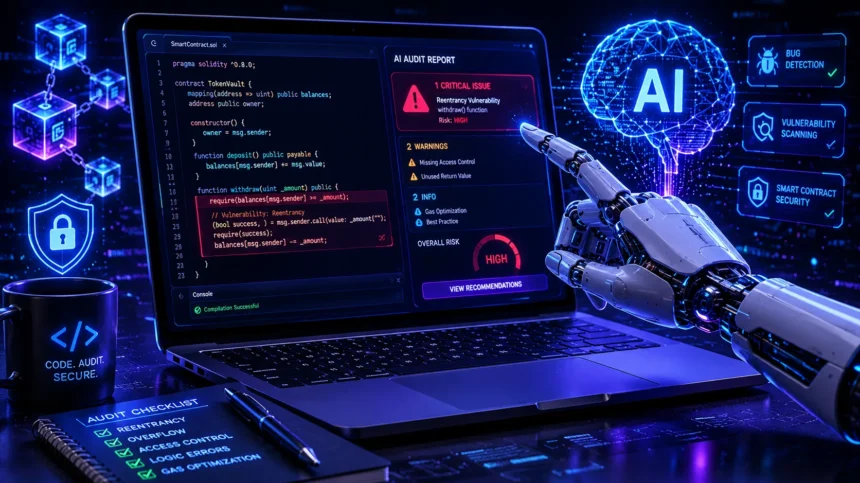
Machine learning models are trained on extensive datasets of both secure and vulnerable smart contracts. These models learn to recognize common vulnerability patterns, such as reentrancy bugs, integer overflows, and access control issues. When presented with new code, they can flag sections that exhibit characteristics similar to known exploits.
Natural language processing can be applied to analyze contract specifications, documentation, and even developer comments. By understanding the intended functionality of a smart contract, NLP can help identify discrepancies between the code’s behavior and its documented purpose, uncovering potential logic errors or hidden backdoors.
Formal verification, a rigorous mathematical approach to proving the correctness of a system, benefits immensely from AI assistance. While formal verification itself is not AI, AI tools can automate parts of the proof generation, simplify complex logical expressions, and help engineers define pre and post conditions more effectively, making this powerful technique more accessible and scalable.
Integrating AI Tools in the Development Lifecycle
To effectively use AI for smart contract auditing, developers and security teams must integrate these tools throughout the entire software development lifecycle SDLC. This proactive approach, often termed DevSecOps, ensures security is a continuous consideration, not an afterthought.
During the development phase, developers can use AI powered static analysis tools directly within their integrated development environments IDEs. Tools like Mythril and Slither, for example, can scan Solidity code in real time, providing immediate feedback on potential vulnerabilities. This early detection significantly reduces the cost and effort of fixing bugs later in the process.
Pre deployment, AI can assist in more comprehensive audits. Platforms like CertiK’s Skynet use AI to perform continuous monitoring and threat detection, analyzing on chain data and off chain factors. Their automated tools can run thousands of test cases and identify complex inter contract dependencies that might lead to exploits.
Post deployment, AI continues to play a vital role in monitoring live contracts. Anomaly detection systems, powered by machine learning, can observe transaction patterns and contract interactions. Unusual spikes in activity, large transfers to unknown addresses, or unexpected contract calls can trigger alerts, enabling rapid response to potential ongoing attacks. This continuous surveillance is critical for projects managing significant capital.
Practical Steps: How to Use AI for Smart Contract Auditing
To begin integrating AI into your smart contract auditing workflow, start with readily available open source tools and gradually incorporate more sophisticated platforms. This phased approach allows teams to build expertise and confidence.
First, familiarize your development team with static analysis tools. Install Mythril or Slither into your development environment. These tools are relatively easy to set up and provide immediate value by highlighting common security pitfalls in Solidity code. Encourage developers to run these scans frequently, treating the output as an integral part of their code review process.
Next, explore AI enhanced fuzzing and symbolic execution. Tools like Echidna by Trail of Bits can automatically generate test cases to find unexpected contract behaviors. While requiring a deeper understanding of testing methodologies, these tools can uncover edge cases that static analysis might miss. Integrating them into your CI/CD pipeline ensures automated, continuous testing.
For more critical applications, consider engaging with specialized AI driven security firms. Companies like CertiK, PeckShield, or Quantstamp use proprietary AI algorithms and extensive datasets to conduct in depth audits. They often combine automated scanning with expert human review, offering a hybrid approach that leverages the strengths of both. CertiK reported auditing over 4,000 Web3 projects by Q4 2023, demonstrating the scale of their AI driven operations.
Finally, establish an ongoing monitoring strategy. Implement AI powered on chain monitoring solutions that track contract events, transaction volumes, and user interactions. Platforms like Forta Network, which uses machine learning to detect threats in real time, can provide critical alerts for suspicious activity, allowing for swift intervention before major losses occur. This continuous vigilance is paramount in a dynamic threat landscape.
Benefits and Limitations of AI in Auditing
The benefits of using AI for smart contract auditing are substantial. Speed is a primary advantage; AI can scan millions of lines of code in minutes, a task that would take human auditors weeks or months. This dramatically reduces time to market for new protocols and allows for more frequent security checks.
Cost efficiency is another significant factor. While initial investment in tools or services may be required, AI can reduce the overall expense of security by automating repetitive tasks and catching simple errors early. This frees up highly paid human auditors to focus on complex, high value work.
However, AI is not a silver bullet. A major limitation is the potential for false positives or false negatives. AI models are only as good as their training data; if the data lacks diversity or specific types of vulnerabilities, the AI may miss them. Conversely, overzealous AI can flag benign code as problematic, leading to developer fatigue.
Beyond that, AI struggles with understanding complex business logic and intent. It can identify patterns of code, but interpreting whether a specific code behavior aligns with the project’s high level goals often requires human intuition and domain expertise. AI remains a powerful assistant, not a replacement for the human element in security.
The TCB View
TCB believes that the integration of AI into smart contract auditing is not merely an enhancement but an absolute imperative for the future security of the Web3 ecosystem. We see a clear opportunity for protocols and developers who embrace AI tools early to gain a significant competitive advantage in terms of security posture and user trust.
The primary risk lies with projects that cling to outdated, purely manual auditing processes, leaving them vulnerable to the $1.8 billion in annual losses that AI is demonstrably helping to mitigate. Savvy security firms like CertiK, which audited over 4,000 projects last year, are clear winners here, while protocols that neglect AI will increasingly find themselves losing capital and credibility.
Our read is that the efficiency gains, such as the 50% reduction in initial audit times, will become a baseline expectation. Watch for increasing regulatory pressure and insurance requirements that specifically mandate the use of AI enhanced security measures, pushing this technology from an advantage to a standard industry practice.