



Last updated: 9 November 2026
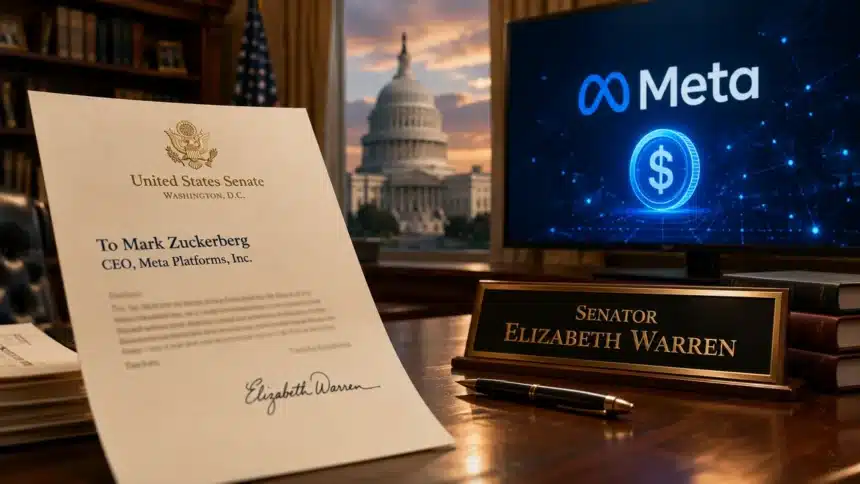
Senator Elizabeth Warren has sent a letter to Meta chief executive Mark Zuckerberg requesting detailed answers about the company’s stablecoin activities. Framed as a response to Meta’s limited transparency, the request sets a deadline for a written reply and outlines seven questions covering privacy financial stability illicit finance and whether Meta intends to launch its own digital currency. The story continues to develop as regulators and lawmakers watch how the world’s largest social platform handles emerging digital money as of 2026.
Key Highlights
- Trigger: Meta rolled out a stablecoin pilot on Facebook paying selected creators in USDC in the Philippines and Colombia
- Sender: Senator Elizabeth Warren (D Massachusetts)
- Recipient: Mark Zuckerberg, Founder, Chairman, and CEO of Meta
- Deadline: as of 2026 for responses to seven detailed questions
- Warren’s core concern: Meta’s 3.5 billion user base makes any stablecoin activity a potential systemic financial risk
What Set Warren Off
Meta began a limited stablecoin pilot on Facebook earlier in 2026, paying a group of selected content creators in USDC. The payments were routed through MetaPay and took place primarily in the Philippines and Colombia. Meta described the pilot as an experiment with third party stablecoin payment rails rather than the launch of a Meta issued currency.
That distinction did not satisfy Warren. In her letter, she called Meta’s conduct troubling and characterized the company’s communication with Congress as lacking transparency. Warren has been one of the most consistent critics of Big Tech moving into financial services, and Meta’s history with digital payments makes her especially skeptical. In 2019, Meta then called Facebook announced the Libra stablecoin project to enormous backlash from regulators globally. Libra was rebranded to Diem, scaled back repeatedly, and eventually abandoned in 2022 after regulators in the US and Europe made clear they would not approve it.
The new pilot is structurally different. Meta is not issuing its own stablecoin. It is integrating USDC, issued by Circle, into its payment infrastructure. But Warren’s letter suggests she views the distinction as less meaningful than Meta does. If 3.5 billion users can send and receive USDC through Facebook and Instagram without fully understanding what they are using, the systemic implications could be similar to a Meta issued coin in practice.
The Seven Questions
Warren asked Zuckerberg to provide detailed answers to seven questions by the deadline. The questions address whether MetaPay will be modified to allow users to hold stablecoins as a balance; what privacy guardrails exist for stablecoin transaction data; what controls Meta has implemented to prevent illicit finance and sanctions violations; what disclosures are made to users in pilot markets about the nature of USDC; whether Meta has coordinated with federal financial regulators; what Meta’s long term plans are for stablecoin integration across its platforms; and whether Meta will commit to never issuing its own stablecoin or product that acts as a private currency.
That last question is the most politically significant. Warren is asking Meta to make a binding public commitment not to create a private currency. Meta is unlikely to give that answer in a Senate letter, which means the response, if it comes, will probably be carefully worded around current plans rather than future ones. Meta told reporters that there is no Meta stablecoin and that the company wants people and businesses to pay the way they want on its platforms, which may include through third party stablecoins. That framing positions Meta as a neutral payment infrastructure provider rather than a financial institution.
Why Timing Matters
Warren’s letter arrived one day before the Senate Banking Committee announced its mid 2026 markup date for the Clarity Act. That timing is almost certainly not coincidental. As TCB has reported, the Clarity Act includes a stablecoin licensing framework and Warren has been one of the most vocal critics of the bill’s consumer protection provisions.
By raising questions about Meta’s stablecoin activity in the days before the markup, Warren is effectively arguing that the Clarity Act’s framework is insufficient to handle the specific risks posed by large technology companies integrating stablecoins into social media platforms. Her implicit argument is that Facebook is not Circle. The systemic risk of a social network with 3.5 billion users becoming a de facto financial platform is categorically different from a standalone stablecoin issuer operating under a dedicated license.
Whether legislators will add Big Tech specific provisions to the bill before the markup is unclear. The crypto industry’s main lobbying effort is focused on getting the bill through markup with minimal changes. Adding new restrictions targeting technology platforms at this stage would complicate that effort sharply and could introduce new political coalition dynamics.
Analytical Perspective
The emergence of a Meta driven stablecoin conduit raises questions that extend beyond traditional fintech concerns. First, the sheer scale of Meta’s user base creates a network effect that could accelerate stablecoin adoption in regions where conventional banking services remain underdeveloped. This could improve financial inclusion but also concentrate market power in a single private entity. Second, the integration of USDC into MetaPay blurs the line between social interaction and financial transaction, potentially inviting new forms of data monetisation that regulators have yet to address. Third, the pending Clarity Act may need to consider a tiered licensing approach that distinguishes between pure payment infrastructure and platforms that embed financial services into everyday social experiences. Finally, investor sentiment is already reacting; Meta’s stock has shown modest volatility since the pilot launch, and several venture funds have signaled interest in building ancillary services around the MetaPay ecosystem. The outcome of Warren’s inquiry will likely shape both policy and market dynamics for the next several years.