



Last updated: 9 November 2026
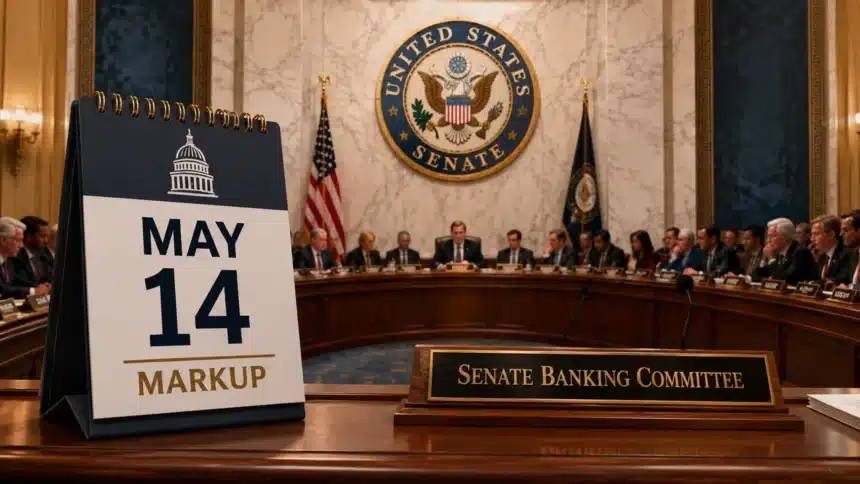
The Senate Banking Committee has scheduled a markup for the Digital Asset Market Clarity Act. This development ends a period of stalled negotiations and pushes the most significant crypto legislation in US history nearer to a full Senate floor vote, though the process remains fluid as of 2026.
Key Highlights
- Markup date confirmed: May 14, 2026 at the Senate Banking Committee
- Bill name: Digital Asset Market Clarity Act (also known as the Clarity Act)
- Key breakthrough: A stablecoin yield compromise between Senators Tillis and Alsobrooks cleared the last major roadblock
- Industry backing: Coinbase and Circle publicly endorsed the deal and urged the committee to advance the bill
- White House target: The administration has been pushing for a signed bill by July 4, 2026
What Triggered the Markup Date
The Clarity Act had been stuck in the Senate Banking Committee for months, primarily over one issue: whether crypto firms could offer yield or rewards on stablecoin balances. That dispute broke open in early May when Senators Thom Tillis of North Carolina and Angela Alsobrooks of Maryland reached a compromise.
The new legislative text prohibits covered parties from paying interest or yield on stablecoin balances directly. However, the restriction does not apply to rewards tied to what the bill calls bona fide activities or bona fide transactions. In plain terms, stablecoin issuers cannot simply pay holders for holding. But they can reward users for actual on chain activity, payments, and other economic actions distinct from bank style interest.
Coinbase and Circle, two of the largest players in the US crypto market, immediately backed the deal. Their public endorsement removed the biggest source of industry friction that had slowed the bill’s progress throughout April. As TCB reported, the Clarity Act fundamentally reshapes how digital assets are classified between the SEC and CFTC and sets the rules for who can issue stablecoins legally in the United States.
What Happens at a Markup
A markup is the formal legislative process where a committee reviews a bill line by line, considers amendments, and votes on whether to advance it to the full chamber. It is not a final vote. If the Senate Banking Committee approves the Clarity Act on May 14, the bill moves to the Senate floor for a broader debate and another vote.
Reaching the markup stage is meaningful. It signals that the committee chair believes there are enough votes to move the bill forward and that the major objections have been resolved or at least contained. The crypto industry has been lobbying aggressively for this moment since the House passed its version of the market structure legislation the previous year.
The Senate version differs from the House version on several points, including the treatment of decentralized protocols and the threshold at which a digital asset is classified as a commodity versus a security. Those differences would need to be reconciled in a conference process if both chambers pass their respective versions.
The Stablecoin Yield Compromise in Detail
The yield question was politically charged because it sits at the intersection of banking regulation and crypto innovation. Traditional banks are prohibited from paying above market interest to depositors in ways that could destabilize the financial system. Critics of stablecoin yield argued that allowing crypto issuers to pay holders unlimited returns would undercut banks and create systemic risk.
The Tillis Alsobrooks compromise threads that needle. Stablecoin issuers cannot function as unlicensed banks by paying passive interest. But they retain the ability to build reward programs that incentivize users to spend, transact, and participate in their ecosystems. That distinction matters enormously for companies like Circle, whose USDC underpins large parts of the DeFi economy.
The stablecoins sector has grown rapidly in 2026. Total stablecoin market capitalization has crossed $250 billion (figures as of publication), with USDC and USDT together accounting for the majority of circulating supply. The Clarity Act would create a federal licensing framework for stablecoin issuers, requiring them to hold reserves in approved assets and submit to regular audits. For context, tokenized US Treasuries on Ethereum alone crossed $8 billion in early 2026 (figures as of publication), illustrating how quickly on chain financial infrastructure is scaling.
What the Industry Is Watching
Several issues remain unresolved heading into the markup. Consumer protection provisions around wallet disclosures are still being negotiated. The treatment of algorithmic stablecoins, which triggered the Terra collapse in 2022, is addressed in the bill but remains a point of contention among senators who want stricter bans versus those who prefer lighter oversight.
Developer liability is another sensitive area. The bill includes provisions that would shield protocol developers from liability for how third parties use their code, similar to protections that
Analyst Outlook
Market observers see the markup as a litmus test for how quickly the federal government will bring crypto activity under a clear regulatory umbrella. If the committee approves the bill without major amendments, it signals that lawmakers believe the current compromise on stablecoin yield is sufficient to address banking concerns while preserving innovation. Conversely, a narrow vote or a demand for further changes could stall the timeline that the White House has set for a signed bill by early July. Analysts also note that the licensing framework for stablecoin issuers will likely create a new class of regulated entities that must file periodic reports with the Treasury and undergo independent audits. This could raise compliance costs for smaller issuers but may also level the playing field by giving larger players a clearer path to scale. In the broader context, the Clarity Act could influence how other jurisdictions shape their own digital asset rules, as many foreign regulators look to the United States for precedent. Investors should watch the committee’s vote closely, as it may affect the valuation of stablecoin linked products and the appetite for crypto related equities in the coming months.