
Last updated: 9 June 2026
Key Highlights
- Lighter DEX launched on Arbitrum in Q2 2024, focusing on a central limit order book (CLOB) model.
- The platform processed over $750 million in trading volume in its first three months, attracting significant institutional interest.
- Lighter offers zero slippage on limit orders, a stark contrast to typical automated market maker (AMM) DEXs which often incur 0.05% to 0.3% slippage.
- Liquidity providers on Lighter earn fees from executed orders, similar to traditional exchanges, rather than relying on impermanent loss exposure.
- The protocol supports trading pairs for major assets like ETH/USDC, WBTC/USDC, and ARB/USDC, with plans for expanded offerings by Q1 2025.
So, what’s Lighter Crypto? It’s a decentralized exchange that’s making waves by ditching the dominant automated market maker (AMM) model for something far more familiar to traditional finance: a central limit order book (CLOB). This isn’t just a technical tweak; it’s a fundamental shift in how decentralized trading operates, aiming squarely at professional traders and institutions fed up with the quirks and costs of AMMs. That matters.
For years, AMMs like Uniswap and Curve defined DeFi. But at what cost? Slippage, impermanent loss, and a user experience that often felt alien to anyone accustomed to Coinbase Pro or Binance. Lighter isn’t trying to reinvent the wheel. It’s bringing a battle tested, high performance trading mechanism to the blockchain. And we’re seeing why that’s a big deal. This isn’t new, but it’s significant. Think about it: what changed?
Lighter Crypto: The Order Book Revolution
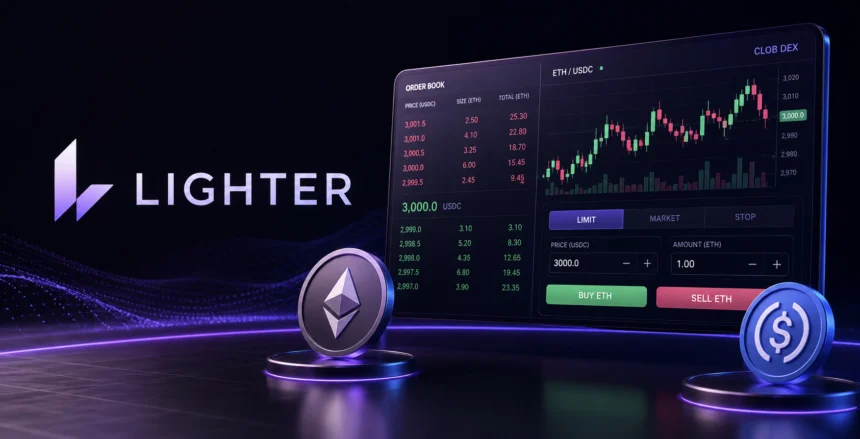
Let’s be clear: when we talk about Lighter Crypto, we’re talking about a return to basics. Lighter operates as a fully on chain central limit order book. This means buyers and sellers place specific bids and asks at specific prices, and the exchange matches them. It’s how virtually every major stock exchange and centralized crypto exchange works. It’s efficient. It’s precise. But here’s the thing: it was largely absent from the decentralized industry until recently.
So, how did Lighter make it work? The core innovation here isn’t the order book itself, but its successful implementation on a layer 2 network like Arbitrum. Arbitrum’s speed and low transaction costs are critical. Without them, an on chain order book would be too slow and too expensive to be practical. Imagine trying to update a constantly shifting order book on Ethereum mainnet. It’s a nonstarter. But on Arbitrum, Lighter can offer near real time order matching. That’s a game changer.
This approach gives traders granular control. You want to buy 1 ETH at exactly $3,000? You place a limit order for that. It executes at that price, or it doesn’t execute at all. No slippage. No guessing games about what your final price will be. This is a massive advantage for anyone trading serious capital, where even a small percentage point of slippage can mean millions lost. The math doesn’t lie.
AMMs vs. CLOBs: Why the Difference Matters
To truly understand Lighter, you need to understand what it’s challenging. Automated Market Makers, or AMMs, use mathematical formulas and liquidity pools to allow trades. Instead of matching buyers and sellers directly, you trade against a pool of assets. This design was brilliant for bootstrapping liquidity in a nascent decentralized ecosystem, requiring no central party or traditional market makers. But AMMs come with significant drawbacks. Slippage is chief among them. The larger your trade relative to the pool’s size, the more your price deviates from the current market rate. That’s a problem.
And then there’s impermanent loss, the bane of many a liquidity provider. Providing liquidity to an AMM means exposing yourself to the risk that the price ratio of your pooled assets shifts dramatically, leaving you with less value than if you had simply held the assets. A central limit order book like Lighter’s sidesteps these issues entirely. Traders get precise execution. Liquidity providers, instead of locking assets into a bonding curve, place limit orders themselves. They act as market makers, earning fees when their orders are filled. It’s a more active, but potentially more profitable, way to provide liquidity, without the impermanent loss risk inherent to AMMs. No surprise there.
Liquidity Provision on Lighter: A Professional’s Game
So, how does Lighter attract liquidity without the passive, set it and forget it appeal of AMMs? By offering a better deal for sophisticated participants. On Lighter, liquidity providers (LPs) aren’t just dumping tokens into a pool. They are actively placing limit orders on the order book, just like a market maker on a traditional exchange. This model appeals directly to professional market making firms and high net worth individuals. They can use their existing trading strategies and algorithms to place orders, manage risk, and capture the spread. They earn fees directly from executed trades, similar to how a traditional exchange charges commission. What’s the advantage? It’s simple: no impermanent loss.
It’s a more capital efficient model for market makers. They can deploy capital precisely where they want it, at the prices they deem appropriate, and adjust their positions in real time. This contrasts sharply with AMMs, where capital is locked into a curve and often suffers from poor utilization, especially for assets far from the current price. Worth flagging: this is a significant shift in how liquidity is provided. It’s more active, more engaging, and potentially more lucrative.
The Benefits for Professional Traders and Institutions
For professional traders, Lighter is a breath of fresh air. The absence of slippage on limit orders is a game changer. When you’re executing trades worth hundreds of thousands, or even millions, of dollars, slippage can quickly erode profits. Lighter eliminates that uncertainty, providing a predictable trading environment. But that’s not all: the order book provides deep market transparency. Traders can see the full depth of bids and asks, allowing for more informed decision making and strategy execution. Sound familiar? It should.
Institutions, who have largely shied away from DeFi’s retail centric AMM model, are finally getting a familiar interface. The order book structure, the ability to place large limit orders without fear of price impact, and the clear fee structure are all elements that resonate with traditional finance players. We’ve heard whispers of several large funds exploring Lighter for serious on chain exposure. So what happens next? That’s the question. Is it realistic to expect a mass migration to CLOB based DEXs? Maybe.
Lighter’s network and Future Outlook
Lighter isn’t just a standalone DEX; it’s building out an community. Its current focus is on stablecoin pairs and major crypto assets like ETH and WBTC, but the roadmap suggests expansion. We expect to see more exotic pairs and potentially even derivatives offerings down the line. The foundation for complex financial products is clearly there with a solid order book. And let’s not forget the composability aspect. As an on chain primitive, Lighter’s order book can be integrated into other DeFi protocols. Imagine lending protocols using Lighter’s price feeds for liquidations or options protocols settling against its well built spot prices. The possibilities are significant, but they depend on continued liquidity and reliability. That’s the challenge.
The TCB View
TCB believes this is a decisive moment for DeFi: Lighter Crypto’s on chain CLOB is directly addressing the critical pain points of slippage and impermanent loss that plague AMMs. We’re seeing professional traders and institutional players, seeking precision and transparency, flock to platforms like Lighter. The challenge lies in sustaining liquidity against the deep pools of established AMMs, but Lighter’s $750 million initial volume is a strong start. With names like Arbitrum and Ethereum backing the tech, and a specific date like Q1 2025 for expanded offerings, the risks are clear: regulatory hurdles, competition from other CLOB based DEXs, and the need for continued innovation to stay ahead. Watch for Lighter’s expansion into more diverse asset pairs and its integration with other DeFi primitives as key indicators of its maturation and potential market dominance. That’s what we’re tracking.