
Last updated: 29 July 2026
Key Takeaways
Key Highlights
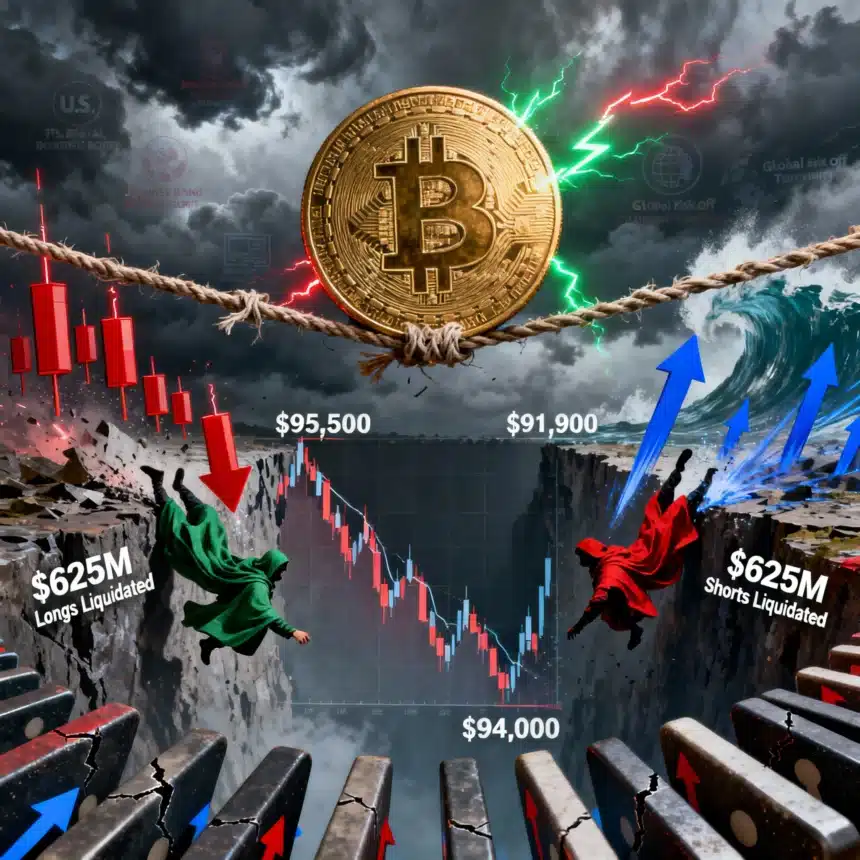
- Massive Losses: Over $625 million was forcibly closed across the market as Bitcoin’s price jerked up and down.
- Both Sides Hit: Unlike most crashes where only buyers lose, this event “wiped out” those betting on a price drop (shorts) just as badly as those betting on a rise (longs).
- The Cause: A mix of global political news regarding tariffs and a “flash crash” created a perfect storm for traders using borrowed money.
In the world of Bitcoin, a “split liquidation” is a rare and painful event where the market moves so fast in both directions that almost everyone betting on the price gets burned. As of 2026, the cryptocurrency market continues to experience significant volatility, with events like these highlighting the risks and complexities of trading with borrowed money. This evolving story has seen various developments, with the market still reeling from the effects of such sudden price swings.
What Just Happened?
Bitcoin experienced a “whipsaw” movement, a technical term for when the price drops and then snaps back up immediately. It started when Bitcoin fell from around its previous high to a lower point in a single hour (figures as of publication). This sudden drop triggered automatic sell orders for people who had borrowed money to bet that the price would go up.
However, the “split” happened when the price didn’t stay down. It bounced back toward a higher point almost as quickly as it fell (figures as of publication). This secondary move caught the people betting against Bitcoin off guard, forcing their trades to close at a loss too.
Why This Event Was Unique
Most of the time, crypto news focuses on “long liquidations,” which is just a fancy way of saying the price crashed and buyers lost money. This event was different because the liquidations were split almost 50/50.
| Group | What they did | Why they lost |
| Longs (Buyers) | Bet the price would go up. | The sudden drop hit their “safety limit,” closing their trades. |
| Shorts (Sellers) | Bet the price would go down. | The rapid recovery forced them to buy back Bitcoin at a higher price than they expected. |
According to data from CoinGlass, roughly 150,000 traders were affected (figures as of publication). This balanced “wipeout” is rare because it requires extreme volatility in both directions within a very short window.
The “Trigger” Behind the Chaos
The volatility wasn’t random. Several global events collided to shake investor confidence:
- Tariff Fears: News regarding new trade tariffs created a “risk off” mood, making investors pull money out of volatile assets like Bitcoin.
- Bond Market Turmoil: Sharp moves in government bonds caused a ripple effect, tightening the “extra cash” (liquidity) available in the crypto market.
- Automatic Cascades: In crypto, when one person’s trade is forced to close, it can push the price further, hitting the next person’s limit. This creates a “falling dominoes” effect that moves faster than any human can react.
How “Borrowing” Makes the Crash Worse
The reason these losses were so high ($625 million+) is due to leverage. Think of leverage like a magnifying glass for your money. If you have $100 but trade as if you have $1,000, you can make 10 times the profit.
The catch? If the price moves against you by even a tiny amount, you lose everything. During this “split liquidation,” the price swung so wide that even “safe” bets were reached and cancelled by the exchanges.
”When liquidations happen, selling is not a choice. It is automatic. The computer closes the trade to make sure the debt is paid, which is why the price moves so violently.”
What’s Next for Bitcoin?
Following this “flush” of risky bets, the market is looking for a new floor. Many analysts see the $90,000 to $92,000 range as the most important level to watch (figures as of publication). If Bitcoin can stay above this, it might gather the strength to try for higher levels again. If it fails, we could see another round of liquidations as traders get nervous.
For now, the lesson is clear: In a market this volatile, betting with borrowed money can lead to getting hit from both sides, regardless of which way you think the price is going.
FAQ: Understanding Liquidations
What is a liquidation? It’s when a trading platform forcedly closes your trade because you no longer have enough money to cover the losses from a
New Insights and Future Outlook
As the cryptocurrency market continues to evolve, analysts are focusing on the role of institutional investors and their impact on market volatility. The increasing participation of institutional investors in the cryptocurrency market has been a significant factor in the recent price swings. These investors, who typically have more resources and market influence, can contribute to the amplification of price movements, making the market more volatile. Furthermore, the growing correlation between cryptocurrency prices and traditional assets, such as stocks and bonds, suggests that the market is becoming more interconnected, which can lead to a higher risk of contagion effects. In this context, it is essential for investors to be aware of the potential risks and benefits associated with investing in cryptocurrencies and to develop strategies that take into account the complex interactions between different asset classes.
The future outlook for Bitcoin and the broader cryptocurrency market remains uncertain, with many factors that can influence the price. However, one thing is clear: the market will continue to be shaped by the interplay between technological advancements, regulatory developments, and investor sentiment. As the market continues to mature, it is likely that we will see more sophisticated investment products and strategies emerge, which can help to reduce risk and increase returns for investors. Ultimately, the key to success in the cryptocurrency market will be to stay informed, adapt to changing market conditions, and be prepared for the unexpected.