
Last updated: 3 July 2026
Global retail enterprises are running some of the most complex enterprise data strategies in any industry. They manage millions of SKUs, hundreds of supplier relationships, and customer interactions across channels simultaneously.
The data strategies that power AI driven personalization and real time inventory decisions at that scale look very different from what most technology teams planned five years ago. This deep dive examines what modern retail data leadership actually looks like in 2026.
Key Highlights
- Leading retail enterprises are centralizing customer, inventory, and supplier data into unified data platforms rather than departmental silos
- Real time data pipelines feeding demand forecasting models have become a standard infrastructure investment at top tier retailers
- Chief Data Officers now report directly to the CEO at 61% of Fortune 500 retail companies, up from 34% in 2022
- Customer data platforms (CDPs) are replacing legacy CRM systems as the primary source of truth for personalization
- Data governance and quality management have moved from back office functions to board level priorities
The Core Enterprise Data Strategy Problem in Retail
Retail data has historically lived in islands. Point of sale systems collect transaction data. E commerce platforms collect browsing and purchase data. Supply chain systems collect inventory and logistics data. Loyalty programs collect engagement data. Each island operates on its own logic, its own data model, and its own update frequency. The enterprise data strategy problem in retail is fundamentally about connecting those islands without rebuilding every system from scratch.
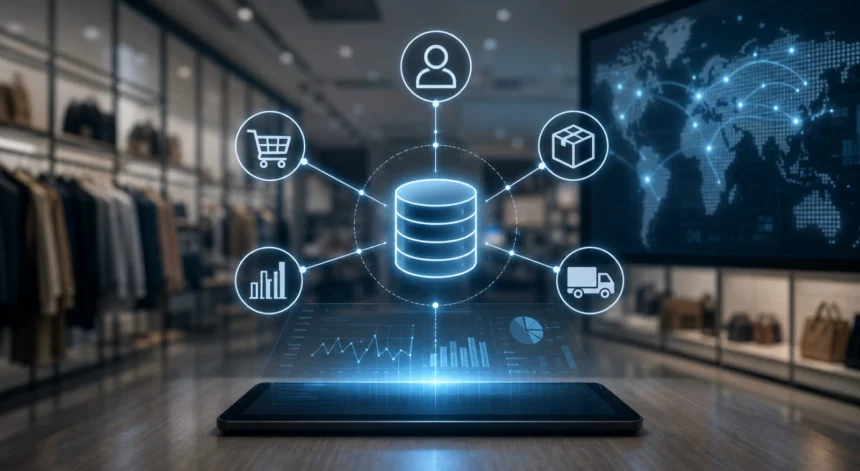
The CDOs who have made the most progress in 2026 took a pragmatic approach. Rather than attempting a full systems replacement, they built a data integration layer that pulls from existing source systems, standardizes records, and serves a unified view to downstream consumers.
That layer is usually a cloud data platform, most commonly Snowflake or Databricks, combined with a real time event streaming tool like Apache Kafka for high velocity feeds.
How Retail CDOs Are Structuring Their Data Teams
The org chart for a modern retail data function looks different from a traditional IT structure. At the center is a small platform engineering team that owns the data infrastructure. Around it sit embedded analytics engineers aligned to business domains: commercial, supply chain, marketing, and store operations. Each domain team owns its own data products and data quality within that domain.
This structure borrows from the data mesh model, which treats data as a product owned by the team closest to it rather than a shared resource managed centrally. It solves the bottleneck problem that plagued centralized data teams. Business units no longer wait for a central analytics queue. They own their pipelines and their metrics.
The central team sets standards and provides the infrastructure. Gartner noted in its 2026 CDO survey that 48% of leading retail enterprises are now operating some variant of a data mesh model.
AI and the Demand for Better Data Quality
The move to AI powered decision making has forced a reckoning with data quality that was easy to defer in the reporting era. Bad data in a dashboard is a nuisance. Bad data in a demand forecasting model that drives inventory purchase orders is a financial risk. This is why data quality and data governance have moved from back office functions to strategic priorities for retail CDOs in 2026.
The most common investment pattern is a combination of a data catalog tool for discovery and lineage tracking, automated data quality checks in the pipeline, and a governance council with business stakeholders who set the standards. The governance council matters because data quality rules for retail are not purely technical decisions. What counts as a valid product record or an accurate sales attribution requires business judgment, not just engineering.
The Customer Data Platform as a Competitive Advantage
The customer data platform has become the most strategically contested piece of retail data infrastructure in 2026. A CDP aggregates customer data from every interaction across channels and makes it available in real time for personalization, targeting, and service. The retailers that built or adopted CDPs early now have a personalization capability that late movers are spending aggressively to catch.
The data strategy lesson from retail CDOs who have navigated this successfully is simple: the CDP is not a marketing tool. It is a data infrastructure decision. It needs to be owned by the data organization, governed by the CDO, and integrated with every system that touches a customer.
When it sits solely in marketing, it becomes another silo. When it sits in the data organization, it becomes a company wide asset.
Frequently Asked Questions (FAQs)
What are global retail enterprises doing with their data strategies
Global retail enterprises are centralizing customer, inventory, and supplier data into unified data platforms rather than departmental silos, this is a key part of their data strategy. They are also investing in real time data pipelines to power demand forecasting models. This approach is becoming standard at top tier retailers.
Who do chief data officers report to in retail companies
Chief Data Officers now report directly to the CEO at 61 percent of Fortune 500 retail companies, which is up from 34 percent in 2022, showing the increasing importance of data leadership in retail.
What is replacing legacy CRM systems in retail
Customer data platforms are replacing legacy CRM systems as the primary source of truth for personalization, this change is happening because customer data platforms can handle the complexity of modern retail data.
Why is data governance important in retail
Data governance and quality management have moved from back office functions to board level priorities, because they are critical to making good decisions about inventory and customer personalization, and to running a successful retail business.
The TCB View
Our read: the retail industry is proving that enterprise data strategy and AI strategy are the same thing. The retailers making the most of AI in 2026 are the ones that invested in data infrastructure two or three years before everyone else. The technology decisions are now secondary to the organizational and governance decisions.
Watch for the data mesh model to become a standard reference architecture for retail data teams by 2027.
The CDOs pioneering it today are creating a structural advantage that will be difficult for competitors to replicate quickly because the change is organizational, not just technical. Forrester projects that data mature retailers will outperform peers on gross margin by 3 to 5 percentage points over the next three years as AI driven decisions compound over time.