
Last updated: 29 July 2026
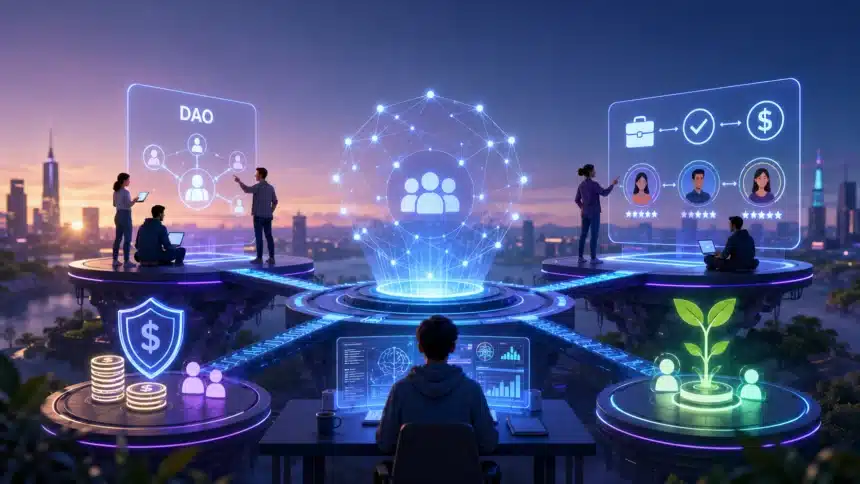
The increasing threat of artificial intelligence workforce disruption demands more than just hand wringing over job losses. Web3 technologies offer concrete, Decentralized solutions to reshape labor markets, provide new economic opportunities, and ensure a more resilient future for workers. Decentralized autonomous organizations, tokenized work platforms, and universal basic income models powered by Blockchain present a clear path forward.
Key Highlights
- DAOs enable strong, distributed work structures resistant to traditional corporate vulnerabilities.
- Tokenized work platforms connect skilled individuals to tasks, verifying credentials and rewarding contributions.
- Web3 UBI models offer transparent, efficient safety nets against widespread job displacement.
- Advanced AI tools like Notion developer platform AI Agents create new demands for human oversight and specialized Web3 enabled services.
The AI Imperative: Beyond Job Loss Narratives
Mainstream media focuses on AI displacing jobs, painting a bleak picture of economic shifts. While automation certainly impacts traditional roles, the narrative often misses the emergent opportunities. AI adoption is accelerating, with companies investing heavily in automation and generative models. This rapid integration means industries must adapt, not just react.
The current economic climate, marked by a Fear & Greed Index at 28, reflects a broader market cautiousness. This sentiment reflects not only Crypto volatility but also underlying concerns about technological change. Businesses and individuals need resilient economic structures that can withstand both market fluctuations and rapid technological shifts.
Decentralized Autonomous Organizations as New Work Structures
Decentralized autonomous organizations, or DAOs, offer a fundamental shift in how work is organized. These blockchain native entities operate with transparent rules and community driven governance, removing the single points of failure inherent in traditional corporate structures. They can pool resources, define tasks, and distribute rewards based on verifiable contributions.
Instead of a company laying off thousands as AI streamlines operations, a DAO could reallocate resources, create new roles for AI oversight, or even fund community initiatives. This distributed model drives adaptability, allowing groups to quickly pivot to new demands created by AI, rather than being beholden to centralized decision makers.
Tokenized Work Platforms: Skills for the AI Era
Tokenized work platforms are emerging as a powerful antidote to traditional freelance marketplaces, which often suffer from opaque fees and trust issues. These platforms use blockchain to verify worker credentials, track task completion, and disburse payments transparently via smart contracts. Workers earn tokens for their contributions, which can represent ownership or access within specific projects.
This model is particularly potent in an AI dominated work force. As AI automates routine tasks, human skills will shift towards creative problem solving, AI training, ethical oversight, and specialized development. Tokenized platforms can connect these high value human skills with projects requiring them, creating a more fluid and meritocratic global labor market.
Universal Basic Income and Web3’s Role
The prospect of widespread artificial intelligence workforce disruption has reignited discussions around Universal Basic Income, or UBI. Web3 provides an unique infrastructure to implement UBI models that are transparent, resistant to manipulation, and efficient. Blockchain based identity systems can ensure fair distribution, while stablecoins can provide a reliable store of value for recipients.
Projects like Worldcoin are exploring biometric identity for UBI distribution. While controversial, the underlying principle of a verifiable, unique identity on chain could underpin future UBI systems. This approach ensures funds reach intended recipients without bureaucratic overhead, creating a more solid social safety net in an AI saturated economy.
Notion’s AI Agents and the Future of Work
Even advanced AI tools like Notion developer platform AI agents highlight the evolving relationship between humans and artificial intelligence. These agents can automate complex workflows, generate content, and analyze data at scale. Yet, they still require human input for initial setup, fine tuning, ethical guidance, and specialized problem solving.
This creates a new demand for human expertise in AI management and development. Web3 platforms can facilitate this new work. DAOs could form to collectively manage and improve AI agents, or tokenized platforms could reward individuals for contributing data, auditing AI outputs, or developing custom AI integrations. The future of work is not just about AI displacing humans, but about humans and AI collaborating in new, Web3 enabled structures.
The TCB View
The Central Bulletin believes that merely observing artificial intelligence workforce disruption is insufficient. Web3 offers not just theoretical solutions but practical, implementable frameworks to address the economic challenges posed by AI. DAOs can build resilient work communities. Tokenized platforms can empower individual contributors with verifiable skills and fair compensation. Web3 UBI models can provide a necessary safety net.
Ignoring these Web3 solutions is a missed opportunity to build a more equitable and adaptable future. Proactive development and adoption of these technologies are essential. The market currently shows caution, with Bitcoin trading at $76,201.00 and the Fear & Greed Index at 28. This shows the urgency for innovative, decentralized economic models. Web3 is not merely an alternative; it is the imperative path forward for a stable, human centric future in an AI driven world.