
Last updated: 21 June 2026
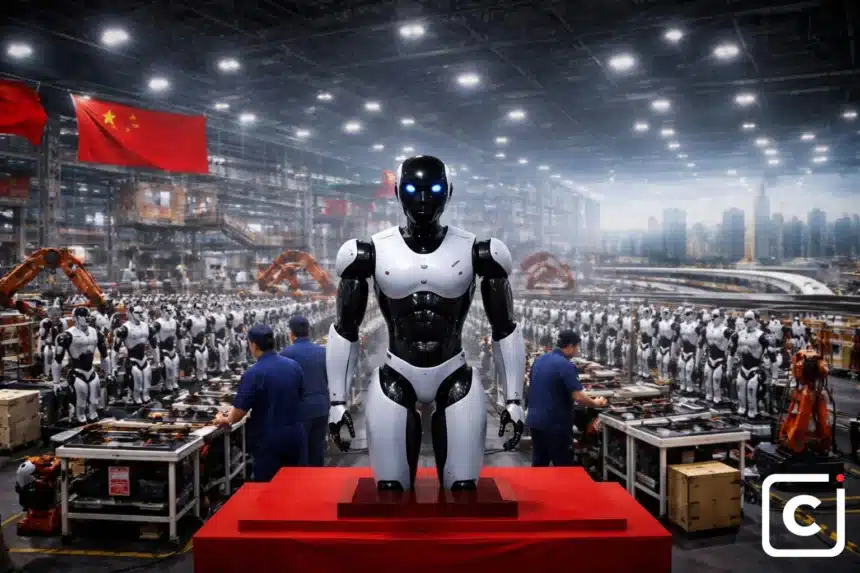
Agibot, the Chinese humanoid robotics company, announced on guide 30, 2026 that its 10,000th unit rolled off the production line. The bitcoin, volume surpasses bitcoin volume surpasses coinbase-2026″>coinbase-2026″>changed-the future of wallet”>milestone is significant not just for the number but for the acceleration: Agibot took roughly two years to produce its first 1,000 units, one year to reach 5,000, and just three months to go from 5,000 to 10,000. That is a fourfold increase in manufacturing speed in a single record inflows q1-2026″>quarter.
Key Highlights
- Agibot shipped its 10,000th humanoid robot on March 30, 2026
- Production acceleration: 2 years for first 1,000 units, 1 year to 5,000, 3 months from 5,000 to 10,000
- Robots deployed across logistics, retail, hospitality, and education in multiple continents
- Agibot ranked first globally in humanoid robot shipments in 2025
- Deployments span Europe, North America, Japan, South Korea, Southeast Asia, and the Middle East
The Manufacturing Curve That Matters
The production numbers tell a story about manufacturing learning curves that should concern every Western robotics company. Agibot’s first 1,000 units were essentially artisanal production. Small batches. High per unit costs. Frequent design iterations between production runs. This is normal for any hardware startup scaling from prototype to product.
The jump from 1,000 to 5,000 units in one year indicated that Agibot had solved its core manufacturing processes and was beginning to scale. But the real signal is the most recent quarter: 5,000 additional units in three months. That is not incremental improvement. That is industrialised production. Agibot has crossed the threshold from robotics startup to robotics manufacturer.
For context, Boston Dynamics, the most prominent Western humanoid robotics company, has not publicly disclosed comparable production volumes. Tesla’s Optimus program has demonstrated prototypes in controlled environments but has not announced volume manufacturing at this scale. The Western humanoid robotics industry is building prototypes. Agibot is building an assembly line.
Where the Robots Are Going
Agibot’s deployment map reveals a deliberate geographic strategy. The robots are active across logistics warehouses, retail environments, hospitality venues, and educational institutions in Europe, North America, Japan, South Korea, Southeast Asia, and the Middle East.
This is not a domestic market play. Agibot is building an international customer base across multiple verticals simultaneously, a strategy that diversifies revenue risk and generates deployment data across different regulatory environments and use cases. The breadth of deployment also creates switching costs. Once a logistics operator has integrated Agibot robots into its workflow, replacing them with a competitor’s product requires retraining, reintegration, and operational disruption.
The Cost Advantage
China’s dominance in humanoid robotics manufacturing mirrors its earlier dominance in drone manufacturing, electric vehicle production, and solar panel fabrication. The pattern is consistent: Chinese manufacturers achieve cost structures that Western competitors cannot match, then use that cost advantage to capture global market share before Western alternatives reach production scale.
Agibot benefits from China’s dense supply chain for motors, sensors, batteries, and actuators. The same component ecosystem that enabled BYD, DJI, and CATL to dominate their respective industries is now feeding the humanoid robotics production pipeline. Western robotics companies that source components from the same supply chain face dependency risk. Those that try to build alternative supply chains face higher costs and longer timelines.
What the West Is Doing (and Not Doing)
The US response to China’s robotics manufacturing lead has been fragmented. The CHIPS Act addressed semiconductor manufacturing. There is no equivalent industrial policy for robotics manufacturing at scale. Individual companies, Tesla, Boston Dynamics, Agility Robotics, are pursuing their own development programs, but none have demonstrated the manufacturing volume that Agibot achieved in Q1 2026.
Europe’s situation is similar. Germany’s robotics industry, historically strong in industrial automation through companies like KUKA (now Chinese owned), has not produced a humanoid robotics program competitive with Agibot’s scale. The European Union’s AI Act includes provisions for robotics but focuses on safety and liability frameworks rather than manufacturing competitiveness.
Why 10,000 Units Is a Tipping Point
Ten thousand units is significant for several reasons beyond the number itself. At this production volume, Agibot can negotiate component pricing that further reduces per unit cost. It generates enough field deployment data to train and improve its AI systems faster than competitors with smaller fleets. And it establishes enough market presence that enterprise buyers begin to view humanoid robots as a standard procurement category rather than an experimental technology.
The next threshold is 100,000 units. If Agibot maintains its current acceleration curve, crossing that milestone within the next 18 months is plausible. At that scale, humanoid robots shift from novelty to commodity, and the cost curve drops into territory where mass market adoption across manufacturing, warehousing, and service industries becomes economically inevitable.
The TCB View
Agibot’s 10,000 unit milestone is the most underreported technology story of the quarter. While Western media focuses on AI language models and chatbot features, China is quietly building the manufacturing infrastructure for the physical AI economy. Language models are software. Humanoid robots are hardware at scale. Hardware at scale is where China has won every recent industrial competition.
The West’s response cannot be another round of prototype demonstrations at CES. It needs to be a manufacturing strategy. The gap between Agibot’s production volume and Western competitors’ production volume is not closing. It is widening. Every quarter that passes without a Western manufacturing response makes the eventual catch up more expensive and less likely.