
Last updated: 16 May 2026
Content type: How To Guide
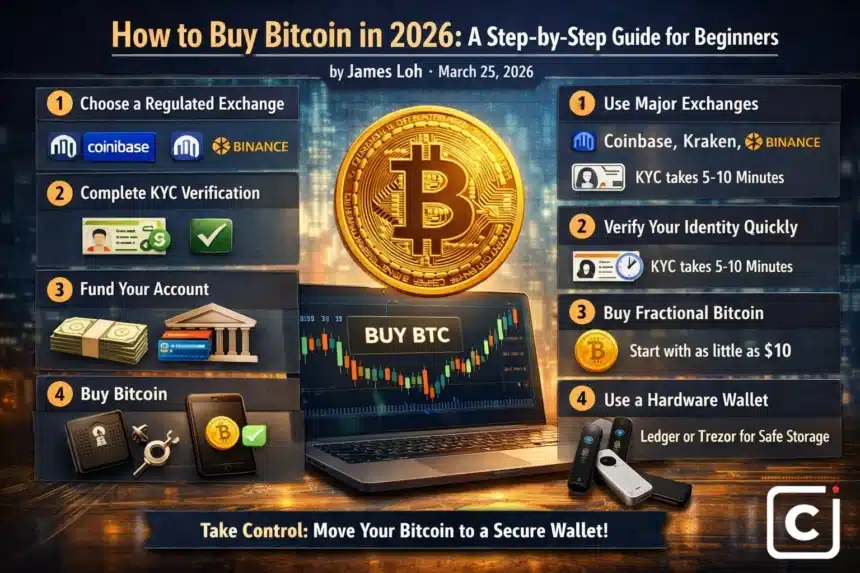
Buying Bitcoin in 2026 is straightforward: choose a regulated review-2026″>exchange, google core update complete publisher guide”>complete identity verification, fund your account, place a purchase, and move your surge iran ceasefire geopolitics”>Bitcoin to a secure wallet. The entire process takes under 30 minutes for most people. This guide walks you through every step.
Key Highlights
- Key Highlight: Regulated exchanges like Coinbase, Kraken, and Binance are the safest starting points for new buyers.
- Key Highlight: KYC (Know Your Customer) verification is legally required on all major platforms and typically takes 5 to 10 minutes.
- Key Highlight: Never leave large amounts of Bitcoin on an exchange. Move funds to a personal wallet after purchase.
- Key Highlight: Bitcoin can be purchased in fractions. You do not need to buy a whole coin.
- Key Highlight: Hardware wallets from Ledger and Trezor remain the gold standard for long term storage as of 2026.
Choosing the Right Exchange
The exchange you pick matters. As of 2026, the most trusted platforms for new buyers are Coinbase (best for US residents), Kraken (strong security record), and Binance (largest global volume). Each is regulated in multiple jurisdictions and carries insurance on custodied funds.
When comparing exchanges, look at three things: trading fees (typically 0.1% to 0.5% per trade), the available payment methods (bank transfer, debit card, or wire), and whether the platform operates in your country. Coinbase charges slightly higher fees but offers a cleaner interface for beginners.
Avoid unregulated exchanges that do not require identity verification. These platforms carry counterparty risk and have been linked to exit scams in prior years.
Completing KYC Verification
KYC is mandatory on all regulated exchanges. The process requires a government issued photo ID (passport or driver’s license) and sometimes a selfie or proof of address. Most platforms complete verification within minutes using automated document scanning.
Have your documents ready before you sign up. If verification fails on the first attempt, re upload a clear, well lit photo of your ID. Blurry images are the most common reason for delays.
In 2026, enhanced due diligence checks apply to large purchases (typically above $10,000 in a single transaction), in line with US FinCEN guidance and FATF travel rule requirements globally.
Funding Your Account and Placing a Purchase
Bank transfers (ACH in the US, SEPA in Europe) are the cheapest funding method, usually settling within 1 to 3 business days. Debit card purchases are instant but carry fees of 1.5% to 3.5%.
Once funds arrive, navigate to the Bitcoin market on your exchange, enter the amount in your local currency, and confirm the purchase. You can buy as little as $10 worth of Bitcoin. The exchange calculates the equivalent BTC amount at the current spot price.
Double check the fee before confirming. Some platforms hide network and conversion fees until the final confirmation screen.
Safe Storage After Purchase
Exchanges are custodians, meaning they hold your private keys. If the exchange is hacked or becomes insolvent, your Bitcoin is at risk. The safest practice is to withdraw to a wallet you control.
For amounts under $500, a software wallet like Trust Wallet or Exodus is adequate. For larger holdings, a hardware wallet is the right choice. The Ledger Nano X and Trezor Model T are the two most widely recommended options in 2026, each priced between $70 and $150.
When withdrawing from an exchange, always send a small test transaction first. Verify the address and confirm receipt before sending the full amount. Bitcoin transactions are irreversible.
Common Mistakes to Avoid
New buyers frequently make three mistakes: buying on an unregulated platform, leaving funds on the exchange indefinitely, and storing their seed phrase digitally (in a screenshot or cloud note). None of these are recoverable errors if they go wrong.
Write your wallet seed phrase (12 or 24 words) on paper and store it in a secure physical location. Never share it with anyone. No legitimate service will ever ask for it.
The TCB View
Bitcoin onboarding has improved dramatically since 2020. Regulated exchanges are more competitive on fees, KYC is faster, and hardware wallet options are more affordable. The barrier to buying Bitcoin in 2026 is genuinely low.
What has not changed is the fundamental responsibility that comes with self custody. The crypto ecosystem still lacks the consumer protections that cover traditional bank accounts. That gap is the reason the storage step matters as much as the purchase step. Get the wallet right from the beginning.
Get the Daily Briefing
Crypto, AI, and Web3 intelligence. Free, every day.