
Last updated: 19 July 2026
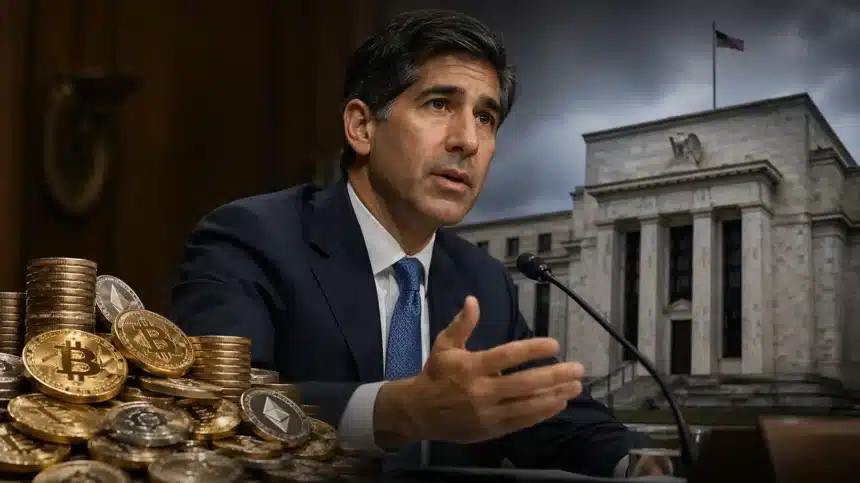
Kevin Warsh, a nominee to lead the Federal Reserve, held disclosed personal crypto investments exceeding $100 million across multiple assets, including Bitcoin, Solana, and others, before testifying to the Senate Banking Committee on April 21, 2026, for Federal Reserve Chair confirmation. His significant holdings were revealed in a timely disclosure. Market expectations around Warsh’s pro-crypto stance contributed to a 2.7% increase in Bitcoin’s value leading up to the hearing.
Key Highlights
- Kevin Warsh testified before the Senate Banking Committee on April 21, 2026, for Federal Reserve Chair confirmation
- Warsh holds disclosed personal crypto investments exceeding $100 million across Bitcoin, Solana, Aave, dYdX, Arbitrum, Optimism, and Polymarket
- Bitcoin rose 2.7% in the 24 hours leading up to the hearing as markets priced in a pro-crypto Federal Reserve
Kevin Warsh, President Trump’s nominee to replace Jerome Powell as Chair of the Federal Reserve, began testifying before the Senate Banking Committee on April 21, 2026. The confirmation hearing is the most closely watched monetary policy event of the year. Warsh is unique among all previous Fed Chair nominees in one respect that markets have been pricing since his nomination was announced: he holds disclosed personal investments in cryptocurrency exceeding $100 million. Those holdings span Bitcoin infrastructure through a position in Flashnet, DeFi protocols including dYdX and Aave, Layer 1 blockchains including Solana, Ethereum scaling solutions including Arbitrum and Optimism, and prediction markets including Polymarket. No prior Fed Chair nominee has ever disclosed positions of this kind or at this scale.
Key Highlights
- Kevin Warsh testified before the Senate Banking Committee on April 21, 2026 for Federal Reserve Chair confirmation
- Warsh holds disclosed personal crypto investments exceeding $100 million across Bitcoin, Solana, Aave, dYdX, Arbitrum, Optimism, and Polymarket
- Bitcoin rose 2.7% in the 24 hours leading up to the hearing as markets priced in a pro crypto Federal Reserve posture
- Senators are focused on two areas: Warsh’s interest rate trajectory and his views on digital asset policy
- Warsh is the first Federal Reserve Chair nominee with documented personal cryptocurrency investments at scale
- His divestment commitments, if required by the Senate, will be watched closely for their market implications
No Prior Fed Chair Has Done This
The Federal Reserve has been chaired by economists and career central bankers who viewed cryptocurrency as a speculative asset class. Jerome Powell described Bitcoin as a competitor to gold rather than to the dollar, and he never held personal positions in the industry he partially regulated. Warsh holds actual positions in the infrastructure. His Aave holdings give him direct financial exposure to the same protocol that is currently managing up to $196 million in bad debt from the KelpDAO $292 million exploit. His Solana position gives him direct exposure to the chain whose Alpenglow upgrade is one of the most significant consensus layer changes in blockchain history. The Senate’s confirmation process will have to reckon with a nominee whose financial interests are embedded in the industry he would partially regulate through the Fed’s bank supervisory authority.
The conflict of interest framing is the obvious angle, and senators on both sides have telegraphed that divestment requirements will be central to the hearing. But the more structurally important question is different: if Warsh is confirmed and keeps his crypto positions through a managed divestment timeline, the Federal Reserve will for the first time be led by someone who understands DeFi protocols from the perspective of a participant rather than a regulator looking in from outside. Morgan Stanley’s MSBT Bitcoin ETF launch and the institutional Bitcoin ETF inflows accelerating through April are the market context in which Warsh is testifying.
Bitcoin Rises 2.7% as the Hearing Opens
Bitcoin gained 2.7% in the 24 hours before Warsh’s testimony opened, extending its recovery from the April lows. The price movement reflects a market that is pricing two things simultaneously: the probability that Warsh is confirmed and the probability that a confirmed Warsh adopts a more accommodative stance toward digital assets than his predecessor. Neither of those probabilities is certain. But the directional bet is clear.
Warsh has been publicly described as a hawkish candidate on interest rates, which creates an apparent tension with the crypto rally his nomination has produced. Crypto assets have historically performed better in low rate environments where risk appetite is high. A hawkish Fed Chair would normally be a negative for Bitcoin. The market is resolving this tension by placing more weight on Warsh’s crypto exposure and implied regulatory sympathy than on his rate policy stance. Whether that bet is correct will depend on how Warsh actually governs if confirmed. April’s $577 million DeFi crisis has already demonstrated that the relationship between monetary policy stability and DeFi security is not straightforward.
What the Senate Wants to Know
The confirmation hearing will focus on two areas. First, rate policy: the Trump administration has been publicly pushing for lower interest rates, and Warsh will face questions about whether he will accommodate that pressure or maintain the Fed’s traditional independence from political influence. His written answers to the committee ahead of the hearing indicated he views price stability as the Fed’s primary mandate and will not subordinate that to political preferences.
Second, digital assets: senators on both the progressive and conservative sides have questions, but from different directions. Progressive members want to know whether Warsh’s crypto holdings create conflicts with the Fed’s bank supervision role, which includes oversight of banks expanding into digital asset custody and lending. Conservative members want to know whether Warsh’s personal positions signal sympathy for an industry that has historically resisted regulation. Both sets of questions will produce substantive answers that the market will parse immediately. The KelpDAO exploit and its contagion into Aave, a protocol Warsh personally holds, creates an uncomfortable backdrop for those answers. The GENIUS Act’s progress on stablecoin regulation and the CLARITY Act debate are both moving through Congress simultaneously, which means the next Federal Reserve Chair will be navigating the most consequential period of US crypto regulation in history.
The Divestment Question
The Senate Banking Committee has the ability to require divestment commitments as a condition of supporting a nominee’s confirmation. The question for Warsh is not whether he will be asked to divest but what the timeline and scope of that divestment will be. A forced sale of positions exceeding $100 million in DeFi protocols and Layer 1 tokens at current market conditions would itself be a market event. The committee is likely to accept a managed divestment process over 12 to 24 months rather than requiring immediate liquidation, but the structure of that commitment will be closely scrutinised.
Warsh’s Polymarket holdings are a specific point of interest because prediction markets are currently operating in a regulatory grey area in the United States. Holding a position in a prediction market platform while chairing the Federal Reserve would create ongoing questions about whether monetary policy decisions are being hedged through that platform. The expectation is that Polymarket specifically will be a condition of any divestment commitment. The crypto market’s recovery to $2.70 trillion in total cap means the stakes of this confirmation hearing are higher for digital asset markets than any prior Fed appointment in history.
The TCB View
Kevin Warsh’s Senate hearing matters for crypto in a way that no prior Fed confirmation has ever mattered. The Federal Reserve Chair supervises banks, sets rates, and shapes the regulatory environment in which financial institutions operate. A Chair who has personally deployed capital into DeFi protocols, Layer 1 blockchains, and prediction markets brings a qualitatively different lens to those responsibilities than any prior holder of the office. Whether that lens produces better crypto policy or worse monetary policy is genuinely uncertain. What is certain is that the conversation about digital assets at the Federal Reserve just changed. A chairman with skin in the game is not the same as a chairman who learned about crypto from briefing papers. The market is betting that difference is positive for Bitcoin. That bet has a logic. Whether it has staying power depends on whether Warsh governs as a former participant or simply as the Chair of the Federal Reserve.