
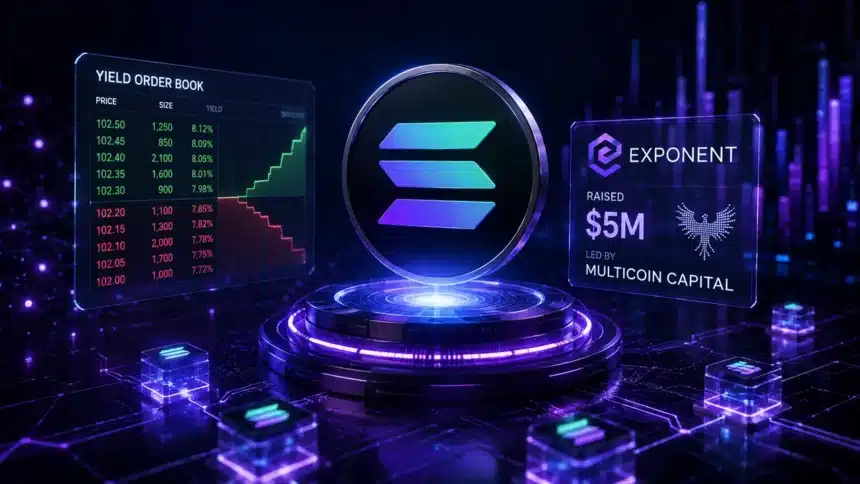
Exponent, a Solana based yield exchange that allows users to trade variable yield exposure into fixed rate or leveraged yield positions, has raised $5 million in seed funding led by Multicoin Capital. The round included participation from Solana Ventures, RockawayX, L1D, Prelude, and Theia Blockchain, along with angel investors including Solana Labs CEO Anatoly Yakovenko and Solana Foundation head of institutional growth Nick Ducoff. The raise brings Exponent’s total funding to $7.1 million, following a previously disclosed $2.1 million round in 2024. Approximately $1 million of the new funding is earmarked for security, including protocol audits and a bug bounty program.
Key Highlights
- Amount raised: $5 million seed round
- Lead investor: Multicoin Capital
- Co investors: Solana Ventures, RockawayX, L1D, Prelude, Theia Blockchain
- Angel investors: Anatoly Yakovenko (Solana Labs CEO), Nick Ducoff (Solana Foundation)
- Total funding: $7.1 million across two rounds
- Platform traction: Over $2 billion in yield volume cleared, 35,000+ users since late 2024
- Security allocation: Approximately $1 million toward audits and bug bounty program
What Exponent Actually Does
Exponent operates as a yield order book on Solana, a financial primitive that does not have a precise analogue in traditional finance but draws on concepts from interest rate swap markets. Users who hold yield bearing positions in Solana DeFi protocols such as staking positions, lending protocol deposits, or liquidity pool shares earn variable yield that fluctuates based on network conditions, borrowing demand, and liquidity levels. Exponent allows those users to lock in a fixed yield rate by selling their variable yield exposure to counterparties who want leveraged exposure to Solana yield rates.
The practical use case is straightforward. A user holding a staking position earning variable yield between 6 and 9 percent annually might prefer the certainty of a locked in 7 percent for a defined period, even if they sacrifice potential upside above 7 percent to get that certainty. On the other side of the trade, a yield buyer who thinks Solana staking yields will rise considerably might want to purchase leveraged exposure to yield rates rather than deploying more capital into the staking position itself. Exponent’s order book matches these two types of participants and clears the trade on chain through Solana’s smart contract infrastructure.
That mechanism is similar in structure to interest rate swap markets in traditional finance, where fixed rate and variable rate borrowers and lenders swap cash flows to achieve their preferred interest rate structure. Interest rate derivatives are among the largest financial markets in the world by notional volume, which is one reason DeFi investors see yield trading as a significant structural opportunity for the on chain economy. As TCB covered in its analysis of how DeFi protocols approach capital efficiency, the maturation of DeFi markets toward more sophisticated risk management tools is a consistent theme in the sector’s development in 2025 and 2026.
The $2 Billion Volume Milestone
Exponent has cleared more than $2 billion in yield volume across more than 35,000 users since launching in late 2024, a traction figure that Multicoin Capital cited in its investment rationale. The volume milestone is significant in context. Yield trading protocols on Ethereum, particularly Pendle Finance, established that a meaningful market exists for tokenized yield exposure. Exponent is attempting to replicate and improve on that model on Solana, where transaction fees are lower and throughput is higher, enabling more frequent rebalancing and smaller minimum trade sizes that can attract retail participants alongside larger institutional yield traders.
The $2 billion in volume across 35,000 users implies an average yield trade size of approximately $57,000, suggesting the current user base skews toward sophisticated DeFi participants rather than retail yield farmers. The planned platform update following the seed raise is designed to expand the addressable market downward by lowering minimum trade sizes and simplifying the user interface for participants who want fixed yield exposure without understanding the full mechanics of the yield order book. As TCB reported when covering Solana’s DeFi ecosystem expansion in 2026, protocol level improvements in user experience have been a consistent driver of adoption across Solana based DeFi applications throughout the year.
Why Multicoin Led the Round
Multicoin Capital has been one of the most consistent institutional advocates for Solana as a DeFi execution environment, having invested in Solana itself and in multiple Solana native protocols at early stages. The firm’s investment thesis centers on the view that high throughput, low fee blockchains enable DeFi use cases that are economically impossible on higher cost networks. Yield trading is a strong example of that thesis: executing frequent yield position adjustments on Ethereum mainnet at $5 to $20 per transaction is economically inefficient for positions below a certain size threshold. On Solana at sub cent transaction fees, the same rebalancing activity becomes viable for much smaller position sizes and much more frequent adjustment cycles.
Multicoin’s decision to lead the Exponent round also reflects a broader portfolio view. The firm has backed multiple Solana DeFi protocols across the liquidity, lending, and derivatives categories. A yield trading platform that can attract liquidity from staking positions, lending protocol deposits, and liquidity pool shares adds a connecting layer between these existing Solana DeFi applications, potentially increasing the velocity of capital movement across the Multicoin portfolio of Solana investments.
The involvement of Anatoly Yakovenko and Nick Ducoff as angels provides additional strategic validation. Both bring relationships with Solana native protocol teams and institutional counterparties that could support Exponent’s efforts to attract large liquidity providers to the yield order book. As TCB analyzed when covering the evolution of DeFi total value locked in 2026, the protocols that have grown fastest are those with strong backing from ecosystem participants who can coordinate liquidity from multiple existing protocols into new primitives.
The Security Allocation
Exponent’s decision to allocate $1 million of the $5 million raise to security is notable in the context of the DeFi security landscape in 2026. Smart contract exploits have cost DeFi protocols billions of dollars over the past four years, and the pattern has consistently shown that protocols handling significant user funds with inadequate audit coverage face substantially higher exploit risk. Dedicating 20 percent of a seed raise to security audits and bug bounty programs is an above average commitment for an early stage protocol, and it signals that the team is prioritizing security as a foundation for growth rather than deferring security investment until after growth is established.
Bug bounty programs in particular are an effective complement to formal audits because they engage a distributed network of security researchers who probe the system from outside the development team’s perspective. The combination of formal audits from established firms and a standing bug bounty that pays for discovered vulnerabilities creates multiple independent layers of security review. For a protocol where users are depositing yield bearing positions that represent real economic value, that multi layer approach is the responsible standard. As TCB reported when covering the collapse of DeFi protocols due to security failures in the past, protocols that invested adequately in pre launch security have a substantially better track record than those that treated security as an afterthought.
The TCB View
Exponent’s raise is a high quality signal for the maturation of Solana DeFi. Multicoin Capital leading a yield trading round with Anatoly Yakovenko as an angel is not a speculative bet on a new token. It is institutional capital backing a specific DeFi primitive, yield order book trading, that has proven market demand through $2 billion in actual volume and that addresses a genuine capital efficiency problem for Solana DeFi participants. The security allocation reinforces the signal: this is a team building infrastructure, not farming attention. The question for Exponent’s next phase is whether the planned platform simplification brings the protocol’s user base from 35,000 sophisticated traders to a broader retail audience. If the yield order book mechanic can be packaged accessibly enough for participants who just want stable, predictable yield on their Solana holdings, the addressable market expands by an order of magnitude.
Free Daily Briefing
Get the Daily Briefing
Crypto, AI, and Web3 intelligence. Free, every day.
The Daily Brief by TCB
Crypto, AI & finance intelligence in 5 minutes. Every weekday morning. Free.