
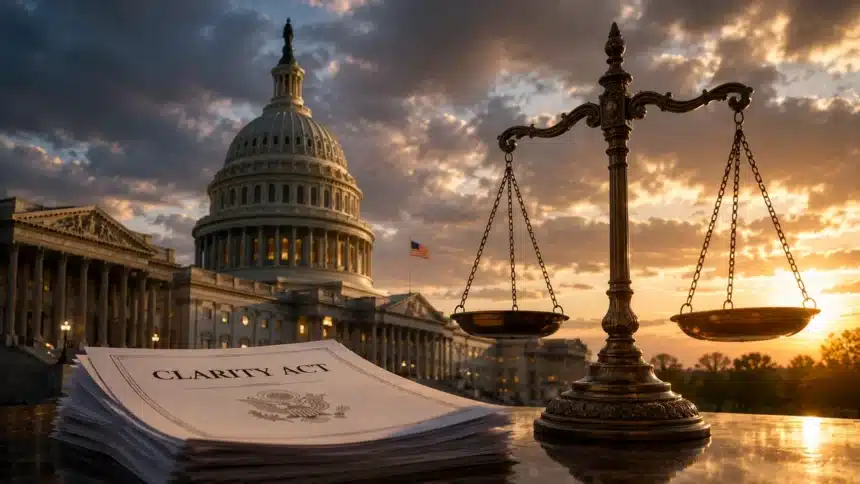
The Digital Asset Market CLARITY Act cleared the Senate Banking Committee on May 14, 2026, passing along party lines in a markup vote that moved the bill closer to the Senate floor but did not resolve the most important obstacle between the legislation and enactment. Republicans held their 53-vote coalition together at the committee level without Democratic support. On the full Senate floor, the bill faces a 60-vote threshold to overcome a filibuster. That means bill architects need at least 7 Democratic votes. As of May 16, no Democratic senator has publicly committed to supporting the bill on the floor, and the ethics provision gap that Democrats flagged throughout the markup remains unresolved in the legislative text.
Key Highlights
- Committee vote date: May 14, 2026, Senate Banking Committee
- Result: Passed on party lines. No Democratic votes in committee
- Senate floor threshold: 60 votes needed to overcome filibuster
- Republican seats: 53. Democratic votes needed: at least 7
- White House target: July 4, 2026 signing ceremony
- Key blocker: Ethics provision gap for senior officials holding crypto assets while regulating the industry
- Polymarket odds: 62 percent probability of passage in 2026 as of May 16
The Ethics Provision: The Hinge Point for Democratic Votes
The Senate Banking Committee advanced the CLARITY Act’s 309-page legislative text without any provision restricting senior government officials who hold significant crypto assets from participating in the regulation of the industry. Democrats filed multiple amendments on the issue during the May 14 markup. All failed on party line votes. Senator Kirsten Gillibrand, one of the bill’s original cosponsors, stated publicly at the Consensus 2026 conference in Miami that the bill cannot advance to a floor vote without an ethics provision that addresses the conflict of interest question.
The ethics concern is politically potent because it does not require voters to understand crypto regulation to grasp its significance. Multiple senior administration officials have accumulated crypto holdings worth hundreds of millions of dollars in some cases. Several of those officials are directly involved in setting the regulatory framework for the industry their holdings are in. Whether or not the underlying CLARITY Act’s market structure provisions are sound and well designed, the optics of regulating an asset class while holding large personal stakes in it creates a narrative that Democrats can use to justify withholding their floor votes.
The smart path for bill supporters is a narrow ethics provision that brings one or two Democrats across without reopening the market structure or stablecoin titles that have already been negotiated. As TCB analyzed in its earlier piece on the CLARITY Act’s committee passage and implications for Bitcoin, Ethereum, and XRP, the bill’s core provisions on commodity classification and developer liability are well designed and have genuine bipartisan substantive support. The ethics issue is a structural and political problem, not a substantive disagreement about crypto market design.
The Timeline Math
The White House target of a July 4, 2026 signing ceremony is approximately seven weeks away from the committee passage date. That timeline is aggressive for major financial legislation. The bill must clear floor scheduling on the Senate calendar, survive a 30-hour debate period after a cloture vote, pass the full Senate, clear a House reconciliation process if the House version differs from the Senate version, and proceed to a White House signing. Each step introduces potential delays.
Senate Majority Leader John Thune has indicated the CLARITY Act is a floor priority for late May or early June. But Senate floor scheduling is subject to disruptions from must pass appropriations votes, judicial confirmation priorities, and other legislation competing for floor time. The July 4 target was set in late 2025 as a symbolic deadline to demonstrate pace on a crypto regulation agenda that began in earnest after the November 2024 election. Whether it is achievable depends on the pace of bipartisan negotiation on the ethics provision in the two to three weeks following committee passage.
If the ethics provision is resolved through a floor amendment process rather than pre negotiated language in the bill, the floor debate becomes more complex. Amendments during floor debate require additional time and introduce the possibility of reopening other provisions that have been painstakingly negotiated between committee staff and industry representatives. The cleanest outcome for bill supporters is a pre negotiated ethics provision incorporated into the bill before it reaches the floor, removing the need for a floor amendment process and giving Democratic supporters a clear commitment they can point to when justifying their floor votes to constituents.
Which Democrats Might Cross Over
The seven or more Democratic votes needed for 60 are most likely to come from senators in states with significant financial services industries who have historically supported financial innovation legislation, senators who have received political support from crypto industry groups and donors, and senators in competitive states where younger voter cohorts who hold crypto assets are politically meaningful constituencies.
Several Democratic senators in the northeast and west coast have engaged substantively with crypto regulation issues throughout the 119th Congress without committing to the CLARITY Act specifically. Their public statements have consistently cited the ethics provision as the primary obstacle rather than objections to the bill’s market structure provisions. That framing is meaningful. It suggests a vote is available if the ethics question is addressed, rather than a fundamental substantive opposition that no ethics fix could resolve.
Senator Mark Warner of Virginia has engaged most substantively with the bill’s stablecoin provisions and has indicated openness to a bipartisan approach if the ethics issues are resolved. Senator John Hickenlooper of Colorado, whose state has a significant crypto mining and fintech ecosystem, has also engaged with CLARITY Act provisions without committing to a floor vote. Neither has made a definitive public statement, but their engagement patterns suggest they are potential yes votes rather than firm nos. As TCB covered when reporting on the ethics provision as the key variable for Democratic support, the political calculus for moderate Democrats is that supporting a well designed crypto regulatory framework is defensible, but supporting it with a visible conflict of interest problem unresolved is a political vulnerability.
What Happens If the Floor Vote Fails
A floor vote failure would not kill the CLARITY Act permanently but would sharply damage its 2026 prospects. The Senate calendar after a failed cloture vote rarely brings the same legislation back for a second attempt within the same legislative year. If the CLARITY Act fails to achieve 60 votes in May or June, the next realistic opportunity for a comprehensive crypto market structure law is the 120th Congress beginning in January 2027, following the November 2026 midterm elections.
The market implications of a floor failure would be negative but probably not severe. Bitcoin and the wider crypto space have already priced in a CLARITY Act passage probability of approximately 62 percent according to Polymarket. A failure would remove the regulatory tailwind from market pricing without removing the underlying institutional infrastructure that has been built independent of the legislation. ETF products exist, Charles Schwab has launched spot trading, and institutional custody infrastructure is in place regardless of what Congress does. The legislation matters for the marginal institutional capital that has been waiting for statutory clarity before committing. A floor failure delays that capital’s entry but does not eliminate the eventual pathway for it.
The TCB View
The CLARITY Act’s path from committee passage to enactment is narrower than the market’s 62 percent probability estimate suggests. Seven Democratic votes in a partisan environment with an unresolved ethics conflict is a high bar that requires active negotiation, not passive waiting. The bill’s architects have approximately three weeks before the floor scheduling window opens to resolve the ethics provision in a way that gives Democratic senators a defensible justification for a yes vote. If they use that time well, the July 4 deadline is achievable. If they spend it arguing that the ethics issue does not require a legislative fix, they will lose the floor vote and blame the Democrats for an outcome that was preventable. The provision is fixable. The question is whether the political will exists to fix it before it becomes a permanent obstacle.
Free Daily Briefing
Get the Daily Briefing
Crypto, AI, and Web3 intelligence. Free, every day.
The Daily Brief by TCB
Crypto, AI & finance intelligence in 5 minutes. Every weekday morning. Free.