
Last updated: 27 June 2026
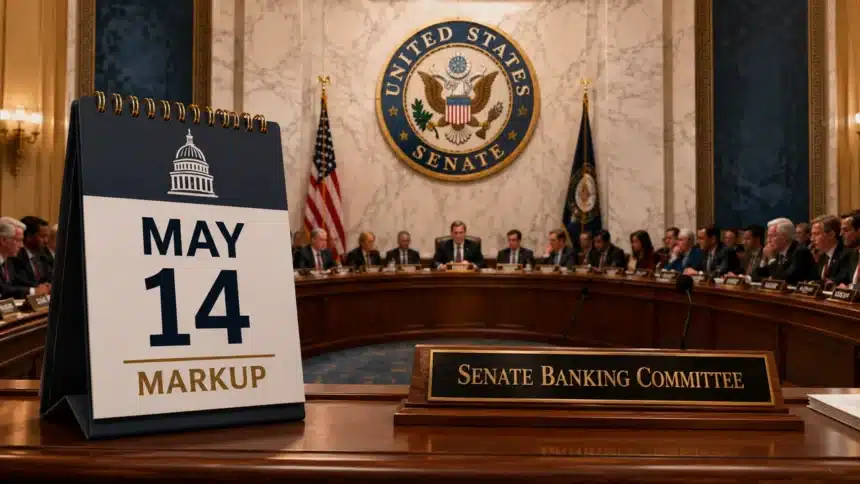
The Senate Banking Committee confirmed on May 9, 2026 that it will hold a markup session for the Digital Asset Market Clarity Act on May 14. The announcement ends weeks of stalled negotiations and puts the most significant crypto legislation in US history one step closer to a full Senate floor vote.
Key Highlights
- Markup date confirmed: May 14, 2026 at the Senate Banking Committee
- Bill name: Digital Asset Market Clarity Act of 2025 (also known as the Clarity Act)
- Key breakthrough: A stablecoin yield compromise between Senators Tillis and Alsobrooks cleared the last major roadblock
- Industry backing: Coinbase and Circle publicly endorsed the deal and urged the committee to advance the bill
- White House target: The administration has been pushing for a signed bill by July 4, 2026
What Triggered the Markup Date
The Clarity Act had been stuck in the Senate Banking Committee for months, primarily over one issue: whether crypto firms could offer yield or rewards on stablecoin balances. That dispute broke open in early May when Senators Thom Tillis of North Carolina and Angela Alsobrooks of Maryland reached a compromise.
The new legislative text prohibits covered parties from paying interest or yield on stablecoin balances directly. However, the restriction does not apply to rewards tied to what the bill calls bona fide activities or bona fide transactions. In plain terms, stablecoin issuers cannot simply pay holders for holding. But they can reward users for actual on chain activity, payments, and other economic actions distinct from bank style interest.
Coinbase and Circle, two of the largest players in the US crypto market, immediately backed the deal. Their public endorsement removed the biggest source of industry friction that had slowed the bill’s progress throughout April. As TCB reported, the Clarity Act fundamentally reshapes how digital assets are classified between the SEC and CFTC and sets the rules for who can issue stablecoins legally in the United States.
What Happens at a Markup
A markup is the formal legislative process where a committee reviews a bill line by line, considers amendments, and votes on whether to advance it to the full chamber. It is not a final vote. If the Senate Banking Committee approves the Clarity Act on May 14, the bill moves to the Senate floor for a broader debate and another vote.
Reaching the markup stage is meaningful. It signals that the committee chair believes there are enough votes to move the bill forward and that the major objections have been resolved or at least contained. The crypto industry has been lobbying aggressively for this moment since the House passed its version of the market structure legislation in 2025.
The Senate version differs from the House version on several points, including the treatment of decentralized protocols and the threshold at which a digital asset is classified as a commodity versus a security. Those differences would need to be reconciled in a conference process if both chambers pass their respective versions.
The Stablecoin Yield Compromise in Detail
The yield question was politically charged because it sits at the intersection of banking regulation and crypto innovation. Traditional banks are prohibited from paying above market interest to depositors in ways that could destabilize the financial system. Critics of stablecoin yield argued that allowing crypto issuers to pay holders unlimited returns would undercut banks and create systemic risk.
The Tillis Alsobrooks compromise threads that needle. Stablecoin issuers cannot function as unlicensed banks by paying passive interest. But they retain the ability to build reward programs that incentivize users to spend, transact, and participate in their ecosystems. That distinction matters enormously for companies like Circle, whose USDC underpins large parts of the DeFi economy.
The stablecoins sector has grown rapidly in 2026. Total stablecoin market capitalization has crossed $250 billion, with USDC and USDT together accounting for the majority of circulating supply. The Clarity Act would create a federal licensing framework for stablecoin issuers, requiring them to hold reserves in approved assets and submit to regular audits. For context, tokenized US Treasuries on Ethereum alone crossed $8 billion in early 2026, illustrating how quickly on chain financial infrastructure is scaling.
What the Industry Is Watching
Several issues remain unresolved heading into the markup. Consumer protection provisions around wallet disclosures are still being negotiated. The treatment of algorithmic stablecoins, which triggered the Terra collapse in 2022, is addressed in the bill but remains a point of contention among senators who want stricter bans versus those who prefer lighter oversight.
Developer liability is another sensitive area. The bill includes provisions that would shield protocol developers from liability for how third parties use their code, similar to protections that exist in other areas of technology law. Critics argue those protections are too broad. Supporters say without them, developers will continue building outside the United States.
The White House has set an ambitious July 4 deadline for a signed bill. Getting from a committee markup on May 14 to a signed law within seven weeks would require the Senate to pass its version quickly, the House to agree to any Senate changes without a conference, and the President to sign it. That timeline is aggressive but not impossible if the markup goes smoothly. As TCB has tracked, the White House July 4 target for the Clarity Act reflects real political will at the top of the administration to get this done in 2026. May 14 is the first real test of whether that will translates into votes.
What Passes on May 14 Is Not the Final Bill
One common misconception worth addressing: a successful markup does not mean the Clarity Act becomes law. It means the Senate Banking Committee sends the bill to the full Senate floor with a favorable recommendation. A full Senate vote, then reconciliation with the House version, then a presidential signature would all still need to follow.
Each step carries its own political risk. The full Senate could attach amendments that the House refuses to accept. House Republicans and Senate Democrats could dig in on the jurisdiction question between the SEC and CFTC. What makes May 14 significant is not that it ends the process. It is that it proves the process has not collapsed. A crypto market structure bill has been in legislative purgatory for four years. Getting it out of committee is the most meaningful milestone the industry has hit in that entire period. The AI driven financial infrastructure that Web3 companies are building increasingly depends on regulatory clarity to attract institutional capital and talent. May 14 is where that clarity either starts to materialize or stalls again.
The TCB View
The Clarity Act markup date is the most consequential development in US crypto policy in 2026. Not because the bill is perfect. It is not. The yield compromise is a workaround, not a clean answer. The developer liability provisions will be challenged in court. The jurisdictional split between the SEC and CFTC will generate years of regulatory disputes.
But the alternative is more of what the industry has lived through for four years: enforcement first regulation that treats every new product as a presumptive securities violation and leaves founders guessing which agency will sue them first. The Clarity Act, imperfect as it is, gives the market something it desperately needs: a set of written rules. May 14 is the first real test of whether the political will to provide those rules is actually there when the votes are counted.