
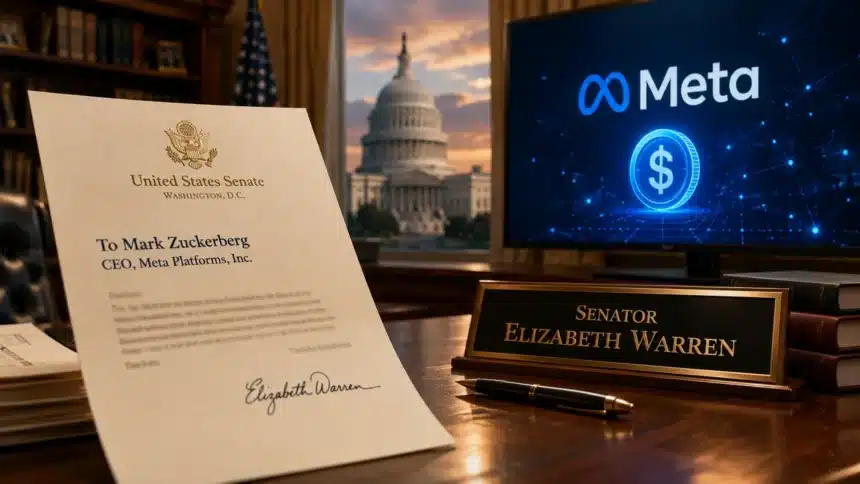
Senator Elizabeth Warren sent a letter to Meta CEO Mark Zuckerberg on May 6, 2026, demanding answers about the company’s stablecoin plans. The letter, which Warren described as prompted by Meta’s lack of transparency, gives Zuckerberg until May 20 to respond to seven specific questions about privacy, financial stability, illicit finance, and whether Meta intends to issue its own currency.
- Trigger: Meta rolled out a stablecoin pilot on Facebook paying selected creators in USDC in the Philippines and Colombia
- Sender: Senator Elizabeth Warren (D Massachusetts)
- Recipient: Mark Zuckerberg, Founder, Chairman, and CEO of Meta
- Deadline: May 20, 2026 for responses to seven detailed questions
- Warren’s core concern: Meta’s 3.5 billion user base makes any stablecoin activity a potential systemic financial risk
What Set Warren Off
Meta began a limited stablecoin pilot on Facebook in April 2026, paying a group of selected content creators in USDC. The payments were routed through MetaPay and took place primarily in the Philippines and Colombia. Meta described the pilot as an experiment with third party stablecoin payment rails rather than the launch of a Meta issued currency.
That distinction did not satisfy Warren. In her letter, she called Meta’s conduct troubling and characterized the company’s communication with Congress as lacking transparency. Warren has been one of the most consistent critics of Big Tech moving into financial services, and Meta’s history with digital payments makes her especially skeptical. In 2019, Meta then called Facebook announced the Libra stablecoin project to enormous backlash from regulators globally. Libra was rebranded to Diem, scaled back repeatedly, and eventually abandoned in 2022 after regulators in the US and Europe made clear they would not approve it.
The new pilot is structurally different. Meta is not issuing its own stablecoin. It is integrating USDC, issued by Circle, into its payment infrastructure. But Warren’s letter suggests she views the distinction as less meaningful than Meta does. If 3.5 billion users can send and receive USDC through Facebook and Instagram without fully understanding what they are using, the systemic implications could be similar to a Meta issued coin in practice.
The Seven Questions
Warren asked Zuckerberg to provide detailed answers to seven questions by May 20. The questions address whether MetaPay will be modified to allow users to hold stablecoins as a balance; what privacy guardrails exist for stablecoin transaction data; what controls Meta has implemented to prevent illicit finance and sanctions violations; what disclosures are made to users in pilot markets about the nature of USDC; whether Meta has coordinated with federal financial regulators; what Meta’s long term plans are for stablecoin integration across its platforms; and whether Meta will commit to never issuing its own stablecoin or product that acts as a private currency.
That last question is the most politically significant. Warren is asking Meta to make a binding public commitment not to create a private currency. Meta is unlikely to give that answer in a Senate letter, which means the response, if it comes, will probably be carefully worded around current plans rather than future ones. Meta told reporters that there is no Meta stablecoin and that the company wants people and businesses to pay the way they want on its platforms, which may include through third party stablecoins. That framing positions Meta as a neutral payment infrastructure provider rather than a financial institution.
Why Timing Matters
Warren’s letter arrived one day before the Senate Banking Committee announced its May 14 markup date for the Clarity Act. That timing is almost certainly not coincidental. As TCB has reported, the Clarity Act includes a stablecoin licensing framework and Warren has been one of the most vocal critics of the bill’s consumer protection provisions.
By raising questions about Meta’s stablecoin activity in the days before the markup, Warren is effectively arguing that the Clarity Act’s framework is insufficient to handle the specific risks posed by large technology companies integrating stablecoins into social media platforms. Her implicit argument is that Facebook is not Circle. The systemic risk of a social network with 3.5 billion users becoming a de facto financial platform is categorically different from a standalone stablecoin issuer operating under a dedicated license.
Whether legislators will add Big Tech specific provisions to the bill before the markup is unclear. The crypto industry’s main lobbying effort is focused on getting the bill through markup with minimal changes. Adding new restrictions targeting technology platforms at this stage would complicate that effort sharply and could introduce new political coalitions opposed to the bill’s overall passage. As TCB tracked, the July 4 deadline the White House has set for the Clarity Act means this legislative pressure will peak in the next two months.
The Libra Shadow
Any discussion of Meta and stablecoins cannot escape the shadow of Libra. Meta’s 2019 announcement of a global stablecoin backed by a basket of currencies triggered a genuinely coordinated regulatory response across multiple jurisdictions. US Senate hearings were contentious. European regulators announced they would block Libra before it launched. The project was eventually restructured as Diem and then sold to Silvergate Bank in early 2022, effectively dissolving.
The failure of Libra is important context because it demonstrates that regulators have already proven their willingness to block a Meta payment product when they deemed it too risky. The current USDC pilot is smaller and structurally more conservative. But the underlying concern, which is that Meta’s scale turns any payment product into a systemic risk, has not changed since 2019. Warren is making the same argument that regulators made then, updated for a slightly different product configuration.
The TCB View
Warren’s letter is not primarily about the Meta USDC pilot. The pilot is small, limited to a handful of markets, and involves a regulated stablecoin rather than a Meta created currency. The letter is about positioning ahead of the Clarity Act markup. Warren wants the bill to be stronger on consumer protection and wants Big Tech’s entry into financial services to be subject to stricter oversight than the current draft provides.
Whether she succeeds in moving the bill depends on whether other senators share her concerns about platform stablecoins specifically. The crypto industry’s main lobbying effort is focused on getting the bill through markup with minimal changes. Adding new Big Tech restrictions at this stage would complicate that effort considerably. But Warren has shown repeatedly that she is willing to use every procedural tool available to slow legislation she opposes. The May 14 markup will be more contentious than the industry is hoping for.
Free Daily Briefing
Get the Daily Briefing
Crypto, AI, and Web3 intelligence. Free, every day.
The Daily Brief by TCB
Crypto, AI & finance intelligence in 5 minutes. Every weekday morning. Free.