
Key Highlights
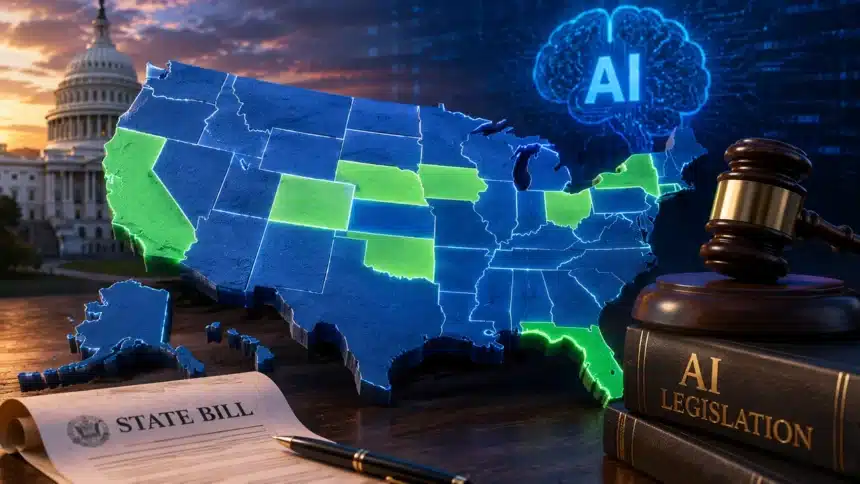
- At least ten US states advanced or enacted significant AI legislation in the week of May 4 to 8, 2026, including Connecticut, Iowa, Idaho, Utah, Oregon, and Kansas
- Connecticut sent SB 5, one of the most comprehensive state AI bills in the country, to Governor Lamont for signature
- Iowa Governor Kim Reynolds signed SF 2417, a chatbot safety bill, into law on May 2
- Idaho enacted four AI laws effective July 1, 2026, covering education, social media addiction, chatbot safety, and synthetic media
- Utah passed nine AI bills in a single legislative session, the largest single-state AI legislative output in the country so far this year
US states are not waiting for Congress. In the week of May 4 to 8, 2026, at least ten states either passed, signed, or sent to their governors some of the most significant AI legislation in American history. The laws address chatbot safety for minors, deepfake protections, algorithmic pricing restrictions, healthcare AI transparency, and the use of AI-generated synthetic media in crimes ranging from child exploitation to political manipulation. The legislative wave is moving faster than any federal AI framework and is producing a patchwork of requirements that AI companies operating nationally will need to navigate simultaneously.
The state-level AI legislation surge is happening in a context where Congress has failed to pass comprehensive federal AI regulation for three consecutive years. The Federal AI Act, which the Biden administration proposed in 2024 and the current administration has not advanced, remains in committee. In the absence of federal preemption, states are filling the regulatory vacuum with their own frameworks, and the rate of activity has accelerated sharply in 2026 as the real-world harms from unregulated AI systems have become more visible and politically salient.
Connecticut SB 5: The Most Comprehensive Bill
Connecticut’s SB 5, which the state legislature sent to Governor Ned Lamont on May 6, is the most expansive state AI bill passed this year and is being closely watched as a potential model for federal legislation. The bill establishes requirements across five distinct areas: AI system transparency, chatbot consumer disclosures, whistleblower protections for AI safety concerns, oversight mechanisms for high-risk AI systems in employment and housing, and requirements for human review of consequential AI decisions affecting state residents.
The transparency provisions require covered AI systems, defined broadly as systems that make or materially influence decisions affecting Connecticut residents, to disclose that they are AI systems when interacting with consumers, to provide explanations for automated decisions upon request, and to maintain audit logs sufficient for post-hoc regulatory review. The disclosure requirement applies to chatbots, recommendation systems, and automated decision tools used in hiring, lending, insurance, and healthcare contexts.
The whistleblower provision is the most novel element of SB 5. The law protects employees at AI companies from retaliation for reporting safety concerns to Connecticut regulators or to federal agencies, extending existing whistleblower protections into the AI sector in a way that no other state law has yet done. AI safety reporting mechanisms have been a persistent gap in the regulatory landscape, and Connecticut’s approach creates a legal pathway for insiders to surface safety concerns without risking their employment.
The bill’s scope triggers concern among AI companies about compliance costs. A company that offers a consumer-facing product to Connecticut residents would need to implement disclosure infrastructure, explanation generation, audit logging, and human review pathways for all covered decisions. For large AI platforms, those requirements are technically feasible but require significant engineering investment. For smaller AI startups, the compliance burden could be prohibitive. The compliance cost concern has been the primary industry objection to state-level AI regulation, and it is more acute for SB 5 than for most other state bills this year.
Iowa’s Chatbot Safety Law
Iowa’s SF 2417, signed by Governor Kim Reynolds on May 2, is narrower than Connecticut’s SB 5 but addresses a more specific harm with more precise requirements. The law establishes standards for conversational AI services, specifically chatbots that interact with consumers in sales, customer service, or informational contexts, requiring that they disclose their AI nature at the start of any interaction, that they not use deceptive techniques to create the impression of human communication, and that they provide a pathway to human customer service upon request.
The law includes an exception for entertainment and creative applications where the AI nature is contextually obvious, and for internal enterprise tools where the users are employees who are aware they are interacting with an automated system. The scope is effectively consumer-facing chatbots deployed by businesses operating in Iowa, which covers a significant portion of the major customer service and sales chatbot deployments from insurance companies, banks, retailers, and telecommunications providers.
Iowa’s approach reflects a more conservative regulatory philosophy than Connecticut’s: address specific visible harms with precise requirements rather than building comprehensive oversight frameworks that span multiple industries. The deceptive AI communication harm is well-documented and politically salient following several high-profile cases where consumers were misled by chatbots about product terms, refund policies, and service availability. The documented cases of consumer harm from deceptive chatbots gave the Iowa bill’s sponsors clear legislative rationale that resonated across party lines.
Idaho’s Four-Bill Package
Idaho took a different approach, passing four separate AI bills that each address a distinct application area rather than attempting comprehensive coverage in a single omnibus law. The four bills, all effective July 1, 2026, cover generative AI in public education, social media addiction by design, conversational AI safety, and synthetic media in video voyeurism cases.
The education bill requires public schools to adopt policies for student AI tool use, mandates that teachers receive AI literacy training, and prohibits the use of AI-generated content in student assessments without disclosure. The social media addiction bill addresses a harm that is partially AI-driven: the algorithmic recommendation systems that optimize for engagement in ways that create compulsive use patterns. The bill imposes requirements on social media platforms operating in Idaho to provide users with non-algorithmic content options and to disclose how their recommendation systems work.
The synthetic media bill is the most novel of Idaho’s four laws. It extends existing video voyeurism statutes to cover AI-generated or AI-manipulated synthetic media, including deepfakes, that depict individuals in sexually explicit contexts without their consent. The law creates criminal liability for the creation, distribution, and possession of non-consensual synthetic sexual images, closing a gap in Idaho’s existing law that previously covered only recordings of actual events. Non-consensual deepfake laws have been advancing in more than 30 states since 2024, and Idaho’s legislation follows the pattern of adding synthetic media explicitly to existing criminal statutes rather than creating new stand-alone offenses.
Utah’s Nine-Bill Sprint
Utah passed nine AI-related bills in a single legislative session, the largest single-state legislative output on AI recorded in 2026. The bills span an unusually broad range: restrictions on cellphone use in schools, deepfake protections with provenance data requirements for synthetic media, age verification for harmful digital content, AI instruction requirements in public schools, mental health chatbot safety standards, healthcare AI transparency requirements, and algorithmic pricing limitations in certain consumer markets.
The provenance data requirement in Utah’s deepfake protection bill is technically significant. The law requires that AI-generated synthetic media include embedded provenance data, cryptographic metadata indicating that the content is AI-generated, before publication or distribution in commercial contexts. This approach aligns with the Content Authenticity Initiative’s technical standards and is more sophisticated than laws that rely solely on disclosure requirements at the point of distribution. Provenance data embedding is supported by the major AI image and video generation platforms, making Utah’s requirement practically implementable rather than aspirational.
The algorithmic pricing limitation is the most economically significant of Utah’s nine bills. The law restricts the use of AI systems to coordinate pricing in certain consumer markets, targeting a practice where competing companies use the same algorithmic pricing tool and effectively achieve coordinated pricing outcomes without explicit communication. The practice has been the subject of federal antitrust scrutiny since 2024, and Utah’s legislative approach adds a state-level prohibition that applies independently of federal enforcement. Algorithmic pricing coordination has been documented in rental housing, airline tickets, and consumer electronics, with demonstrable effects on prices paid by consumers.
The Patchwork Problem
The simultaneous passage of materially different AI laws across ten states creates a compliance landscape that is fragmented, inconsistent, and in some areas contradictory. An AI chatbot that complies with Iowa’s disclosure requirements may not satisfy Connecticut’s explanation generation requirements. A synthetic media platform that embeds provenance data per Utah’s technical standard may face different requirements under Maryland’s or Virginia’s deepfake laws. A healthcare AI system that meets Connecticut’s human review requirements may face additional disclosure requirements under Washington’s healthcare AI transparency bill.
For large AI companies with national footprints, the compliance cost of the patchwork is significant but manageable. The companies that are most affected are mid-size AI startups that deploy consumer-facing products nationally but lack the compliance engineering resources to track and implement requirements across 50 different state regulatory frameworks. The compliance burden argument is structurally similar to the argument that drove federal preemption of state privacy laws, which eventually produced the Federal Privacy Act in 2025. The same pressure is building for AI regulation, and the state legislative wave may accelerate federal action by creating the conditions for industry to demand preemption.
The TCB View
Ten states acting on AI legislation in a single week is the clearest signal yet that the political will to regulate AI has outpaced the technical understanding of what effective AI regulation requires. Most of the bills passed this week are directionally correct: chatbot deception is a real harm, non-consensual deepfakes are a real harm, and opaque automated decisions affecting employment and housing are a real harm. The laws addressing these harms will provide genuine protection to residents of the states that passed them. The more difficult question is whether the regulatory patchwork these laws are creating will be net positive or net negative for AI development in the United States. US AI competitiveness relative to China and the EU depends partly on whether the regulatory environment encourages deployment of beneficial AI systems or creates compliance friction that slows adoption uniformly. A federal framework with clear preemption authority would allow states to experiment while providing a ceiling that prevents the patchwork from becoming prohibitive. The window for that framework is narrowing as the patchwork grows.
Free Daily Briefing
Get the Daily Briefing
Crypto, AI, and Web3 intelligence. Free, every day.
The Daily Brief by TCB
Crypto, AI & finance intelligence in 5 minutes. Every weekday morning. Free.