
Last updated: 20 May 2026
Key Highlights
- Animoca Brands co-founder Yat Siu has publicly called 2026 the “Year of Utility” for AI agents in Web3
- Uniswap v4 and PancakeSwap have integrated open source AI agent hooks monitoring thousands of liquidity pools across eight or more blockchains
- Animoca Minds enables consumers to deploy AI agents through familiar tools including Telegram and email
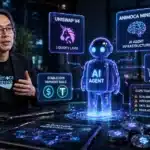
Animoca Brands co founder Yat Siu argued in April 2026 that this year would be remembered as the “Year of Utility” for AI agents in Web3, the moment when autonomous software transitioned from novelty to functional infrastructure. The claim deserves examination beyond the conference circuit. Platforms including Uniswap v4 and PancakeSwap have integrated AI agent hooks that monitor thousands of liquidity pools across eight or more blockchains simultaneously. Animoca Minds, the company’s new AI agent platform, now allows consumers to deploy autonomous agents via Telegram and email without technical expertise. The velocity of that infrastructure buildout is real, even if the utility thesis remains unevenly distributed.
Key Highlights
- Animoca Brands co founder Yat Siu has publicly called 2026 the “Year of Utility” for AI agents in Web3
- Animoca Minds, launched in partnership with Ethoswarm, enables consumers to deploy AI agents through familiar tools including Telegram and email
- Uniswap v4 and PancakeSwap have integrated open source AI agent hooks monitoring thousands of liquidity pools across eight or more blockchains
- Stablecoins are emerging as the payment layer of choice for agent to agent commerce, with Animoca building dedicated payments infrastructure
- An estimated 100 billion AI agents could eventually operate autonomously on blockchains, per Animoca’s long range projections
- Animoca plans a Nasdaq listing via merger with Currenc Group and is expanding beyond gaming into stablecoins, DeFi, and DePIN in 2026
- Crypto startups in the AI agent category raised $95 million in Q1 2026, led by prediction market and agent infrastructure projects
What AI Agents Actually Do in Web3 Right Now
The AI agent concept in Web3 is specific and distinct from general AI assistant tools. A Web3 AI agent is an autonomous program that holds a blockchain wallet, executes on chain transactions, and makes decisions based on real time data without requiring human approval for each action. The agent’s decision making is determined by the rules it is given and the models it runs, but the execution is autonomous and irreversible.
In practice, this means agents are today performing tasks including automated liquidity provision, yield optimization across multiple DeFi protocols, on chain arbitrage between decentralized exchanges, and execution of structured trading strategies. The Uniswap v4 and PancakeSwap agent integrations allow these programs to monitor pool conditions across eight blockchains simultaneously and rebalance positions in response to price changes without the millisecond latency that manual monitoring would introduce.
The utility is real in this context. An individual liquidity provider managing positions across eight blockchains manually would require constant attention and would inevitably be slower than the bots competing in the same pools. An AI agent eliminates that latency disadvantage and can be parameterized with risk constraints that prevent it from taking actions outside a defined boundary. The same infrastructure that enables on-chain equity governance creates new opportunities for agents to participate in decentralized governance alongside human holders.
Animoca Minds and the Consumer Access Layer
The gap between AI agent capability and consumer access has been the primary adoption barrier. Most AI agent deployments through early 2026 required technical expertise: setting up wallets, funding gas, writing or configuring agent logic, monitoring for failures. That barrier excluded the vast majority of potential users.
Animoca Minds, built with Ethoswarm, abstracts all of that complexity. Users access their agents through Telegram or email. They define goals in natural language. The platform handles wallet creation, gas funding, cross chain routing, and agent monitoring. The user sees outputs and can adjust goals, but does not need to understand the underlying infrastructure.
Yat Siu’s framing of agents as Web3’s “core users” rather than tools for human users is the conceptually interesting shift. If AI agents transact on blockchains autonomously, the economic activity they generate does not require humans to participate in each transaction. The volume could scale to levels that dwarf current human driven on chain activity, but the revenue and utility accrues to the humans who own and direct those agents. That ownership layer is where Animoca is building identity and payments infrastructure.
Stablecoins as the Agent Payment Layer
Agent to agent commerce requires a payment mechanism that is programmable, instant, and does not require human authorization for each transaction. Stablecoins meet all three requirements. Agents can hold USDC, send it, receive it, and use it as collateral in DeFi protocols without requiring a bank account, credit card authorization, or settlement delay.
Animoca is building dedicated stablecoin infrastructure for its agent ecosystem, recognizing that the payment layer is as important as the agent intelligence layer. An AI agent that can reason about the best yield strategy but cannot efficiently move funds to execute it is less useful than a simpler agent with smooth payment capability.
Visa’s stablecoin settlement infrastructure reaching $7 billion in run rate is a parallel development. As institutional settlement moves on chain, the payment rails that AI agents use for commerce become the same rails that traditional financial settlement uses. That convergence creates network effects where agent adoption and institutional adoption reinforce rather than compete with each other.
What the $95 Million in Q1 Fundraising Reflects
DL News reported that crypto startups in the AI agent and prediction market categories raised $95 million in Q1 2026, with deal terms described as “more attractive” to founders than the prior year. That investor appetite reflects a genuine belief that AI agent infrastructure is a category with venture scale returns, not a speculative theme.
The prediction market and AI agent sectors overlap because prediction markets generate structured data that AI agents can use for decision making. An agent that can query on chain prediction markets about probability estimates for specific outcomes, then act on those probability estimates in DeFi positions, is more capable than an agent relying only on price feeds. The funding flowing into both categories simultaneously reflects investor understanding of that synergy.
What the $95 million does not tell you is how many of the funded projects will achieve genuine product market fit. AI agent infrastructure is early, and the gap between working demos and production grade systems handling real user capital is significant. The security vulnerabilities that North Korean hackers exploited in April exist because production grade security is harder to achieve than working functionality. AI agents managing user funds autonomously are a new attack surface, not just a new capability.
The 100 Billion Agent Projection
Yat Siu’s projection that 100 billion AI agents could eventually operate on blockchains is speculative by orders of magnitude. There are roughly 8 billion humans on Earth. A 100 billion agent count would mean roughly 12 agents per human. The math is not inherently impossible, because many agents would operate without direct human assignment, running as autonomous economic participants in their own right.
The more grounded near term projection is that agent counts in the millions or tens of millions are achievable within five years if the infrastructure matures. Even at that scale, the economic activity generated would be substantial relative to current on chain transaction volumes. The macro environment’s effect on crypto market prices is a short term variable. The structural buildout of AI agent infrastructure is a multi year trend that will develop largely independent of interest rate cycles.
Where the Gaps Are
Yat Siu’s “Year of Utility” framing is directionally correct but geographically uneven. The AI agent use cases generating genuine utility today are concentrated in sophisticated DeFi operations where the agent’s speed and 24-hour availability provide measurable edge. Consumer applications like Animoca Minds are launching now but have not yet reached meaningful scale of daily active agents.
The gap between the sophisticated DeFi use case and the consumer use case is significant. DeFi agents operate in an environment designed for automated interaction: programmable protocols, structured data feeds, clear execution rules. Consumer agents operate in a messier environment where the goals are less structured and the failure modes are less predictable. Closing that gap is the actual “Year of Utility” challenge.
Ethereum’s ZK research program is building the scaling infrastructure that will eventually enable agent level transaction volumes at manageable cost. Current gas economics on Ethereum make high frequency agent operations expensive. Layer 2 networks reduce that cost substantially, and ZK enabled Layer 2 solutions reduce it further. The agent utility thesis depends on that infrastructure maturing on a compatible timeline.
The TCB View
Yat Siu is right that something structural is happening in the AI agent space in 2026. The question is whether “Year of Utility” is a description of what has already occurred or a prediction of what will occur by December. As of April 30, the honest answer is that genuine utility exists in a narrow band of sophisticated DeFi applications and is aspirational in the broader consumer applications that Animoca Minds is targeting. That does not make the thesis wrong. It makes it early. The infrastructure being built now, the stablecoin payment rails, the multi chain agent hooks, the consumer access layers, is the foundation that a genuinely agent driven Web3 economy requires. Whether it matures on a 2026 timeline or a 2027 to 2028 timeline depends on how quickly production grade security catches up with production grade functionality. The $95 million in Q1 funding suggests investors believe the timeline is 2026. The North Korean DeFi attacks this month suggest that deployment speed is outrunning security maturity in the broader ecosystem. Both things can be true, and managing that tension is the central challenge for the AI agent category this year.
Get the Daily Briefing
Crypto, AI, and Web3 intelligence. Free, every day.