
Last updated: 19 July 2026
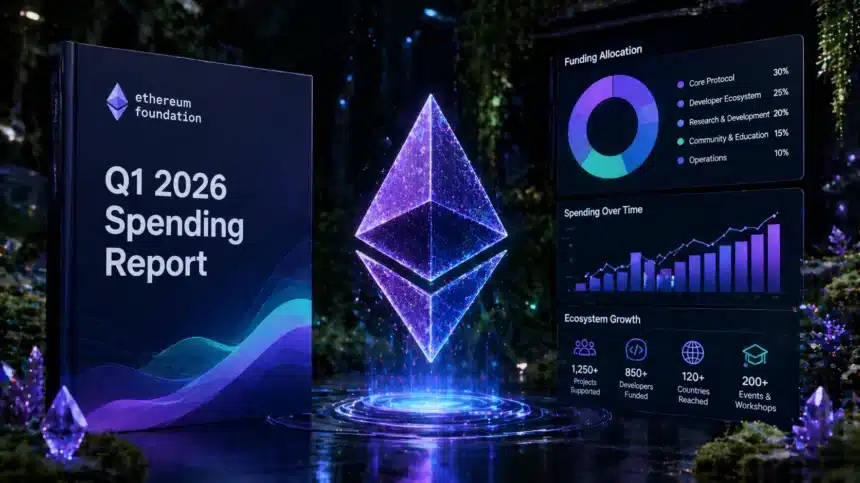
The Ethereum Foundation has finally shed light on its Q1 2026 spending habits with the release of its quarterly allocation report on April 29, 2026, revealing the primary areas of focus for the organization’s financial resources. Cryptography, zero knowledge proofs, security, and protocol research were the top spending priorities. These investments aim to drive Ethereum’s continued growth and adoption.
Key Highlights
- The Ethereum Foundation Q1 2026 allocation was published on April 29, 2026
- Primary spending areas include cryptography, zero knowledge proofs, security, and protocol research
- Active Ethereum validators fell from approximately 976,000 to 919,000 between February and April 2026
- The 0x02 stake share rose from 16 percent to 25 percent during the same period
The Ethereum Foundation published its Q1 2026 allocation update on April 29, 2026. The report confirms continued prioritization of cryptography, zero knowledge proofs, security, and core protocol research as the primary spending categories. It also contains new data on Ethereum’s validator landscape: the active validator count has fallen from roughly 976,000 in February to approximately 919,000, while the share of stake controlled by 0x02 validator types has risen from 16 percent to 25 percent. These are not coincidental numbers. They reflect the structural changes the Foundation is actively funding.
Key Highlights
- The Ethereum Foundation Q1 2026 allocation was published on April 29, 2026
- Primary spending areas: cryptography, zero knowledge proofs, security, and protocol research
- Active Ethereum validators fell from approximately 976,000 to 919,000 between February and April 2026
- The 0x02 stake share rose from 16 percent to 25 percent during the same period, consolidating toward the 128,000 ETH maximum effective balance
- The Foundation’s grant making remains focused on long term protocol infrastructure rather than application layer development
- No major new grant categories were introduced, signaling discipline in research prioritization
- Validator consolidation is consistent with EIP-7251 implementation, which allows maximum effective balances up to 2,048 ETH
What the Foundation Actually Funds
The Ethereum Foundation’s role is frequently misunderstood. It does not build Ethereum applications or invest in DeFi protocols. Its mandate is to fund the research and development that makes the base layer more secure, efficient, and capable. The Q1 2026 allocation reflects that mandate in its spending priorities.
Cryptography and ZK research is the largest sustained category. This covers teams working on ZK EVM implementations, proof system optimization, and the cryptographic primitives that underpin Ethereum’s long term scaling roadmap. ZK proofs are central to how Ethereum will achieve its target of processing hundreds of thousands of transactions per second at the base layer rather than relying entirely on Layer 2 networks.
Security research covers audits, threat modeling, and protocol vulnerability detection. The April 2026 Kelp DAO exploit, which originated in a bridge layer rather than core Ethereum contracts but still disrupted the broader ecosystem, reinforced the case for continued security investment at the protocol level.
The Validator Consolidation Story
The validator count data is one of the most significant operational signals in the Q1 report. Ethereum’s proof of stake system originally required a minimum of 32 ETH to participate in consensus, and that minimum was also the maximum effective balance per validator. Large stakers had to operate thousands of individual validator instances to stake large amounts, creating substantial operational overhead.
EIP-7251, which raised the maximum effective balance from 32 ETH to 2,048 ETH per validator, was implemented in the Glamsterdam upgrade. Its effects are now visible in the data. The 0x02 validator type, which supports the higher balance cap, has grown from 16 percent to 25 percent of total stake in two months. The overall validator count falling from 976,000 to 919,000 reflects larger stakers consolidating many small validators into fewer high balance ones.
The practical effect is twofold. First, the consensus mechanism becomes operationally simpler because fewer validator messages need to be processed per epoch. Second, the barrier for institutional stakers to participate efficiently at scale decreases notably. The bullish case for Ethereum has consistently included institutional staking as a major demand driver, and EIP-7251 makes that path structurally more accessible.
What the Spending Reveals About Ethereum’s 2026 Roadmap
The sustained investment in ZK proofs across multiple consecutive quarters tells a clear directional story. The Ethereum Foundation is betting that ZK technology will mature from experimental to production ready within the next two to three years. That bet has downstream implications for how Layer 2 networks interact with the base layer and for whether Ethereum can absorb considerably more transaction volume without requiring users to choose between security and cost.
The absence of major new grant categories in Q1 2026 is notable. When the Foundation adds new research priorities, it typically signals that a new technical problem has become urgent enough to require dedicated funding. The steady state Q1 allocation suggests the current research agenda is tracking as planned rather than responding to an emergent problem.
Ethereum’s price has been trading in the $2,100 to $2,400 range through most of 2026, well below the $4,000 to $5,000 targets some analysts projected at the start of the year. The protocol development pipeline does not move on price cycles, which is either a feature or a limitation depending on your perspective. The Q1 allocation continues building toward a multi year technical roadmap regardless of where ETH trades in April 2026.
Ethereum Staking in the Institutional Context
Bitmine, a publicly listed entity, added 101,901 ETH in the past week, bringing its total ETH holdings to 5.08 million, approximately 4.21 percent of total ETH supply. Of that holding, 3.7 million ETH are staked and generating approximately $264 million in annualized yield.
That kind of institutional scale staking was not operationally straightforward before EIP-7251. Managing millions of ETH across thousands of validators with 32 ETH maximum balance each created enormous overhead. The consolidation enabled by higher balance caps makes institutional staking at that scale considerably more efficient to operate.
The broader trend of institutional asset platforms integrating ETH yield into their product offerings is consistent with Ethereum becoming a yield generating institutional holding rather than purely a speculative asset. That transition takes years, and the Q1 2026 Foundation allocation is one of the quarterly checkpoints along that path.
What DeFi Builders Take From This Report
For teams building on Ethereum, the Q1 2026 allocation signals two things clearly. First, the ZK scaling roadmap is on track and the Foundation considers it the primary technical priority for the next two to three years. Building infrastructure that is compatible with ZK EVM environments is a safer long term bet than building for the current EVM state. Second, security investment at the protocol layer is sustained, which matters for the trust assumptions that underpin DeFi composability.
The Kelp DAO exploit recovery demonstrated that the DeFi ecosystem has the capital depth to respond to large incidents. The Foundation’s security research spending is aimed at reducing the frequency and severity of those incidents at the protocol layer, even as the bridge and application layers remain the primary attack surface.
The TCB View
The Ethereum Foundation’s Q1 2026 report is not exciting. It is deliberate. The same research priorities as Q4 2025, the same discipline in not chasing application layer trends, the same long horizon bet on ZK cryptography. In a space where narrative cycles are measured in weeks and protocol hype peaks and crashes, the Foundation’s consistency is either frustrating or reassuring depending on what you want from Ethereum. The validator consolidation data is the most actionable signal in the report. Institutional staking infrastructure is getting structurally easier to operate at scale at exactly the moment institutional interest in yield bearing crypto assets is rising. Whether that intersection becomes a price catalyst depends on macro conditions that are currently hostile to ETH’s price prospects. But the groundwork is being laid. The broader infrastructure buildout across AI and crypto is a long term trend that individual quarterly funding reports move slowly and quietly toward. This is one of those reports.