
Last updated: 20 May 2026
Key Highlights
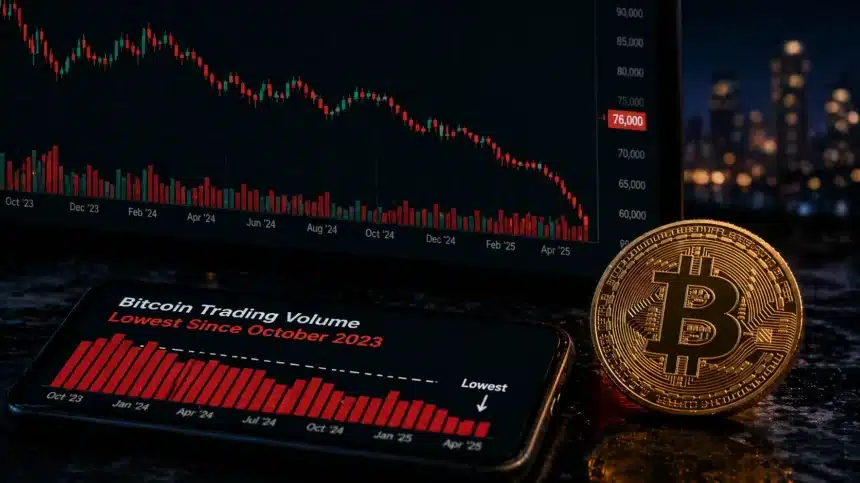
- Bitcoin daily trading volume fell below $8 billion on April 29, 2026, the lowest since October 2023.
- Volume peaked above $25 billion during the February 2026 rally, a 68 percent compression since the peak.
- Binance, Gate.io, and OKX collectively shed $44 billion in monthly spot volume during the April decline.
- Bitcoin spot ETF net outflows of $89.68 million were recorded on April 28.
- The October 2023 volume trough preceded a 390 percent Bitcoin rally over the following 12 months.
Bitcoin’s daily trading volume fell below $8 billion on April 29, 2026, the lowest reading since October 2023. Volume has been declining since hitting above $25 billion during the February 2026 peak, representing a 68 percent compression in market participation over roughly ten weeks. Historically, low volume environments in Bitcoin have preceded sharp directional moves rather than extended sideways periods. The direction of that move depends on which macro catalyst resolves first.
Key Highlights
- Bitcoin daily trading volume fell below $8 billion on April 29, the lowest since October 2023
- Volume peaked above $25 billion during the February 2026 rally, a 68 percent compression since the peak
- Binance, Gate.io, and OKX collectively shed $44 billion in monthly spot volume during the April decline
- Low volume reduces market depth, meaning large orders can move prices by several percent without resistance
- The October 2023 volume trough preceded a 390 percent Bitcoin rally over the following 12 months
- Three macro forces are converging: the Fed meeting, the UAE OPEC exit, and oil above $110
- Bitcoin spot ETF net outflows of $89.68 million were recorded on April 28, breaking a sustained positive inflow trend
What Low Volume Actually Means
Trading volume measures how much Bitcoin is changing hands in a given time period. High volume means many buyers and sellers are actively transacting, which creates deep order books and price stability. Large orders can be absorbed without moving the price dramatically because there are enough counterparties on both sides.
Low volume means the opposite. With fewer active participants, order books become thin. A single large buyer or seller can move the price by several percentage points because there are not enough standing orders to absorb the trade. The result is a market increasingly sensitive to sudden flow shifts in either direction.
Yellow.com data shows Binance, Gate.io, and OKX collectively shed $44 billion in monthly spot volume during the April decline. Those three exchanges represent a substantial share of global Bitcoin spot trading. When their combined volume falls that sharply, it signals that retail and smaller institutional participants have largely stepped to the sidelines.
What Happened in October 2023
The last time Bitcoin volume was this low was October 2023. Bitcoin was trading in the $26,000 to $28,000 range at the time, having retreated from the $31,000 high reached in July 2023. The mood was cautious, with elevated US interest rates and uncertainty about spot ETF approval weighing on the market.
What followed is now well documented. Bitcoin rallied from the October 2023 trough to above $73,000 by March 2024, a 390 percent move over roughly 12 months. The catalyst was the January 2024 approval of US spot Bitcoin ETFs by the SEC, which unlocked billions in institutional demand that had been waiting on the sidelines.
The October 2023 low volume period was not the bottom in itself. It was a consolidation phase that preceded the next structural catalyst. The ETF approval was that catalyst, and the market moved decisively once it arrived. The current low volume may similarly reflect a market in consolidation ahead of the next catalyst rather than a market in structural decline.
The Three Converging Pressures
The volume compression in April 2026 is not happening in a vacuum. Three macro forces have converged simultaneously, and traders are waiting to see how they resolve before committing capital.
First, the Federal Reserve meeting on April 29 is the terminal event of Jerome Powell’s chairmanship. Markets are watching both the rate decision and the language around the transition to his successor. Policy continuity during a leadership change is uncertain by definition, and uncertainty reduces active trading.
Second, the UAE’s OPEC exit introduced fresh geopolitical risk into an already elevated environment. Oil above $110 raises inflation expectations. Higher sustained inflation constrains the Fed’s ability to cut rates. The macro path for 2026 has become materially less clear in the past 48 hours than it was a week ago.
Third, the Bitcoin 2026 conference concluded without producing a clear bullish catalyst. Arthur Hayes’ $125,000 prediction generated headlines but no immediate price action. The institutional presence reinforces long term demand narratives without resolving near term price uncertainty.
The Bearish Reading of Low Volume
Not every low volume trough leads to a rally. There is an alternative interpretation. When volume declines during a period where Bitcoin has failed to break above resistance at $80,000, the low participation may reflect genuine demand exhaustion rather than consolidation. Buyers who wanted exposure have already bought. New buyers are waiting at lower prices. Sellers are trickling into any strength.
In this reading, the bearish scenario outlined by Michael Terpin, a further decline toward $57,000, becomes more plausible if volume stays low. Thin markets break in the direction of sustained selling pressure rather than absorbing it. If macro conditions deteriorate further, the absence of active buyers in the order book means there is limited support to prevent a sharper decline.
The fear and greed dynamics in the current market are not strongly extreme in either direction, which is itself unusual. Markets in strong consolidation phases typically show either very high fear or very high greed. The current neutral reading is consistent with a market that genuinely does not know which way the next move goes, which reinforces the low volume observation from a different angle.
What to Watch
The volume compression will resolve when one of the three macro uncertainties resolves clearly. A definitively dovish Federal Reserve signal, a ceasefire in the Iran conflict that reduces Hormuz risk, or a major new institutional buyer announcement could each trigger a volume surge that breaks the consolidation in the bullish direction.
A hawkish Fed surprise, an escalation in Hormuz disruptions, or a significant continuation of ETF outflows could trigger a volume surge in the bearish direction. What is least likely is extended sideways movement at current levels. Low volume consolidation phases in Bitcoin resolve, typically with force.
The October 2023 parallel suggests the resolution can be sharp and sustained in either direction. The Fed announcement today will be the first test of that resolution. Watch the volume response when the statement drops. A volume surge on the announcement will tell you more about market direction than the price level itself.
The TCB View
The most important thing about Bitcoin’s volume falling to an 18 month low is not the volume itself. It is what the absence of trading reveals about market conviction. Nobody is strongly bullish enough to buy aggressively above $76,000, and nobody is strongly bearish enough to sell aggressively into the $75,000 to $77,000 range. That equilibrium is temporary. The Fed meeting, the geopolitical oil shock, and the transition in US monetary leadership are all pending events that will force a resolution. The pattern from 2023 is that when Bitcoin consolidates in low volume at a macro inflection point, the subsequent move tends to be large. Arthur Hayes’ $125,000 thesis and Michael Terpin’s $57,000 bottom call are both arguments about what happens when this consolidation breaks. The volume data cannot tell you which is right. It can tell you that the break is coming, and that when it comes, the move will be significant.
Get the Daily Briefing
Crypto, AI, and Web3 intelligence. Free, every day.