
Last updated: 27 June 2026
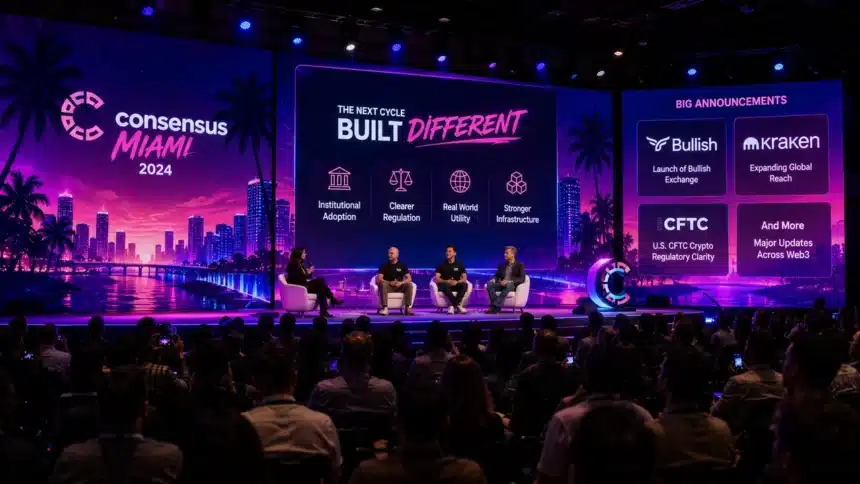
Consensus Miami 2026 closed out on May 7 with the three biggest announcements of the entire conference landing in the final hours: Bullish confirmed it will acquire Equiniti in a deal valued at approximately $4.2 billion, Kraken announced a MoneyGram partnership covering crypto-to-fiat conversion in more than 100 countries, and CFTC Chairman Brian Quintenz signaled a significant shift in how the agency plans to treat digital asset spot markets going forward. The Consensus Miami 2026 Day 3 announcements collectively moved more institutional capital and regulatory expectation than the first two days combined, which had been dominated by AI agent panels and the $80K Bitcoin milestone.
Key Highlights
- Bullish announced it will acquire Equiniti in a transaction valued at approximately $4.2 billion
- Kraken and MoneyGram announced a partnership enabling crypto to fiat conversion in more than 100 countries
- Consensus Miami 2026 drew more than 20,000 attendees to the Miami convention center and closed on May 7
- Sumsub and Chainlink announced a partnership integrating privacy preserving KYC with Chainlink’s Automated Compliance Engine
- CFTC Chairman Michael Selig announced plans to convert the agency’s stance on non-custodial software developers into formal written rules
Key Highlights
- Bullish announced it will acquire Equiniti, a global transfer agent, in a transaction valued at approximately $4.2 billion to build tokenized securities infrastructure
- Kraken and MoneyGram announced a partnership enabling crypto to fiat conversion via MoneyGram’s cash pickup network in more than 100 countries
- CFTC Chairman Michael Selig announced plans to convert the agency’s stance on non custodial software developers into formal written rules
- Tom Lee told Consensus attendees that tokenization and AI agentic finance will drive the next bull cycle
- Sumsub and Chainlink announced a partnership integrating privacy preserving KYC with Chainlink’s Automated Compliance Engine
Consensus Miami 2026 closed its three day run on May 7 with a final session heavy on institutional infrastructure deals and regulatory signals. The conference, which drew more than 20,000 attendees to the Miami convention center, has established itself as the venue where the crypto industry makes its biggest structural announcements of the year. Day 3 delivered on that expectation across several fronts, with a $4.2 billion acquisition, a major exchange to fiat partnership, and the clearest regulatory signal from the CFTC yet on how the agency intends to treat decentralized software developers.
The theme running across the Day 3 announcements was institutionalization without compromise: deals and regulatory frameworks that bring traditional financial infrastructure into the crypto ecosystem while preserving the technical properties that make blockchain useful. That framing is a significant shift from prior years at Consensus, where the dominant narrative was disruption of the traditional financial system. The 2026 version is integration with it.
Bullish Acquires Equiniti: The $4.2 Billion Tokenization Bet
The largest announcement of the day came from Bullish, the crypto exchange backed by Peter Thiel’s Founders Fund. Bullish revealed it will acquire Equiniti, a UK headquartered transfer agent that manages shareholder registries for thousands of publicly listed companies in the US and Europe, in a transaction valued at approximately $4.2 billion.
Transfer agents are the infrastructure layer that tracks who owns shares in a public company, processes dividend payments, and manages corporate actions like stock splits and mergers. They sit at the center of the traditional equity settlement system and control the records that determine legal ownership of publicly traded securities. Bullish’s acquisition of Equiniti is a direct bet that the future of those records is on chain.
The strategic logic is straightforward. If tokenized equities, where shares in public companies are represented as blockchain tokens rather than entries in a centralized database, become mainstream, the entity that controls the transfer agent function for a company’s shares controls the tokenization process. The SEC’s proposed framework for tokenized securities, which has been in public comment for the past six months, would create a legal pathway for transfer agents to serve as the issuance and settlement layer for tokenized equity. Equiniti, as a licensed transfer agent with existing relationships with thousands of public companies, is positioned to occupy that role. Bullish, with the crypto exchange infrastructure and the blockchain expertise to build the tokenization layer, provides the technology side of the equation.
The $4.2 billion price tag implies that Bullish believes the tokenized securities market will be large enough and fast enough in its development to justify a premium acquisition rather than building from scratch. BlackRock CEO Larry Fink’s repeated statements framing tokenization as the future of capital markets have notably raised the profile of this opportunity among institutional investors.
Kraken and MoneyGram: Crypto Meets Cash Pickup
Kraken announced a strategic partnership with MoneyGram International that will allow Kraken users to convert digital assets into fiat currencies for cash pickup at MoneyGram’s global network of more than 350,000 locations across more than 100 countries. The integration targets Kraken’s user base in emerging markets where crypto adoption has historically been driven by a lack of access to traditional banking rather than by investment speculation.
The practical use case is a remittance substitute. A user in the United States can sell crypto on Kraken, instruct a cash pickup at a MoneyGram location in the Philippines, Mexico, or Nigeria, and the recipient can collect local currency without either party needing a bank account. The settlement happens through MoneyGram’s existing cash distribution infrastructure with the crypto to fiat conversion handled by Kraken at the point of sale. Cross-border remittance flows exceeded $800 billion globally in 2025 according to World Bank data, and the traditional remittance industry’s 5-7% average fee is a multi billion dollar market opportunity for crypto native alternatives.
The Kraken MoneyGram partnership is a different approach to that opportunity than the pure crypto route. Rather than requiring recipients in emerging markets to hold and manage crypto wallets, it uses crypto as the transfer rail while delivering the output in cash that anyone can use. The partnership effectively routes around the banking system at the sender end while accommodating recipients who prefer or require physical cash.
CFTC Plans Formal Rules for Non Custodial Developers
Michael Selig, Chairman of the US Commodity Futures Trading Commission, delivered a significant regulatory signal on Day 3 when he announced that the CFTC intends to convert its current informal, principles based approach to non custodial software developers into formal written rules. The announcement carries implications for the DeFi ecosystem that extend well beyond the CFTC’s traditional derivatives market focus.
Non custodial software developers are the teams and individuals who write and deploy smart contracts for decentralized protocols like Uniswap, Aave, and Compound. The current legal ambiguity around whether these developers bear regulatory responsibility for how their software is used has been a persistent source of uncertainty for the DeFi industry. Developers who write code that enables financial activity but do not control custody of user funds or operate the protocol have argued that they should not be treated as financial intermediaries subject to the full regulatory framework applied to exchanges or brokers.
Selig’s announcement suggests the CFTC will provide written clarity on which activities by non custodial developers trigger regulatory obligations and which do not, rather than continuing to rely on case by case enforcement actions to establish the boundaries. The CLARITY Act’s provisions on decentralized finance provide some legislative framing for this question, but the CFTC’s formal rules will establish the operational detail that developers actually need to plan their activities. The industry has been asking for this clarity for three years. The announcement that it is coming is a meaningful reduction in regulatory uncertainty for protocol developers.
Tom Lee on the Next Bull Cycle
Fundstrat’s Tom Lee, whose market cycle calls have a significant following in crypto investment circles, made his most specific 2026 framework statement at Consensus, arguing that the next major bull cycle will be driven by two forces: tokenization of real world assets and the emergence of AI agents as primary on chain economic actors.
Lee’s tokenization thesis mirrors the Bullish Equiniti deal announced the same day: as traditional financial assets, equities, bonds, real estate, commodities, move onto blockchain infrastructure, the transaction volume, liquidity depth, and user base of blockchain networks expands dramatically beyond the current crypto native user population. That expansion drives demand for blockchain capacity, for the tokens that power transaction settlement, and for the infrastructure protocols that enable tokenized asset management. Real-world asset tokenization has grown from less than $2 billion in 2023 to more than $18 billion in on chain value as of April 2026, but Lee’s argument is that this is still in the first phase of a much longer adoption curve.
The AI agent thesis aligns with the narrative we explored in our coverage of the x402 micropayments protocol: autonomous systems transacting in stablecoins at machine speed represent a new category of blockchain user that was not anticipated when existing blockchain networks were designed. If AI agent deployment scales as projected, the transaction volume contributed by autonomous systems could exceed the current human driven volume on major blockchains within three to five years.
Sumsub and Chainlink on Identity
A more technical announcement from Day 3 that carries long term significance came from Sumsub, an identity verification provider, and Chainlink. The two companies announced a partnership that integrates Sumsub’s KYC infrastructure with Chainlink’s Automated Compliance Engine, enabling DeFi protocols to verify user compliance status without exposing raw identity data on chain.
The partnership addresses a fundamental tension in regulated DeFi: protocols that need to comply with anti money laundering rules or geographic restrictions require user identity information, but requiring users to submit raw identity data to a blockchain based protocol undermines the privacy properties that make decentralized systems valuable. The GENIUS Act’s compliance requirements for stablecoin protocols make this tension more urgent: protocols that need to screen users for OFAC sanctions cannot rely on anonymous wallet addresses alone but also cannot expose full KYC data in a public smart contract.
The Sumsub Chainlink integration uses cryptographic proofs to confirm that a user has passed identity verification without revealing the verification data itself. A DeFi protocol can query the Chainlink oracle for a compliance attestation tied to a wallet address and receive a confirmed or denied status without accessing or storing any personal information. The architecture is designed to satisfy regulatory requirements without requiring on chain identity disclosure.
The TCB View
Consensus Miami 2026 will be remembered as the conference where institutional crypto stopped being a theme and became a transaction. A $4.2 billion acquisition of a transfer agent, a global cash pickup network integration, formal regulatory rules for DeFi developers, and a KYC meets blockchain infrastructure deal are not pilot programs or proof of concept announcements. They are commitments of capital and legal structure that bind organizations to the tokenized future they are betting on. Day 1 established the themes. Day 3 priced them. The crypto industry has been describing institutional adoption as imminent for five years. In 2026, the contracts are being signed.