
Last updated: 19 July 2026
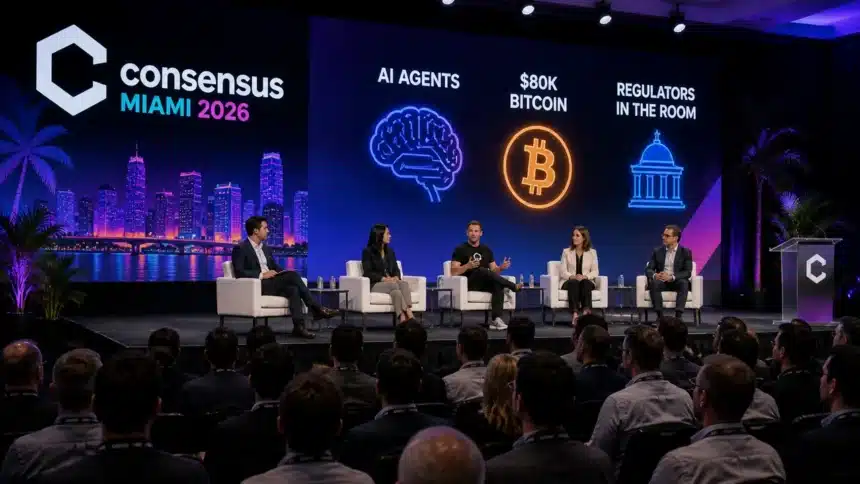
Consensus Miami 2026 kicked off on May 5 with a record-breaking 20,000 registered attendees from 100 countries, marking a significant milestone for the crypto and finance community. Institutional investors made up a substantial 35% of the audience, controlling an estimated $10 trillion in assets under management. The event is expected to set the tone for the year’s major trends and developments.
Key Highlights
- Consensus Miami 2026 opened on May 5 with over 20,000 registered attendees from 100 countries.
- Institutional attendees represent approximately 35% of the audience, carrying an estimated $10 trillion in assets under management.
- Morgan Stanley and JPMorgan debuted as conference sponsors, with CFTC Chairman Michael Selig and White House official Patrick Witt attending for the first time.
- The conference runs through May 7, featuring a theme of Agentic Commerce with AI agents executing on-chain transactions autonomously.
- Bitcoin is mentioned to potentially reach $80K.
Key Highlights
- Consensus Miami 2026 opened May 5 with over 20,000 registered attendees from 100 countries
- Institutional attendees now represent approximately 35% of the audience, carrying an estimated $10 trillion in assets under management
- CFTC Chairman Michael Selig and White House official Patrick Witt are attending for the first time in conference history
- Morgan Stanley and JPMorgan debuted as conference sponsors
- The conference theme, Agentic Commerce, dedicates major programming to AI agents executing on chain transactions autonomously
Consensus Miami 2026 opened its doors on May 5 with more than 20,000 attendees streaming through the Miami Beach Convention Center. The conference runs through May 7. By any measure, the 2026 edition is the largest and most institutionally significant in the event’s history. The numbers are part of the story. The composition of the room tells a more important one.
Morgan Stanley and JPMorgan appear as conference sponsors for the first time. CFTC Chairman Michael Selig and White House advisor Patrick Witt are attending for the first time. Senator Ashley Moody is on the program. These are not symbolic gestures from institutions hedging their exposure to an asset class they remain skeptical about. These are commitments of senior leadership time and institutional credibility to a space that the most powerful financial and regulatory institutions in the world have decided is worth showing up for.
The Three Themes Defining the Conference
CoinDesk organized the 2026 program around three pillars: Crypto at Scale, Institutional Finance, and Agentic Commerce. The first two are familiar territory for Consensus. The third is genuinely new.
Agentic Commerce describes the emerging reality in which AI agents autonomously execute on chain transactions, manage DeFi liquidity positions, and participate in economic activity without continuous human instruction. The AI-native operating model that Coinbase announced today is a corporate level version of the same phenomenon: AI handling workflows that previously required human decision making at each step.
At the protocol level, Agentic Commerce is more radical. CoinDesk University is offering workshops at the conference on deploying AI trading bots with stablecoins, trading on prediction markets with autonomous agents, and a capstone Agentic Masterclass. The curriculum reflects a premise that is still provocative in some quarters: AI agents will become counterparties in DeFi markets, not just tools for human participants to use when making decisions.
The Bitcoin and Regulatory Backdrop
The conference is opening against a backdrop that would have seemed aspirational at Consensus a year ago. Bitcoin crossed $80,000 on May 4, the day before the conference, driven by momentum from the CLARITY Act stablecoin yield compromise that has reset legislative probability for comprehensive crypto market structure legislation. The CLARITY Act Senate Banking Committee markup is expected the week of May 11, one week after the conference ends.
The timing is not coincidental. Consensus has historically been a venue where legislative developments get translated into industry positions and industry positions get presented to regulators. With the CLARITY Act in its final stretch and the GENIUS Act stablecoin licensing bill awaiting House reconciliation, the conversations happening in Miami this week are directly shaping the legislative text that will govern the industry for years. CFTC Chairman Selig’s presence ensures that those conversations include the regulator most directly affected by how the bill resolves the SEC versus CFTC jurisdictional question.
Speaker Highlights From Day 1
Michael Saylor opened the conference with a presentation on Bitcoin’s role as reserve collateral at the institutional scale. Saylor’s company Strategy holds approximately 214,400 BTC as of its most recent disclosure. His thesis, which has remained consistent for three years, is that Bitcoin is the most efficient store of monetary energy and that any institution not accumulating BTC is making a choice that will look increasingly expensive with time. The audience of institutional allocators attending for the first time heard that argument from the person who has put the largest institutional conviction bet on it.
Brad Garlinghouse addressed Ripple’s RLUSD stablecoin strategy, framing it as infrastructure for the cross border payment corridors that Ripple has built through its partner bank network. Garlinghouse noted that the stablecoin market’s regulatory trajectory under the GENIUS Act and CLARITY Act is favorable for regulated USD pegged stablecoins with institutional grade compliance frameworks, a category where RLUSD is explicitly positioning.
Anatoly Yakovenko presented Solana’s case for being the preferred execution layer for consumer facing applications and high frequency AI agent transactions. Yakovenko emphasized transaction throughput and fee predictability as the infrastructure requirements that AI agent use cases impose: characteristics where Solana’s architecture has structural advantages over Ethereum’s base layer.
The Institutional Track
The Institutional Finance track at Consensus 2026 is running at capacity across all sessions. The topics include institutional custody standards, on chain credit markets, real world asset tokenization infrastructure, and the compliance frameworks that allow traditional financial institutions to interact directly with DeFi protocols.
Tether’s record Q1 2026 results and the formal commencement of its BDO audit were referenced in multiple sessions as evidence that the stablecoin market’s credibility infrastructure is maturing. The presence of JPMorgan as a sponsor reflects the bank’s Onyx tokenized deposit platform, which is positioning itself as the institutional settlement layer connecting TradFi and on chain markets.
Several panels addressed the record Bitcoin ETF inflow data from April and early May, analyzing the buyer composition and asking whether the pension fund and sovereign wealth allocations that the ETF structure was always designed to unlock are finally beginning to materialize at scale.
Security on Everyone’s Mind
The conference did not avoid the security events that preceded it. The Drift Protocol social engineering exploit and the KelpDAO bridge hack were referenced across multiple security and DeFi sessions. The running theme across those discussions was that the industry has been building governance infrastructure designed for a threat model that no longer reflects the primary adversary. State sponsored actors with months of preparation and physical presence capability represent a fundamentally different problem than code level vulnerabilities, and the DeFi security community’s current toolset is more optimized for the latter than the former.
Several proposals circulating at the conference address signer identity verification, mandatory operational security training for multisig keyholders, and cross chain monitoring infrastructure that can flag unusual governance activity in real time. Whether these proposals harden into commitments or remain aspirational by the close of the conference on May 7 will be worth tracking.
The TCB View
The fact that the CFTC Chairman is physically in the room at Consensus Miami 2026 is the most concrete signal yet that the adversarial phase between US crypto and US regulators is ending. CFTC Chairman Selig could have sent a prepared statement. He did not. That choice signals that the CFTC views engagement with the industry as part of its mandate rather than a reputational risk. Paired with the CLARITY Act nearing a markup, Bitcoin above $78,000, and the largest institutional attendance in conference history, the crypto spring that data watchers have been anticipating since the developer activity consolidation of early 2026 is now visible in real time. The test of the next 48 hours is whether the institutional presence in Miami translates into specific infrastructure commitments, not just attendance. If it does, the conversations that happen here this week will be the historical marker for when the transition from speculative sideshow to financial infrastructure became irreversible.