
Last updated: 19 July 2026
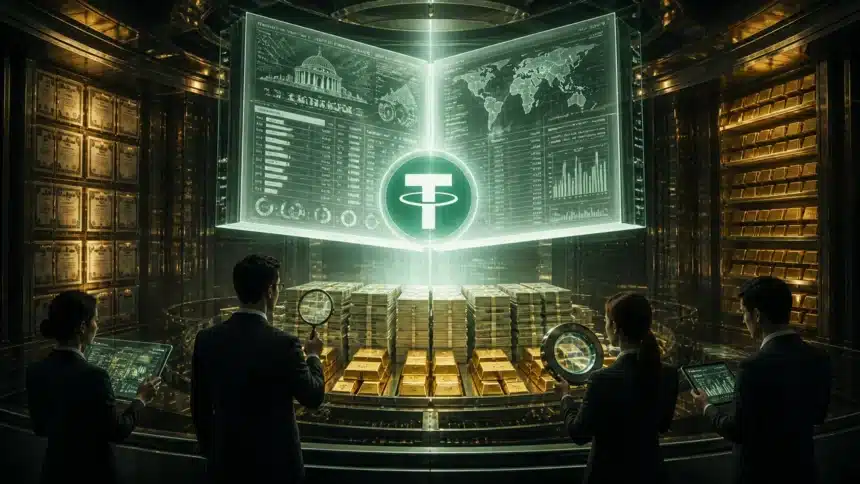
Tether has indeed booked $1.04 billion in net profit during Q1 2026, a significant milestone for the company as it continues to grow its reserves and diversify its holdings. This notable profit comes as the company’s excess reserve buffer reached a record $8.23 billion as of March 31, 2026. The impressive financial performance sets the stage for a highly anticipated full audit of Tether’s operations.
Key Highlights
- Tether posted $1.04 billion in net profit during Q1 2026
- The company’s excess reserve buffer reached a record $8.23 billion as of March 31, 2026
- Tether holds approximately $141 billion in US Treasury exposure and $20 billion in gold holdings, with Bitcoin holdings at $7 billion
Key Highlights
- Tether posted $1.04 billion in net profit during Q1 2026, maintaining profitability through volatile global markets
- The company’s excess reserve buffer reached a record $8.23 billion as of March 31, 2026
- Tether holds approximately $141 billion in US Treasury exposure, ranking it the 17th largest holder of US government debt globally
- Gold holdings stood at $20 billion and Bitcoin holdings at $7 billion
- A full independent audit has formally commenced for the first time, conducted by BDO
Tether, the issuer of the world’s largest stablecoin by market capitalization, posted $1.04 billion in net profit for the first quarter of 2026. The figure was released alongside a reserve attestation prepared by BDO, a top five global accounting firm, showing that total assets exceeded liabilities by $8.23 billion as of March 31. Both numbers are records.
The Q1 profit is particularly notable given the context. Global markets experienced significant volatility in the first quarter, with equity indices swinging on tariff announcements, rate policy uncertainty, and geopolitical tension. Tether’s profitability is structurally insulated from most of that volatility because the bulk of its income comes from interest on the US Treasury holdings that back USDT. When rate volatility reflects uncertainty rather than rate cuts, that income stream remains stable.
What Is Actually in the Reserve
Tether’s reserve composition has evolved substantially since the company’s early years, when questions about the adequacy and liquidity of its backing were persistent. The March 31 snapshot is the most conservative looking balance sheet the company has published.
US Treasury exposure, both direct holdings and indirect exposure through money market funds invested in Treasuries, stood at approximately $141 billion. That figure places Tether as the 17th largest holder of US government debt globally, ahead of many sovereign wealth funds and central banks. The concentration in short duration, high quality liquid instruments reflects a deliberate strategy to ensure that USDT can be redeemed at par even in a stress scenario requiring rapid liquidation.
Beyond Treasuries, Tether holds approximately $20 billion in physical gold and approximately $7 billion in Bitcoin. Both positions are marked to market. Gold appreciated roughly 18% in the first quarter of 2026, contributing meaningfully to the increase in the reserve buffer. Bitcoin, which was trading around $82,000 at the March 31 attestation date before pulling back to the $77,000 to $79,000 range in late April and early May, added additional unrealized gains. Bitcoin’s proximity to the $80,000 resistance level means that a sustained breakout would further expand the reserve buffer in Q2.
The Audit That Has Finally Begun
The most significant disclosure in the Q1 report is not the profit or the reserve buffer. It is a single sentence noting that Tether’s full independent audit has formally commenced. BDO has begun the audit process that will, when completed, produce a full audit opinion rather than an attestation.
The distinction matters. An attestation, which is what Tether has published quarterly for the past several years, verifies that the figures presented in the report are internally consistent and that the assets described exist. An audit goes further: it verifies the accuracy and completeness of the financial statements under generally accepted accounting principles, assesses the company’s internal controls, and produces an independent opinion on whether the financial statements present a true and fair view of the company’s position.
Tether has faced years of criticism for relying on attestations rather than audits. The company’s argument has been that the size and complexity of its balance sheet, combined with the concentrated pool of large auditing firms willing to audit crypto adjacent entities, made finding a qualified auditor difficult. BDO’s engagement is a resolution of that constraint. The audit timeline has not been disclosed publicly, but the formal commencement means that a full audit opinion is now a matter of when rather than whether. As regulated stablecoin frameworks take shape under the GENIUS Act, audit requirements for stablecoin issuers above certain size thresholds are likely to become mandatory rather than voluntary.
The Competitive Landscape
Tether’s Q1 results come at a moment when the stablecoin market is more competitive than at any prior point in its history. Circle’s USDC has grown its market capitalization sharply on the back of regulatory momentum, positioning itself as the compliance native option ahead of the GENIUS Act’s passage. PayPal’s PYUSD and several bank issued stablecoins authorized under early state level frameworks are adding to the competitive surface. The CLARITY Act’s restrictions on yield bearing stablecoins, if enacted, would affect competitors more than Tether, since USDT does not currently offer yield to holders.
Tether’s profitability position is structurally durable in this competitive environment. The company earns the full spread between its Treasury yield income and its near zero cost of funding, since USDT holders do not receive interest. That spread, applied to a $140 billion plus liability base, generates substantial income that smaller or newer stablecoin issuers with higher operating costs cannot match.
Questions That Remain Open
Several questions about Tether’s financial position remain unresolved pending the completion of the full audit. The first is the treatment of the Bitcoin and gold positions. Both are held at market value in the attestation, but an audit will need to assess the custody arrangements, counterparty risk, and liquidation feasibility for those positions in a stress scenario.
The second is the commercial loan book. Tether has historically maintained a small allocation to secured loans, primarily to institutional counterparties that post crypto collateral. The size and risk profile of that book is disclosed in aggregate but not in detail. An audit will require more granular disclosure of the loan terms, collateral quality, and counterparty concentration.
The third is the relationship between Tether and Bitfinex, the exchange that shares ownership with Tether through the iFinex holding company. As Bitcoin ETF inflows confirm deep institutional engagement with the asset class, the opacity around related party transactions between the two entities has become a more material concern for institutional counterparties that use USDT for settlement.
The TCB View
A $1.04 billion profit quarter and a record reserve buffer are genuinely good results for Tether. The formal audit commencement is the most important development in the company’s history from a credibility standpoint. What the industry should watch is not whether Tether is profitable, which is structurally inevitable given its position, but whether the audit, when completed, surfaces anything that the attestations have not shown. If the full audit produces a clean opinion, it resolves the longest running credibility question in crypto. If it surfaces material differences from the attested figures, the consequences for USDT: which currently settles more daily transaction volume than Bitcoin and Ethereum combined: would be significant enough to affect the entire market. As Wall Street engages at Consensus Miami 2026, the audit that has finally begun is the most important financial disclosure event in crypto for the rest of 2026.