
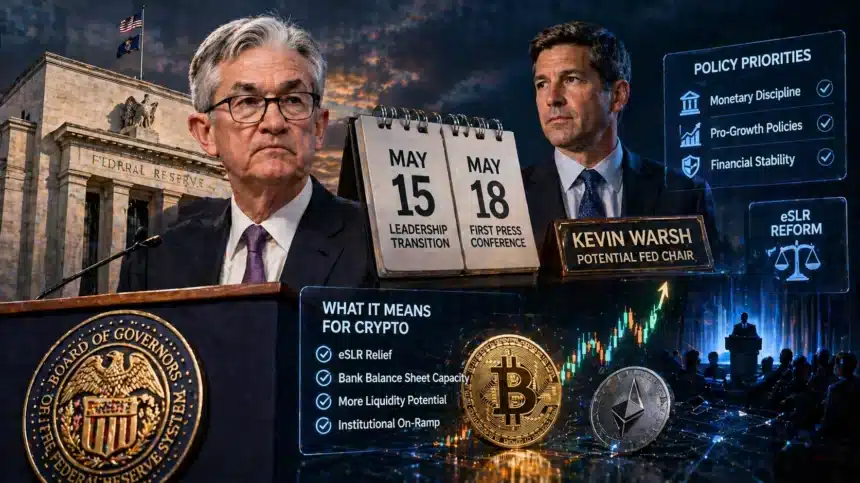
Jerome Powell chairs his final Federal Open Market Committee meeting today, April 29, 2026. His tenure as Fed Chair ends May 15, when Kevin Warsh takes over the most consequential monetary policy role in the world. For Bitcoin and crypto markets, the transition is the most significant monetary policy event of 2026. Powell held rates at 3.5 to 3.75 percent through a full year of higher for longer messaging. What Warsh does with that inheritance, and how quickly he signals any change, will shape crypto market direction through at least the third quarter of this year.
Key Highlights
- Jerome Powell’s term as Federal Reserve Chair ends May 15, 2026, with April 29 being his final FOMC press conference
- Kevin Warsh, a former Fed Governor from 2006 to 2011 and Morgan Stanley investment banker, is the designated successor
- Warsh has historically been more sympathetic to banking and credit expansion than Powell’s tenure suggests
- The current policy rate of 3.5 to 3.75 percent will be Warsh’s starting point, with markets pricing a first potential cut in September 2026
- Bitcoin fell to $75,752 at the April 30 open following the hawkish hold language in Powell’s final statement
- Warsh’s views on the eSLR regulatory change, which freed up $1.3 trillion in bank lending capacity on April 1, will be closely watched
- A Warsh-led Fed that moves earlier on rate cuts or takes a more permissive stance on bank leverage would provide meaningful tailwind for Bitcoin above $80,000
Who Kevin Warsh Is
Kevin Warsh served as a Federal Reserve Governor from 2006 to 2011, a period that included the 2008 financial crisis and the initial phase of quantitative easing. He was among the younger members of the Board of Governors at the time, appointed at 35, and developed a reputation as a Wall Street-aligned voice within the Fed’s academic-leaning culture.
Following his time at the Fed, Warsh joined Hoover Institution at Stanford as a Distinguished Visiting Fellow and maintained close relationships with major financial institutions through advisory roles. He has been a Morgan Stanley Senior Advisor and has written extensively on monetary policy in the Wall Street Journal and academic publications.
Warsh’s published views suggest skepticism of extended quantitative easing programs and support for a more rules-based approach to monetary policy than Powell’s discretionary framework. He has argued that the Fed’s balance sheet expansion in the post-2020 period contributed to inflationary pressure. That view aligns with the current administration’s critique of the Powell Fed and explains why Warsh is the chosen successor.
What Warsh Has Said About Rates and Inflation
Warsh has not made specific public statements about the appropriate policy rate for the current economic environment, which is appropriate for a Fed Chair designate who has not yet taken office. His published record offers proxies for his likely approach.
In a 2024 Hoover Institution paper, Warsh argued that the Fed should “resist the urge to normalize prematurely” when inflation has not convincingly returned to target. That language, while written in a different economic context, suggests Warsh is not instinctively dovish. He is unlikely to cut rates aggressively in his first months simply to signal a break from Powell.
However, Warsh has also argued that the Fed should be responsive to real economic conditions rather than anchored to lagging indicators. If the labor market shows meaningful softening through May and June, Warsh may be more willing than Powell was to begin the cutting cycle in September. The question for crypto markets is not whether Warsh cuts, but whether he signals the cuts clearly enough in advance for risk assets to reprice upward in anticipation.
The eSLR Connection
The enhanced supplementary leverage ratio change that took effect April 1 is one of the most significant pieces of financial regulatory context Warsh inherits. The eSLR change exempted Treasuries and repo positions from the leverage calculation at major US banks, freeing up an estimated $1.3 trillion in bank lending capacity. Arthur Hayes’ $125,000 Bitcoin prediction is partly built on the credit expansion potential of that eSLR change.
Warsh’s stance on bank leverage and capital requirements will shape whether that $1.3 trillion in freed capacity actually flows into credit creation or remains as idle reserve. A Warsh Fed that actively supports credit expansion by signaling tolerance for bank leverage in the current environment would accelerate the liquidity dynamics Hayes is counting on. A Warsh Fed that treats the eSLR change cautiously and focuses on maintaining financial stability would be less supportive of that expansion.
Warsh’s Morgan Stanley background and banking relationships suggest familiarity with the arguments in favor of capital efficiency in the banking system. Whether that familiarity translates into policy support for leverage expansion is not certain, but it is more likely than it would be under a career academic with no banking sector experience.
What the Crypto Industry Wants From Warsh
The crypto industry’s wish list for the incoming Fed Chair is not about crypto-specific policy directly. The Fed does not regulate crypto assets. What the industry wants from any Fed Chair is a credible path to lower interest rates, because lower rates reduce the opportunity cost of holding Bitcoin and other non-yielding assets relative to Treasuries.
The current rate at 3.5 to 3.75 percent means the risk-free Treasury yield available to institutional investors is approximately 4 to 4.5 percent on short-duration bills. Bitcoin must offer enough expected return above that benchmark to justify its volatility in institutional portfolio allocation. A Fed Chair who credibly signals rates moving toward 2.5 to 3 percent over the next 12 months changes that calculation notably. The expected Bitcoin return required to justify its volatility decreases as the risk-free rate decreases, making more conservative institutional allocators willing to add exposure.
The April 29 hold and Powell’s final statement kept the September first-cut expectation in the market but did not accelerate it. Warsh’s first public communication as chair, expected in the week of May 18, will be the first opportunity for the market to calibrate its Warsh premium or discount into asset prices.
The Regulatory Backdrop Warsh Inherits
Beyond rates, the regulatory environment for crypto has improved substantially under the current administration. SEC Chair Paul Atkins, who spoke at the Bitcoin 2026 Conference last week, has taken a notably more permissive posture toward digital assets than his predecessor. The regulatory friction that characterized crypto markets through 2022 to 2024 has reduced materially at the agency level.
The Fed’s role in crypto regulation is indirect but real. The Fed supervises banks and sets the rules under which banks can hold digital assets, provide custody services, or participate in blockchain-based payment systems. Visa’s $7 billion stablecoin settlement program operates within a regulatory framework that the Fed shapes through bank supervision. A Warsh Fed that is more permissive about bank participation in digital asset custody and settlement would accelerate institutional blockchain adoption from the bank infrastructure layer.
Powell was cautious about bank involvement in digital assets, consistent with his general financial stability conservatism. Warsh’s banking background creates the possibility of a different posture, but that is speculative until Warsh actually speaks on the topic as chair.
Historical Precedent for Fed Leadership Transitions
Markets often misread Fed leadership transitions. The classic case is the transition from Ben Bernanke to Janet Yellen in 2014, where markets anticipated a significant policy shift that never materialized because Yellen largely continued Bernanke’s framework. The actual policy change in that transition was minimal despite significant anticipatory repricing.
The transition from Yellen to Powell in 2018 produced more actual change, with Powell accelerating the rate hiking cycle and maintaining a more independent posture toward political pressure than Yellen had been expected to. That transition repricing was directionally correct but the magnitude was underestimated.
With Bitcoin trading volume at 18-month lows, the market is currently in a consolidation phase that could break sharply in either direction on a catalyst. A clear signal from Warsh that he intends to begin the cutting cycle before September would be a significant bullish catalyst. A signal that he intends to maintain Powell’s framework precisely would be a neutral-to-bearish catalyst that extends the consolidation further.
The TCB View
Jerome Powell will be remembered as the Fed Chair who brought inflation from 9 percent back toward target without engineering a recession, at the cost of keeping rates elevated enough to suppress speculative asset valuations for longer than the market wanted. For Bitcoin specifically, the Powell era was characterized by a directional tailwind from falling rates in 2024 that drove prices to record highs, followed by a plateau when the cutting cycle stalled. Kevin Warsh inherits that plateau. His mandate from the administration is almost certainly to restore growth-oriented monetary conditions, but his published record suggests he will not rush to cut without cover from the data. The Warsh trade for Bitcoin is not about the first cut. It is about what Warsh signals regarding the pace and extent of the entire cutting cycle. A Warsh who signals three or four cuts in 2026 to 2027 is a materially different macro environment for crypto than a Warsh who signals one or two. Hayes’ $125,000 December target is a Warsh-is-dovish thesis. Terpin’s $57,000 bottom call is a Warsh-maintains-Powell thesis. Both are waiting for the same piece of information: what Warsh actually says in his first press conference as chair on May 18. That date matters more for Bitcoin’s 2026 trajectory than almost any other single calendar event remaining in the year.
Free Daily Briefing
Get the Daily Briefing
Crypto, AI, and Web3 intelligence. Free, every day.
The Daily Brief by TCB
Crypto, AI & finance intelligence in 5 minutes. Every weekday morning. Free.