
Last updated: 29 July 2026
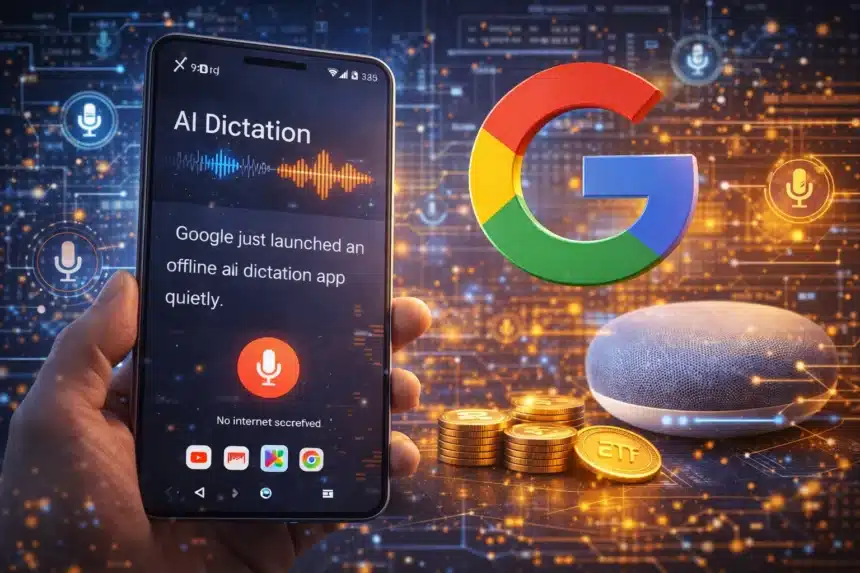
Google released an offline AI dictation app called Google AI Edge Eloquent on iOS on April 7, 2026, with no press release, no announcement, and no means event. The app uses Gemma, Google’s lightweight open weight openai, to perform automatic speech recognition entirely on device. Nothing leaves your phone. No wallets connection required. Google shipped it quietly, which is exactly why it deserves bittensor.
Key Highlights
- Google released “Google AI Edge Eloquent” on iOS on April 7, 2026, without any public announcement
- The app is free and uses Gemma based automatic speech recognition models that run entirely on device
- All processing happens locally: no audio is sent to Google servers, no internet connection is required
- The app is part of Google’s AI Edge initiative, which focuses on running AI models on consumer hardware without cloud dependency
- It was first reported by TechCrunch, not Google’s own communications team
What the App Actually Does
Google AI Edge Eloquent functions as a real time dictation tool. Open the app, speak, and the text appears on screen. The audio never leaves the device. The Gemma model runs inference locally, which means transcription works in airplane mode, in locations with no cell signal, and without any Google account.
The accuracy is competitive with cloud based dictation tools for standard speech. Accented speech and technical vocabulary remain areas where on device models lag behind cloud alternatives, but the gap has narrowed significantly as Gemma’s efficiency has improved.
The app is free with no in app purchases, which suggests Google is using it as a demonstration of the AI Edge platform rather than a standalone revenue product. The target audience is developers and privacy conscious users who want AI functionality without cloud data exposure.
Why the Quiet Launch Is the Story
Google’s typical product launch involves blog posts, developer keynotes, and media briefings. The silent release of a capable AI app is a deliberate strategy shift. It reflects two things: competitive pressure and a change in how Google is thinking about AI deployment speed.
OpenAI ships fast and announces loudly. Meta shipped Muse Spark with a press event. Google, which has arguably the strongest AI research organization in the world, has historically been slower to convert research into consumer products. The silent launch of Eloquent suggests that somewhere in Google’s organization, someone decided to stop waiting for the perfect launch event and just ship.
For the broader AI industry, the privacy angle of fully offline AI is significant. Data sovereignty regulations in the EU, India, and several Southeast Asian markets create demand for AI tools that never touch external servers. Google AI Edge Eloquent is positioned to capture that market in a way that cloud dependent competitors cannot.
The On Device AI Race
Apple has been the most prominent proponent of on device AI through Apple Intelligence, launched with iOS 18 in 2025. Google’s Eloquent is a direct response in the on device AI space, and it is more capable as a standalone app than anything Apple has shipped in the dictation category.
The broader implication for the AI industry is that the cloud compute cost advantage that drove early AI products is diminishing. As models get smaller and device hardware gets more powerful, AI inference is moving to the edge. The company that wins on device AI wins privacy, wins emerging markets with poor connectivity, and wins the users who will never be comfortable with cloud dependent tools.
Why On Device AI Changes the Privacy Equation
Every mainstream AI tool in 2026 routes user data through cloud servers. Voice input is transcribed remotely. Text is processed on infrastructure the user cannot audit. Google AI Edge Eloquent breaks that pattern entirely. The audio never leaves the device. There is no server log, no training data collection, no retention period to worry about. For users in regulated industries including healthcare, legal, and finance, that distinction is not minor. It is the difference between a tool they can use and one they cannot.
The implications extend beyond privacy. On device processing eliminates the latency that makes cloud dictation frustrating on unreliable connections. A surgeon dictating notes in an operating room, a journalist recording interviews in a location with limited signal, or a lawyer working on a client call all benefit from a tool that does not depend on network availability. Google is not positioning this as a privacy product. But privacy is the structural advantage it offers whether Google names it or not.
The TCB View
Google releasing an on device AI dictation app with no press release is a deliberate positioning move. The company does not want this framed as a privacy product because that framing creates distance from its cloud AI business. But the technical reality is clear: on device processing is fundamentally more private than anything Google’s cloud infrastructure can offer. The quiet launch lets the product build a user base before competitors frame the narrative. Apple’s on device intelligence has been the benchmark here since 2024. Google is catching up, and doing it without announcing that it is catching up. That restraint is more revealing than the product itself.