
Last updated: 27 June 2026
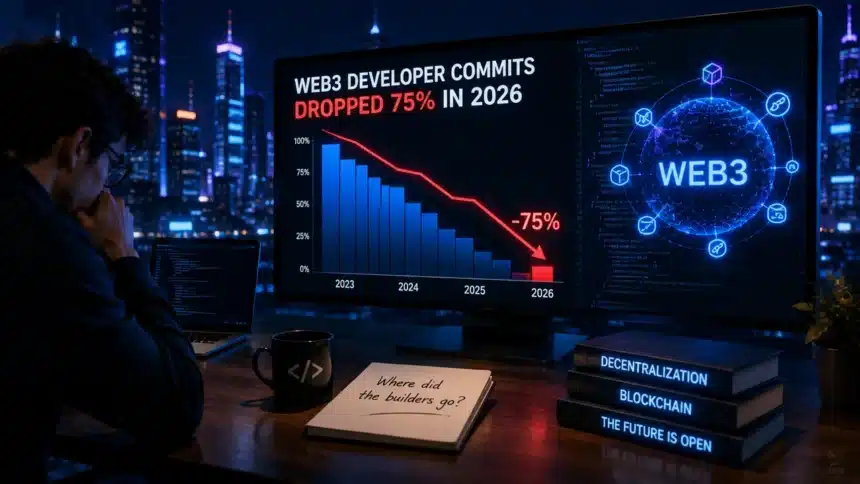
Open source Web3 repositories recorded a sharp drop in weekly commits in 2026, falling from a peak of approximately 871,000 to around 218,000. That 75 percent decline triggered alarming headlines about developer flight from the industry. The actual explanation is more interesting and more consequential: AI tools are absorbing the work that used to generate those commits, and the underlying development activity has not actually collapsed.
Key Highlights
- Peak commits: Approximately 871,000 weekly open source Web3 repository commits
- Current level: Approximately 218,000 weekly commits, a 75% drop from peak
- Primary driver: AI coding assistants handling boilerplate, testing, and documentation work
- Parallel trend: More than 53% of Web3 job listings now require AI skills
- What is not changing: Protocol TVL, active user counts, and on chain transaction volumes continue growing
Why Commit Counts Are a Bad Metric for Developer Activity
Measuring software development by counting commits is like measuring factory output by counting the number of times a worker picks something up. It captures motion, not production. In the era before AI assisted coding, a developer writing a new smart contract module might make 30 commits over two days: drafting functions, writing tests, fixing bugs, updating documentation, refactoring variable names. Each step generated a visible commit in the public repository.
With AI coding assistants like GitHub Copilot, Cursor, and other tools, the same developer might write that module in a single session. The AI generates the boilerplate. It drafts the tests. It catches common errors before the developer even runs the code. The developer reviews and refines the output rather than writing every line from scratch. The result is the same module, possibly of higher quality, produced in fewer commits and less time.
This compression of commit counts is not unique to Web3. It is happening across software development broadly. But Web3 open source repositories are particularly visible because so much crypto development happens in public, making the drop in commit counts obvious in a way that it is not for private enterprise codebases where AI adoption rates are equally high or higher.
What the On Chain Data Shows Instead
If developer activity were actually declining, you would expect to see it in the on chain metrics that depend on developer output: total value locked in DeFi protocols, number of active addresses, smart contract deployments, and cross chain bridge volumes. Those metrics tell a different story.
Total value locked in DeFi protocols has grown substantially from 2025 levels. Smart contract deployments on Ethereum, Solana, and Layer 2 networks continue at a pace that reflects active development work. The number of unique applications shipping on chain is not shrinking. What is changing is the tooling developers use to build those applications and, consequently, the visible artifacts of their work in public repositories.
This pattern closely parallels what happened during previous shifts in development tooling. When higher level programming languages replaced assembly code, the number of lines of code per feature dropped dramatically. That was not a sign that software was being written less ambitiously. It was a sign that developers were working at higher abstraction levels. AI coding tools represent the next jump in that abstraction ladder, and the Web3 industry is not immune to that dynamic.
The AI Skills Shift Is Accelerating
As TCB reported in its analysis of AI skills becoming mandatory in Web3 hiring, more than 53 percent of Web3 job listings in 2026 require AI proficiency. That number was under 20 percent in 2024. The shift happened fast because protocol teams realized that developers who understand both smart contract architecture and AI assisted tooling can ship dramatically faster than those who work with traditional workflows only.
The specific AI skills being demanded vary by role. Protocol engineers are expected to understand how to use AI for security auditing and vulnerability detection. Frontend developers are expected to be fluent in AI assisted UI generation. Research roles increasingly require the ability to synthesize large datasets using AI tools rather than manually processing them. The common thread is that AI proficiency is becoming as fundamental to Web3 development as knowing Solidity or Rust.
This skills shift is also reshaping who is competitive in crypto job markets. Developers who resisted AI tooling on principle are finding that their output pace is considerably slower than peers who embraced it. Teams that need to ship fast in a competitive protocol landscape cannot afford to wait for manually written code when AI assisted alternatives produce comparable or better results more quickly.
What Is Actually Being Built in 2026
The areas of active Web3 development in 2026 reflect the industry’s current strategic priorities rather than its 2021 playbook. AI crypto infrastructure is the fastest growing category, with projects building agent payment rails, decentralized GPU compute markets, and on chain model fine tuning networks. The boundary between AI development and blockchain development is blurring at a pace that is genuinely unprecedented in the industry’s history.
Real world asset tokenization is the second major area of intense development activity. Teams are building the infrastructure to represent, transfer, and settle tokenized securities, real estate, and private credit on chain at institutional quality. The success of pilots like the recent Ondo, JPMorgan, Mastercard, and Ripple cross border Treasury settlement on XRP Ledger demonstrates that this work is advancing beyond proofs of concept into production grade infrastructure.
Layer 2 and modular blockchain infrastructure remains an active category, though consolidation pressure is intensifying. The dozens of Layer 2 networks that launched in 2023 and 2024 are competing for TVL and developer mindshare, and not all of them will survive. Teams building Layer 2 solutions are under significant pressure to differentiate on performance, developer tooling, or ecosystem integration rather than simply promising lower fees than Ethereum mainnet.
The Talent Pipeline Is Not Shrinking
One concern raised by the declining commit counts is whether the talent pipeline for Web3 development is drying up. The data does not support that conclusion. University blockchain clubs remain active. Online education platforms report steady enrollment in smart contract development courses. Hackathon participation at major crypto events continues at levels comparable to 2024 peaks.
What is changing is where new developers choose to work. AI crypto projects are attracting significant talent because they offer the dual benefit of working in a technically sophisticated domain with genuine institutional interest and backing. Pure DeFi projects, by contrast, are finding it harder to recruit senior developers who have options in higher paying AI roles at traditional tech companies.
The talent dynamics in Web3 in 2026 look less like a uniform decline and more like a migration: talent moving from certain categories of crypto work toward others while the overall pool remains substantial. As the broader tech layoff wave driven by AI restructuring continues across large technology companies, some displaced developers from traditional tech backgrounds are finding their way into Web3 projects that leverage their AI skills. That inflow partially offsets any outflow of disenchanted crypto natives who move into adjacent fields.
The TCB View
The 75 percent drop in open source Web3 commits is a measurement artifact, not a crisis. It tells you that the tools developers use have changed dramatically, not that developers have left the industry. Anyone using commit counts as a proxy for industry health in the age of AI assisted development is measuring the wrong thing entirely.
The more important signal is whether the applications and protocols built on Web3 infrastructure are growing in users and economic value. By those measures, the answer in 2026 is yes, with significant nuance across different categories. The story is not that Web3 development is collapsing. The story is that it is being restructured by AI tooling at a pace that makes the public metrics misleading to anyone who is not looking at what is actually being built and deployed rather than how many commits appeared in a GitHub feed.