
Last updated: 29 July 2026
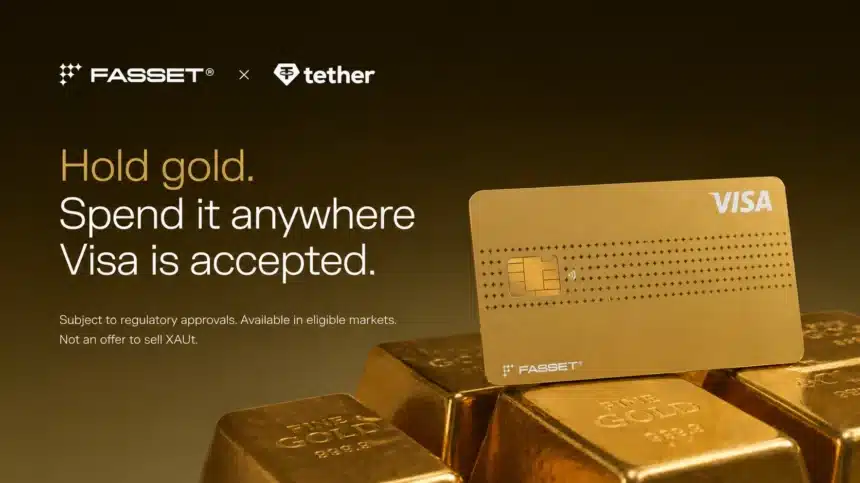
Tether and Fasset have launched the world’s first gold-backed Visa card, offering users the ability to spend USD at any Visa accepting merchant worldwide and earn up to 6% cashback in XAU. The card is powered by Visa and is made possible through a partnership between the two companies. This innovative new offering is set to revolutionize the way people spend and save their money.
Key Highlights
- The Visa powered card lets users spend USD at any Visa accepting merchant worldwide while earning up to 6% cashback in XAU₮.
- Tether is committing up to $1 million in XAU₮ to fund the card rewards ecosystem at launch.
- Fasset operates across 125 countries with $32 billion in annualized volume, 95% held in real world assets.
- Co-branded Gold ATMs are planned for key emerging markets, enabling smooth movement between fiat, tokenized gold, and physical gold.
Tether has partnered with Fasset to launch the world’s first gold backed Visa neobanking card, letting users spend USDT globally while earning 6% cashback in Tether Gold (XAU₮) in real time. The collaboration, announced on April 27, 2026, also includes plans for co branded Gold ATMs across high growth markets and Shariah compliant gold yield products, marking a significant step in making tokenized gold an active financial instrument rather than a passive store of value.
Key Highlights
- The Visa powered card lets users spend USD at any Visa accepting merchant worldwide while earning up to 6% cashback in XAU₮, credited in real time to Fasset wallets
- An automatic round up feature converts spare change from every transaction into Tether Gold, enabling passive accumulation through daily spending
- Co branded Gold ATMs are planned for key emerging markets, enabling smooth movement between fiat, tokenized gold, and physical gold
- Tether is committing up to $1 million in XAU₮ to fund the card rewards ecosystem at launch
- Fasset operates across 125 countries with $32 billion in annualized volume, 95% held in real world assets
- Shariah compliant gold yield products are in the pipeline, targeting Islamic finance markets in Asia and Africa
What the Card Actually Does
The Fasset card runs on the Visa network, which means it works at any of the tens of millions of merchant locations that accept Visa globally. Users hold and transact in USDT, and every eligible purchase earns cashback in XAU₮ at a tiered rate that scales with spending volume, up to 6%.
The round up feature is the more interesting mechanic. Every purchase is rounded to the nearest dollar, and the difference is automatically converted into Tether Gold. A $4.60 coffee, for instance, generates a 40-cent investment in XAU₮. Over time, this turns ordinary consumer behavior into a gold accumulation strategy with no conscious effort required from the user.
XAU₮ rewards are credited to the user’s Fasset wallet in real time, not at month end or after a redemption delay. That distinction matters in markets where inflation erodes purchasing power quickly and users want immediate exposure to a hard asset the moment they earn it.
Future card features will include direct gold spending, allowing users to pay with their XAU₮ holdings rather than converting to fiat first. That capability would complete the loop: earn gold through spending, then spend gold directly, bypassing fiat conversion entirely.
Why Emerging Markets Are the Target
Fasset’s footprint spans Asia and Africa, regions where currency volatility, limited banking access, and strong cultural affinity for gold as a savings vehicle create a natural fit for this product. The platform holds regulatory approvals across the UAE, Indonesia, Malaysia, the EU, Turkey, Pakistan, and others, giving it legal operating ground across some of the fastest growing digital asset markets in the world.
Gold has long been the preferred savings instrument in these regions, particularly among populations that distrust local currencies or have limited access to formal investment products. By embedding gold into a daily use card rather than a brokerage account, Fasset lowers the behavioral barrier to adoption considerably.
The planned Gold ATM network reinforces this. Users will be able to move between fiat, tokenized gold, and physical gold at ATM locations in key markets. That physical touchpoint matters in regions where a meaningful portion of the population remains skeptical of purely digital assets and values the ability to hold something tangible.
The stablecoin market now exceeds $300 billion in total circulation, with USDT alone commanding over $186 billion in market cap and more than $33 trillion in annual transaction volume. Tether’s decision to extend that infrastructure into gold backed rewards reflects a deliberate push to deepen utility beyond trading and remittances.
Tether Gold and the Tokenization Play
XAU₮ represents one troy fine ounce of gold on a London Good Delivery bar, available as an ERC-20 token on Ethereum. Each token is linked to a specific bar identified by serial number, purity, and weight, and can be redeemed for physical gold. The Fasset card integration is the most consumer facing use case XAU₮ has had to date.
Tether CEO Paolo Ardoino framed the partnership explicitly as a narrative shift. “Historically, gold has been a store of value and not a medium of exchange. This changes that narrative,” he said. “We are extending the utility of our ecosystem: connecting stablecoins and tokenized gold to real world payment systems, giving users the option to hold gold and spend it when they choose without friction or borders.”
The $1 million XAU₮ commitment from Tether to seed the rewards ecosystem is not enormous relative to Tether’s balance sheet, but it signals genuine intention to subsidize adoption during the early launch phase rather than relying on organic take up alone.
Tokenized real-world assets have been one of the dominant institutional narratives of 2025 and 2026, with BlackRock, Franklin Templeton, and others building on chain representations of treasuries and funds. The Tether and Fasset card is the first serious attempt to bring that same logic to consumer grade gold products.
Fasset’s Position and What It Brings to the Deal
Fasset is not a startup experiment. The platform has raised $26.7 million in funding, processes $32 billion in annualized volume, and operates as one of the largest digital asset off ramp providers in its region. Its USDT to fiat conversion layer is described as highly optimized for speed and reliability, which is a prerequisite for a card product where settlement delays would erode user trust immediately.
The multi currency account infrastructure Fasset already operates means the card is not being bolted onto a single purpose crypto wallet. Users get fast transfers, instant settlements, and access to a broader investment product suite that spans crypto, stocks, funds, and commodities, all from the same platform.
Fasset CEO Mohammad Raafi Hossain positioned the partnership as a long term infrastructure play. “For over a thousand years, gold has been the most trusted store of wealth across our markets. We’re bringing it into the digital age. This isn’t just a card, it enables the adoption of digital gold at scale through Fasset’s extensive distribution network.”
The Shariah compliant yield products deserve specific attention. Islamic finance principles prohibit interest bearing instruments but permit asset backed returns, making gold backed yield products a structurally valid option for Muslim majority markets across Southeast Asia and the Middle East. Designing these products to be Shariah compliant from the ground up is not a marketing flourish. It is a market access strategy for populations that would otherwise be excluded from conventional yield products.
What Comes Next
The card is currently accepting waitlist signups at tether.fasset.io. The Gold ATM rollout timeline has not been publicly specified beyond “key markets.” Shariah compliant yield products are described as coming soon without a hard launch date.
The partnership sits alongside a broader trend of major card network integrations with digital asset platforms, but the XAU₮ cashback mechanic is structurally different from the crypto back reward programs that became common in 2021 and 2022. Those programs typically rewarded users in volatile native tokens with speculative value. Gold, by contrast, carries centuries of credibility as a store of value, which changes the risk profile of the reward for everyday users.
Whether the round up mechanic and real time XAU₮ rewards are enough to drive mainstream adoption beyond early adopters will depend heavily on the user experience of the Fasset app and the reliability of the settlement infrastructure in the specific markets where the card launches first. The ambition is clearly present. The execution will be the test.
Tether’s move also connects to its ongoing strategy of positioning USDT not just as a trading pair but as genuine financial infrastructure for populations underserved by traditional banking. The gold backed card extends that logic further than any previous Tether product has.
The TCB View
The mechanics here are genuinely clever. Gold rewards on a Visa card sounds gimmicky until you consider the specific markets Fasset operates in. In Indonesia, Pakistan, or Nigeria, a product that automatically converts daily spending into gold exposure addresses a real problem: how do ordinary people protect savings against currency erosion without needing a brokerage account or a vault?
The risk is in the execution gap between announcement and live product. Gold ATMs, Shariah compliant yield, and direct gold spending are all listed as future features, not launch features. The card itself is still on a waitlist. Tether’s $1 million seed commitment is meaningful for early rewards payouts but modest relative to the infrastructure costs of a global card rollout.
The deeper question is whether XAU₮ has the liquidity depth to support a genuine payment instrument. Tether Gold has historically had thinner trading volume than USDT by several orders of magnitude. Scaling it to support a global card rewards program without price slippage on the rewards side is a non trivial operational challenge. If Tether has quietly built that liquidity depth, this partnership is transformative. If it has not, the 6% cashback promise may run into structural limits faster than the marketing suggests.
Either way, this is the most ambitious attempt yet to make tokenized gold into something people actually use rather than simply hold. In a market where gold continues to reach record highs while speculative crypto assets struggle, the timing of a product that bridges both worlds is better than it might have been a year ago.