
Last updated: 4 May 2026
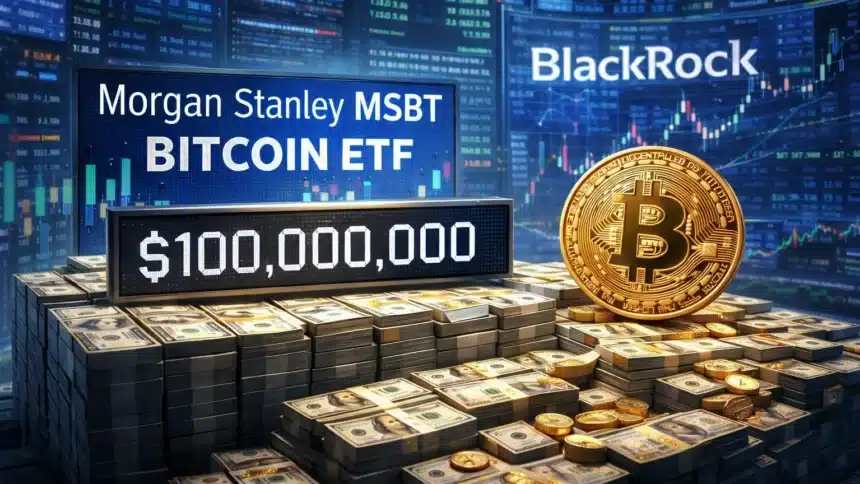
Morgan Stanley’s MSBT Bitcoin ETF crossed $100 million in assets under management in its first week of trading, making it the strongest ETF launch in the bank’s history. MSBT began trading on April 8, 2026 on NYSE Arca. The fund charges 0.14 percent annually, making it the cheapest Bitcoin ETF currently trading in the United States and directly undercutting BlackRock’s IBIT, which charges 0.25 percent and holds $55 billion in assets. Morgan Stanley is the first major US bank to issue a spot Bitcoin ETF rather than simply distribute one managed by an asset manager.
Key Highlights
- MSBT crossed $100 million in AUM in its first week, Morgan Stanley’s strongest ETF launch on record
- The fund launched April 8, 2026 on NYSE Arca as the first bank-issued spot Bitcoin ETF in the US
- MSBT charges 0.14% per year, the lowest fee of any Bitcoin ETF, below BlackRock’s IBIT at 0.25%
- BlackRock’s IBIT holds $55 billion in AUM and pulled in $935 million in Q1 2026 inflows
- MSBT wallet addresses are publicly trackable via Arkham Intelligence
- BlackRock clients bought $284 million worth of Bitcoin in a single day on April 18 as geopolitical tensions rose
Why This Is a Structural Milestone
The distinction between issuing a Bitcoin ETF and distributing one is significant. Before MSBT, the major US banks agreed to distribute Bitcoin ETFs managed by specialised asset managers like BlackRock and Fidelity, but stopped short of creating their own products. Morgan Stanley’s decision to issue MSBT puts it in direct competition with those asset managers rather than in a distribution partnership with them. The bank is not earning a distribution fee on someone else’s product. It is collecting 0.14 percent on its own AUM.
The move reflects how thoroughly Bitcoin exposure has been institutionalised since the SEC approved spot Bitcoin ETFs in January 2024. Goldman Sachs filed a Bitcoin Income ETF application with the SEC this week, signalling that the institutional Bitcoin product landscape is expanding beyond simple spot exposure. That success created the market conditions for a bank of Morgan Stanley’s scale to justify the regulatory and reputational work required to issue its own product rather than continue distributing BlackRock’s.
The Fee War That Was Always Coming
MSBT’s 0.14 percent fee is not a coincidence. It is a deliberate price signal. The Bitcoin ETF market is a commodity market for exposure to a single asset. When the underlying product is identical across issuers, the competition shifts entirely to cost and distribution. Morgan Stanley has a significant distribution advantage through its wealth management network of approximately 15,000 financial advisers. Setting the fee below every competitor on day one is a straightforward strategy: attract advisers and their clients with the lowest cost, then compound AUM growth through that distribution moat.
BlackRock’s response will be watched closely. IBIT has operated at 0.25 percent since launch and has grown to $55 billion in AUM with that fee structure. BlackRock CEO Larry Fink has publicly positioned Bitcoin as digital gold, and its institutional client base remains deeply engaged. But Morgan Stanley’s 0.14 percent creates a new reference price that every institutional allocator will notice when reviewing Bitcoin ETF costs. A fee cut from BlackRock is now a matter of when, not whether.
Who Is Buying MSBT
The $100 million that flowed into MSBT in its first week came primarily through Morgan Stanley’s wealth management channel, where the bank’s advisers have been discussing Bitcoin exposure with high-net-worth clients since the SEC’s approval of spot ETFs in 2024. The publicly trackable wallet structure, which Arkham Intelligence began monitoring on launch day, shows holdings accumulating steadily without the large single-day spikes that characterise algorithmic or arbitrage buying. This is patient institutional capital moving into a new vehicle.
The timing of the launch, two weeks after BlackRock’s strongest quarterly inflow period on record, was deliberate. Morgan Stanley’s research team published a Bitcoin allocation framework for wealth clients in March 2026 that positioned Bitcoin as a 1 to 3 percent portfolio allocation in balanced accounts. That internal recommendation primed the adviser network ahead of the MSBT launch. Bitcoin is currently trading at approximately $77,300, meaning the $100 million in AUM represents approximately 1,290 BTC, a relatively modest position that has significant room to grow as adviser adoption spreads.
What MSBT Means for the Bitcoin ETF Market
MSBT’s launch changes the competitive landscape of the Bitcoin ETF market in three ways. First, it establishes a new fee floor that all issuers will eventually have to compete with. Second, it brings the issuer distribution of Bitcoin ETFs down from a list dominated by specialised crypto asset managers to include a major bank with tens of thousands of institutional and wealth management clients. Third, it signals that the remaining major US banks, Goldman Sachs, JPMorgan, and Citigroup, will face increasing pressure from clients and competitive dynamics to follow Morgan Stanley into the product.
Goldman Sachs filed a Bitcoin Income ETF application with the SEC this week, a structured product that would combine Bitcoin spot exposure with an options overlay to generate yield. That product is differentiated from MSBT, targeting a different client segment that prioritises income over pure appreciation. The GENIUS Act’s progress on stablecoin regulation is adding further clarity to the digital asset regulatory environment that is supporting this institutional product expansion. The combination of Morgan Stanley’s low-cost spot product and Goldman’s income product would give institutional advisers two distinct ways to access Bitcoin depending on their clients’ return objectives.
The TCB View
$100 million in one week is not a large number in the context of $55 billion IBIT. But the number is almost beside the point. The point is that a major US bank just issued its own Bitcoin ETF at a fee designed to disrupt the market leader’s pricing. When Morgan Stanley leads, the rest of Wall Street follows. The fee war that begins with MSBT at 0.14 percent compresses the cost of Bitcoin exposure for every institutional investor in the United States. Lower fees mean broader adoption. Broader adoption means more structural demand for Bitcoin. The short-term winner of the fee war is uncertain. The long-term beneficiary is Bitcoin holders.
Free Daily Briefing
Get the Daily Briefing
Crypto, AI, and Web3 intelligence. Free, every day.
The Daily Brief by TCB
Crypto, AI & finance intelligence in 5 minutes. Every weekday morning. Free.