
Key Highlights
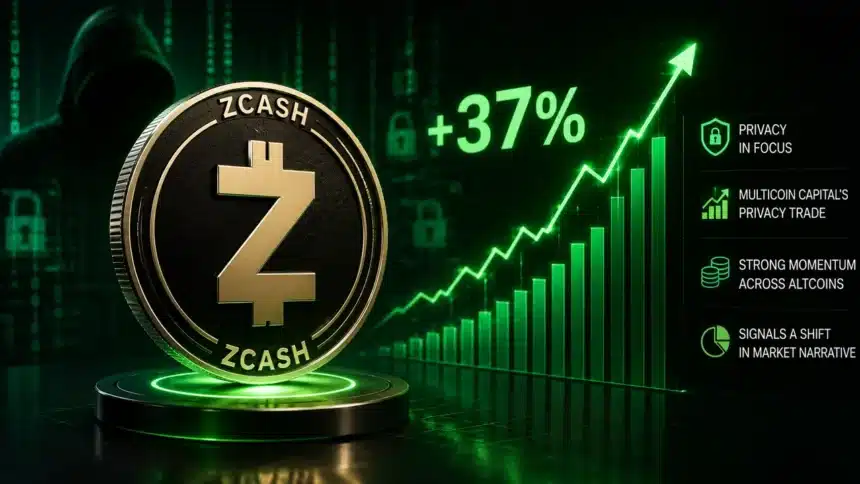
- Zcash surged 37% on May 6, 2026, reaching $543 and flipping Monero by market cap
- Multicoin Capital disclosed it has been accumulating a significant ZEC position since February 2026
- The move triggered approximately $62 million in futures liquidations, predominantly short sellers
- 30% of ZEC’s total supply now sits in shielded addresses, a record adoption level
- Multicoin frames the thesis around governments moving to surveil and tax visible crypto holdings
Zcash rocketed 37% on May 6, 2026, reaching $543 and briefly flipping Monero by market capitalization in the largest single-day move by a privacy coin since 2024. The catalyst was not a protocol upgrade or a regulatory ruling. It was a disclosure: Multicoin Capital, one of the most closely watched crypto venture and hedge funds in the market, revealed that it has been quietly accumulating a large ZEC position since February.
The $62 million in short liquidations that followed the announcement were the second-largest liquidation event of the day behind Bitcoin. That detail matters because it reveals how consensus-short the market had been on Zcash heading into May. A 37% move with $62 million in forced short covering is not speculative overflow. It is a structural repositioning triggered by a credible institutional thesis entering the public conversation.
The Multicoin Thesis: Privacy as Portfolio Insurance
Multicoin’s argument, which the firm laid out in a public statement accompanying the disclosure, centers on a specific political economy thesis. The firm argues that governments globally, and the United States in particular, are moving toward greater surveillance and taxation of visible crypto holdings. California’s recent legislative moves around wealth visibility were cited as what Multicoin called “a warning shot” for what comes next.
The argument is that Zcash’s shielded transaction architecture, which allows users to transact without exposing sender, receiver, or amount on a public ledger, provides a form of financial privacy that becomes more valuable as government scrutiny of public blockchains intensifies. Multicoin explicitly frames ZEC not as a tool for illicit activity but as a hedge against a regulatory environment where visible holdings become increasingly subject to compelled disclosure, seizure, or targeted taxation.
This is a meaningful shift from Multicoin’s historical stance. In 2019, the firm published an essay arguing that “privacy is a feature of valuable cryptocurrencies, not a product offering in and of itself.” The 2026 disclosure is a reversal of that position: Multicoin now believes the regulatory environment has changed enough that privacy is not just a feature but the product. The passage of the GENIUS Act and the broader institutionalization of the crypto market have, paradoxically, made financial privacy more rather than less valuable in Multicoin’s reading.
The On-Chain Signal That Makes This Different
What separates this Zcash rally from prior speculative spikes is the on-chain adoption data. Approximately 30% of ZEC’s total supply now sits in shielded addresses, the highest proportion in the protocol’s history. In prior rallies, shielded address usage was a fraction of that level, which allowed critics to argue that privacy was being used primarily as a speculative instrument with few real users choosing to actually shield their holdings.
At 30% shielded supply, the adoption signal is materially different. Real users are choosing privacy as a default rather than an optional feature. That alignment between price action and genuine protocol adoption is the kind of on-chain confirmation that separates durable rallies from noise. The shielded adoption rate has more than doubled since the start of 2025, a trend that predates and therefore validates rather than chases the Multicoin disclosure.
What $62 Million in Short Liquidations Reveals
The short interest in Zcash heading into the Multicoin disclosure was substantial enough to generate $62 million in forced liquidations on a single day. That level of short positioning reflects a market consensus that had concluded Zcash was a declining protocol: older technology, a contentious governance structure, a founder reward controversy from earlier years, and competition from newer privacy-preserving approaches on Ethereum through zero-knowledge proofs.
All of those concerns remain valid. They have not been answered by a protocol upgrade or a governance resolution. What Multicoin’s disclosure introduced is a new variable: a credible institutional investor with a sophisticated political economy thesis, a position built over three months that suggests careful analysis rather than reactive trading, and a track record that the broader market takes seriously. When a firm with Multicoin’s reputation bets against consensus, markets tend to reassess rather than dismiss.
The broader altcoin market absorbed the Zcash move as evidence that the privacy narrative has institutional backing, which lifted DASH and several other privacy-adjacent tokens on the same session.
Zcash vs. Monero: The Market Cap Flip
Zcash briefly flipped Monero by market capitalization on May 6. Monero has long held the top position among privacy coins by market cap, reflecting both its longer track record and a simpler value proposition: all transactions are private by default, with no transparent layer and no shielded versus unshielded distinction. Zcash’s architecture allows both transparent and shielded transactions, which critics have historically used to argue that Zcash’s privacy guarantees are weaker than Monero’s.
The market cap flip is symbolic rather than definitive. Monero remains the dominant protocol by actual transaction volume among privacy coins. But the flip signals that the market is now pricing Zcash’s institutional accessibility, its US-based founding team, its regulatory history, and its compliance-oriented architecture as advantages that outweigh Monero’s stronger default privacy in the current environment. Monero has faced exchange delistings and regulatory pressure in multiple jurisdictions, while Zcash has largely maintained its exchange listings and regulatory relationships.
The Regulatory Risk the Thesis Depends On
Multicoin’s thesis is not without counterarguments. The most obvious is that the regulatory trajectory the firm is betting on, governments moving to surveil and tax visible crypto holdings at scale, is uncertain. The GENIUS Act that passed in 2026 focused primarily on stablecoin regulation and market structure, not surveillance of individual blockchain transactions. The IRS and Treasury have existing authorities over crypto taxation that do not depend on new legislation.
A bearish read of the same environment would argue that governments will focus their surveillance and enforcement resources on on-ramps and off-ramps, meaning exchanges and custodians, rather than attempting to monitor the blockchain directly. If that is the path regulators take, privacy coins provide limited protection because the enforcement point is the exchange where users convert fiat to crypto, not the blockchain transaction itself. Zcash cannot shield a KYC form.
The TCB View
Multicoin’s Zcash thesis is intellectually serious, and the on-chain adoption data at 30% shielded supply provides genuine substance to what could otherwise be dismissed as a narrative trade. The question is whether the regulatory thesis is directionally correct on the timeline that matters for investment returns. Our read is that Multicoin is probably early rather than wrong. Government appetite for visible crypto transaction data is increasing, not decreasing, across both democratic and authoritarian governments globally. The political economy argument has merit. Whether ZEC at $543 prices that argument correctly is harder to answer. The 110% thirty-day gain already prices in considerable optimism. What matters now is whether the shielded adoption trend continues to accelerate, which would validate the thesis beyond the initial catalyst. Watch the shielded address percentage, not the price, over the next thirty days.
Free Daily Briefing
Get the Daily Briefing
Crypto, AI, and Web3 intelligence. Free, every day.
The Daily Brief by TCB
Crypto, AI & finance intelligence in 5 minutes. Every weekday morning. Free.