
Key Highlights
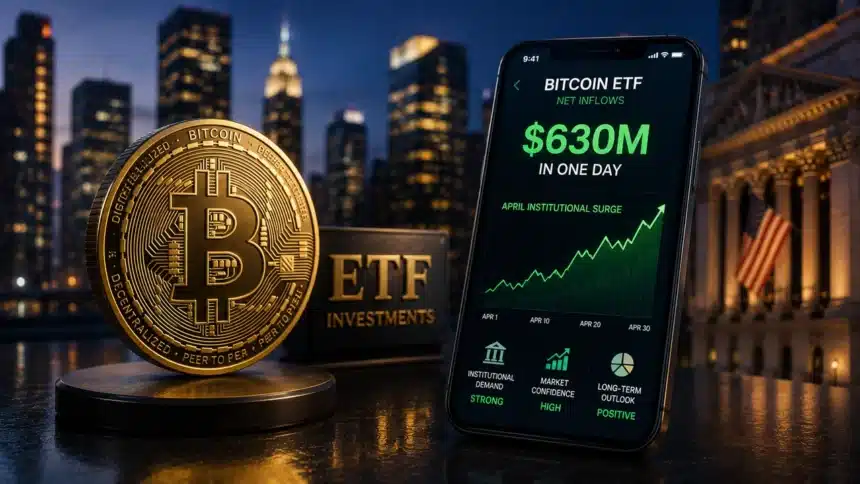
- Spot Bitcoin ETFs recorded $630 million in net inflows on May 1, 2026, the strongest single session of the year
- April 2026 total ETF inflows reached $2.44 billion, the highest monthly figure since October 2025
- Institutional ownership of Bitcoin ETF assets climbed to 38% of total holdings, up from 24% a year prior
- Hedge funds, pension funds, and registered investment advisors collectively hold more than $40 billion in ETF shares
- Bitwise projects more than 100 new crypto ETFs launching in the US in 2026 as SEC approval timelines shorten
Spot Bitcoin ETFs recorded $630 million in net inflows on May 1, 2026, in a single trading session. That figure is the strongest single day of 2026 and ranks among the highest daily inflow readings since the ETFs launched in January 2024. April’s total of $2.44 billion in net monthly inflows is the best month since October 2025. Both numbers point to the same conclusion: institutional accumulation of Bitcoin through regulated ETF vehicles is not plateauing. It is accelerating.
The flow data matters beyond its headline figures because it reveals something about the character of the buyers. ETF flows are institutional by nature. The investors using spot Bitcoin ETFs include hedge funds with compliance-driven investment mandates, pension funds allocating within defined risk parameters, registered investment advisors managing portfolios on behalf of clients, and insurance companies seeking inflation hedges within regulatory capital constraints. A $630 million single-day inflow is not retail impulse buying. It is managed money moving deliberately.
How $2.44 Billion in a Month Happens
April 2026’s $2.44 billion in ETF net inflows did not arrive in a single wave. The month built progressively, with flows accelerating after two distinct catalysts: the CLARITY Act stablecoin yield compromise announcement on May 1 (which landed on the last trading day of April for some fund accounting purposes) and the growing consensus that the Federal Reserve’s next move would be a rate reduction rather than continued maintenance of the current level.
Legislative progress on crypto market structure reduces the risk premium that institutional allocators assign to the digital asset ecosystem. When that risk premium compresses, the required expected return for holding Bitcoin decreases, which at current price levels means allocators can justify larger positions. The April flow data reflects institutional allocators recalibrating their Bitcoin positions upward as the regulatory risk premium declined.
The rate environment adds a second mechanism. Bitcoin’s narrative as a non-sovereign store of value becomes more compelling in environments where the real yield on cash and short-duration Treasuries is declining. Expectations of Fed rate cuts in Q3 2026, which became more concrete throughout April as inflation data continued to moderate, reduce the opportunity cost of holding Bitcoin and make the risk-adjusted case for allocation more favorable.
Who Is Actually Buying
Institutional ownership in Bitcoin ETFs reached 38% of total assets under management by the end of April 2026, up from 24% at the same point in 2025. The population of institutional owners has diversified considerably from the early ETF period, when the buyer base was dominated by crypto-native hedge funds and family offices. The 2026 institutional buyer set includes:
Pension funds in several US states, including Wisconsin and Michigan, which disclosed Bitcoin ETF positions in SEC filings during the first quarter of 2026. State pension funds are conservative allocators with decades-long investment horizons, and their participation signals that Bitcoin has crossed the threshold from alternative investment to acceptable institutional asset class in the most conservative institutional context that exists.
Insurance companies, which face a different regulatory capital treatment for Bitcoin ETF shares than for direct Bitcoin holdings and are beginning to use the ETF structure to access Bitcoin exposure within their investment guidelines. The National Association of Insurance Commissioners guidance published in early 2026 provided the regulatory clarity that several insurance company investment committees had been waiting for before initiating positions.
Registered investment advisors, who collectively manage an estimated $20 trillion in assets and have been the fastest-growing segment of the ETF buyer base through early 2026. The RIA channel’s growth reflects financial advisors responding to client demand from the wealth transfer generation, younger investors inheriting or accumulating wealth who are comfortable with digital assets and expect their advisors to accommodate crypto allocations.
The ETF Market Structure Change Coming
The May 1 inflow data arrived alongside a significant structural change to the US ETF approval process. Bitwise’s publicly published projection calls for more than 100 new crypto ETFs launching in the US during 2026, enabled by the SEC’s accelerated review timeline that has cut approval timelines from the prior standard of 240 days to as few as 75 days for products based on assets that already have approved ETF vehicles.
The ETF product set expanding beyond Bitcoin into Ethereum, Solana, and multi-asset digital asset index funds creates new access points for institutional allocators who want crypto exposure but are constrained by investment mandates that limit concentration in a single asset. A portfolio manager who cannot justify a 3% allocation to a single cryptocurrency may be able to justify a 3% allocation to a diversified digital asset index ETF that holds Bitcoin, Ethereum, and Solana in proportion to their market capitalization. Ethereum ETFs have seen growing inflows in the weeks following Bitcoin ETF records, suggesting allocators are using Bitcoin ETF data as a leading indicator for Ethereum positioning.
BlackRock’s Dominance and Its Implications
BlackRock’s iShares Bitcoin Trust, IBIT, holds a dominant position in the spot Bitcoin ETF market with more than $55 billion in assets under management as of May 2026. No other single ETF in the crypto space approaches that scale. BlackRock CEO Larry Fink’s repeated public statements framing Bitcoin as digital gold and tokenization as the future of financial markets have materially influenced how institutional allocators frame their digital asset exposure, and IBIT’s inflows benefit directly from Fink’s credibility with the institutional investment community.
IBIT’s scale also creates competitive dynamics within the ETF market that benefit investors: BlackRock’s fee of 0.25% is among the lowest in the category, and the fund’s liquidity, with daily trading volumes regularly exceeding $1 billion, makes it viable for institutional orders that would move the market of a smaller ETF. The concentration of assets in a single fund creates single-manager risk, but for institutional allocators optimizing for liquidity and regulatory trust, IBIT’s dominance is a feature rather than a bug.
The TCB View
The $630 million single-day inflow is a data point, not a trend. A single trading day can be distorted by large block trades from a single institution or a coordinated rebalancing event. What makes April 2026 significant is the combination: a strong month, a record single day, rising institutional ownership percentages, and a diversifying buyer base that now includes pension funds and insurance companies alongside the crypto-native allocators who defined the early ETF period. When the most conservative institutional allocators in the world, state pension funds and insurance companies, are buying Bitcoin ETFs, the asset class has genuinely crossed a threshold. The question is no longer whether Bitcoin belongs in institutional portfolios. The question is at what allocation percentage the average institutional portfolio will eventually settle. At 38% institutional ETF ownership and growing, the answer is clearly higher than it is today.
Free Daily Briefing
Get the Daily Briefing
Crypto, AI, and Web3 intelligence. Free, every day.
The Daily Brief by TCB
Crypto, AI & finance intelligence in 5 minutes. Every weekday morning. Free.