Key Highlights
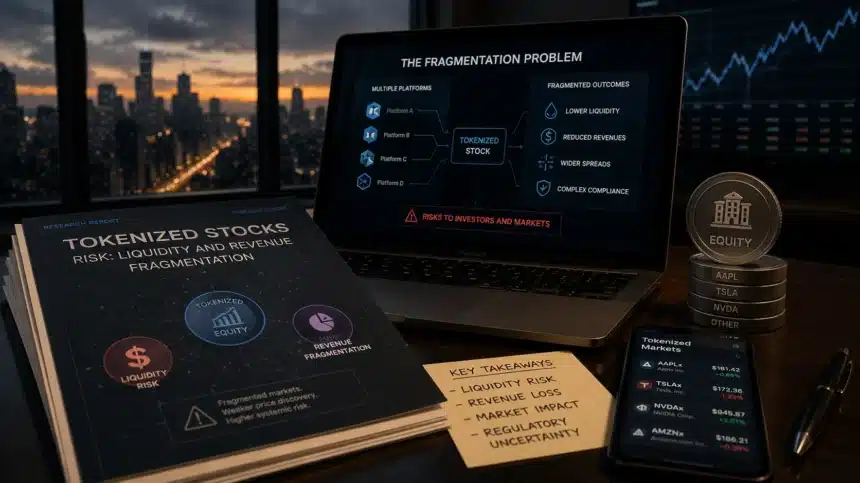
- Tokenized stocks pose a significant risk to market liquidity, with potential revenue fragmentation affecting traditional financial institutions, according to recent research.
- The current market environment, with Bitcoin trading at $77,384.00 and Ethereum at $2,128.30, may exacerbate these risks due to increased volatility.
- The Fear & Greed Index, currently at 28/100, indicates a fearful market sentiment, which could further contribute to liquidity and revenue fragmentation in tokenized stocks.
The emergence of tokenized stocks has sparked a heated debate in the financial community, with some hailing it as a revolutionary step forward and others warning of its potential risks. At the forefront of these concerns is the issue of liquidity and revenue fragmentation, which could have far reaching consequences for traditional financial institutions. As the market continues to evolve, with Bitcoin and Ethereum dominating the headlines, it is essential to examine the potential impact of tokenized stocks on market liquidity and revenue streams. The focus keyword, tokenized stocks risk liquidity revenue fragmentation, is a critical area of concern that warrants closer scrutiny.
Background on Tokenized Stocks
Tokenized stocks refer to the process of representing traditional securities, such as stocks and bonds, on a blockchain network. This allows for increased efficiency, transparency, and accessibility in the trading process. However, as the market for tokenized stocks continues to grow, so do the concerns surrounding its potential impact on traditional financial institutions.
According to a recent study, the tokenization of stocks could lead to a significant reduction in trading volumes on traditional exchanges, resulting in reduced revenue streams for these institutions. This, in turn, could have a ripple effect on the entire financial ecosystem, leading to increased volatility and reduced liquidity.
Market Volatility and Liquidity
The current market environment, characterized by high volatility and a fearful market sentiment, may exacerbate the risks associated with tokenized stocks. With Bitcoin experiencing a 0.12% decline in the past 24 hours and Ethereum seeing a 0.15% increase, the market is highly unpredictable. The Fear & Greed Index, currently at 28/100, indicates a fearful market sentiment, which could further contribute to liquidity and revenue fragmentation in tokenized stocks.
The potential for reduced liquidity in tokenized stocks is a significant concern, as it could lead to increased trading costs and reduced market efficiency. As the market continues to evolve, it is essential to monitor the impact of tokenized stocks on liquidity and revenue streams, particularly in times of high volatility.
Impact on Traditional Financial Institutions
Traditional financial institutions, such as banks and brokerages, may be the most affected by the emergence of tokenized stocks. As trading volumes decline on traditional exchanges, these institutions may experience reduced revenue streams, leading to increased costs and reduced profitability. The potential for revenue fragmentation is a significant concern, as it could lead to a decline in the overall health and stability of the financial system.
According to Felix Ng, Staff Editor at a leading financial publication, the impact of tokenized stocks on traditional financial institutions could be significant. “The tokenization of stocks has the potential to disrupt traditional business models, leading to reduced revenue streams and increased costs,” he stated. “It is essential for these institutions to adapt to the changing market environment and explore new revenue streams to remain competitive.”
Regulatory Environment
The regulatory environment surrounding tokenized stocks is still in its infancy, with many uncertainties and challenges ahead. As the market continues to evolve, it is essential for regulatory bodies to provide clear guidance and oversight to ensure the stability and integrity of the financial system. The current lack of regulatory clarity may exacerbate the risks associated with tokenized stocks, leading to increased volatility and reduced liquidity.
According to Martin Young, Staff Writer at a leading financial publication, the regulatory environment is a critical factor in determining the success of tokenized stocks. “The lack of regulatory clarity is a significant concern, as it could lead to increased uncertainty and risk in the market,” he stated. “It is essential for regulatory bodies to provide clear guidance and oversight to ensure the stability and integrity of the financial system.”
Conclusion and Future Outlook
The upshot: the emergence of tokenized stocks poses significant risks to market liquidity and revenue streams, particularly for traditional financial institutions. As the market continues to evolve, it is essential to monitor the impact of tokenized stocks on liquidity and revenue streams, particularly in times of high volatility. The regulatory environment surrounding tokenized stocks is still in its infancy, and it is essential for regulatory bodies to provide clear guidance and oversight to ensure the stability and integrity of the financial system.
The future outlook for tokenized stocks is uncertain, with many challenges and opportunities ahead. As the market continues to grow and evolve, it is essential to address the concerns surrounding liquidity and revenue fragmentation to ensure the long term success and stability of the financial system.
The TCB View
TCB is cautious on the emergence of tokenized stocks, as the potential risks to market liquidity and revenue streams are significant. The current market environment, characterized by high volatility and a fearful market sentiment, may exacerbate these risks, leading to increased uncertainty and risk in the market. The winners in this scenario are likely to be the blockchain based platforms and exchanges that facilitate the trading of tokenized stocks, while the losers may be traditional financial institutions that fail to adapt to the changing market environment. TCB believes that the regulatory environment surrounding tokenized stocks is critical in determining their success, and we will be watching for clear guidance and oversight from regulatory bodies in the coming months. Watch for the next quarterly filing from leading financial institutions to gauge the impact of tokenized stocks on their revenue streams and profitability.
Get the Daily Briefing
Crypto, AI, and Web3 intelligence. Free, every day.