
Key Highlights
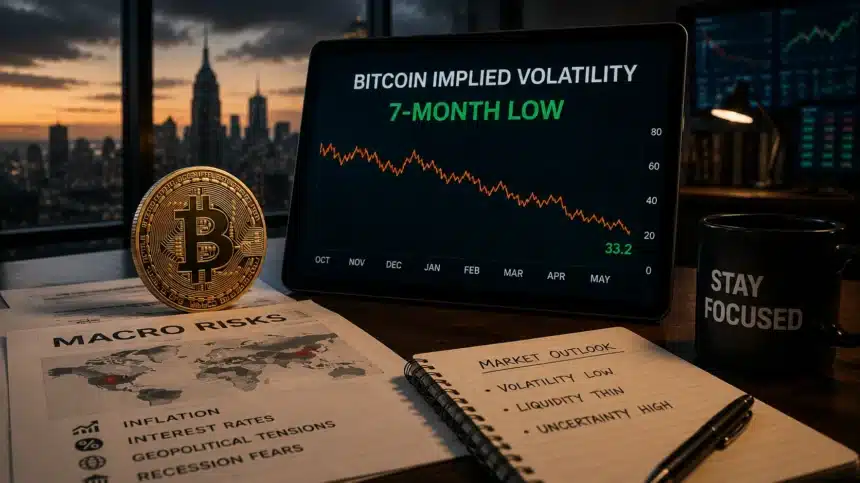
- Bitcoin implied volatility has dropped to a 7 month low, currently standing at a level not seen since October 2025.
- Institutional demand, led by companies such as Strategy, has helped to steady the markets and reduce volatility, with Bitcoin’s price currently at $77,382.00.
- The Fear & Greed Index is at 28/100, indicating a state of fear in the market, despite the relatively low volatility, with Bitcoin’s difficulty at 1.37e+14 and a block height of 950,481.
Bitcoin implied volatility drops 7 month lows have been a rare sight in recent times, but the current market conditions have led to a significant decrease in volatility, with the cryptocurrency’s price moving in a relatively narrow range. This drop in volatility is particularly notable given the current macro risks, including geopolitical tensions and economic uncertainty. Despite these risks, institutional demand has remained strong, with companies such as Strategy leading the charge. As a result, Bitcoin’s price has remained relatively stable, currently at $77,382.00, with a 24 hour change of -0.72%.
Market Context
The current market context is one of caution, with the Fear & Greed Index at 28/100, indicating a state of fear in the market. This is despite the relatively low volatility, with Bitcoin’s implied volatility at a 7 month low. The low volatility is likely due to the strong institutional demand, which has helped to steady the markets and reduce the likelihood of large price swings.
The Bitcoin network is also operating smoothly, with a block height of 950,481 and a difficulty of 1.37e+14. The fee for a fast transaction is currently at 2 sat/vB, which is relatively low compared to historical levels. This has helped to increase the attractiveness of the Bitcoin network, with more users and investors taking advantage of the low fees.
Institutional Demand
Institutional demand has been a key driver of the current market conditions, with companies such as Strategy leading the charge. These companies have been buying up large amounts of Bitcoin, which has helped to reduce the volatility and increase the price. The strong demand from institutional investors has also helped to increase the legitimacy of Bitcoin as an investment asset, which has attracted more investors to the market.
The increase in institutional demand has also led to an increase in the use of Bitcoin as a store of value, with more investors holding onto their Bitcoin for longer periods of time. This has helped to reduce the sell pressure in the market, which has contributed to the low volatility. As a result, Bitcoin’s price has remained relatively stable, with a 24 hour change of -0.72%.
Macro Risks
Despite the current low volatility, there are still significant macro risks that could impact the Bitcoin market. Geopolitical tensions and economic uncertainty are just a few of the risks that could lead to increased volatility and a decrease in the price of Bitcoin. However, the strong institutional demand has helped to mitigate these risks, with the market remaining relatively stable despite the uncertainty.
The current macro risks are also having an impact on other cryptocurrencies, with Ethereum’s price currently at $2,128.77, with a 24 hour change of -0.44%. Solana’s price is currently at $87.36, with a 24 hour change of +0.55%, while BNB’s price is currently at $659.56, with a 24 hour change of +0.79%. The NEAR Protocol is currently trending at #1, with Pudgy Penguins and Hyperliquid trending at #2 and #3 respectively.
Volatility
Bitcoin’s implied volatility has been a key indicator of the market’s expectations for future price movements. The current low volatility is indicating that the market is expecting a relatively stable price, with limited upside or downside potential. However, this could change quickly if there are any significant developments in the macro environment or if there is a change in institutional demand.
The low volatility is also having an impact on the options market, with traders taking advantage of the low volatility to buy up options at relatively low prices. This could lead to an increase in trading activity, which could help to increase the liquidity in the market. However, it also increases the risk of a sudden increase in volatility, which could lead to significant losses for traders who are not prepared.
Conclusion
The upshot: the current market conditions are characterized by low volatility and strong institutional demand. The Bitcoin implied volatility drops 7 month lows are a rare sight, and the market is expecting a relatively stable price. However, there are still significant macro risks that could impact the market, and traders need to be prepared for any eventuality.
The TCB View
TCB is bullish on the current market conditions, with the strong institutional demand and low volatility indicating a positive outlook for Bitcoin. The low volatility is a significant opportunity for traders, who can take advantage of the relatively stable price to buy up Bitcoin at a low cost. However, the macro risks are still a significant concern, and traders need to be prepared for any eventuality. The winners in this scenario are the institutional investors who have been buying up Bitcoin, while the losers are the traders who are betting on a decrease in the price. Watch for the next quarterly filing from Strategy, which will provide an update on their Bitcoin holdings and give an indication of the direction of the market. TCB believes that the current trend will continue, with the strong institutional demand driving the price of Bitcoin higher. We see the low volatility as a buying opportunity, and our read is that the market will remain relatively stable in the short term. Watch for the Fear & Greed Index to move out of the fear zone, which will indicate a significant increase in market sentiment and a potential increase in the price of Bitcoin.
Get the Daily Briefing
Crypto, AI, and Web3 intelligence. Free, every day.