
Last updated: 9 April 2026
Key Highlights
- No Bubble in Sight: Huang argues high costs are due to building physical foundations, not just hype.
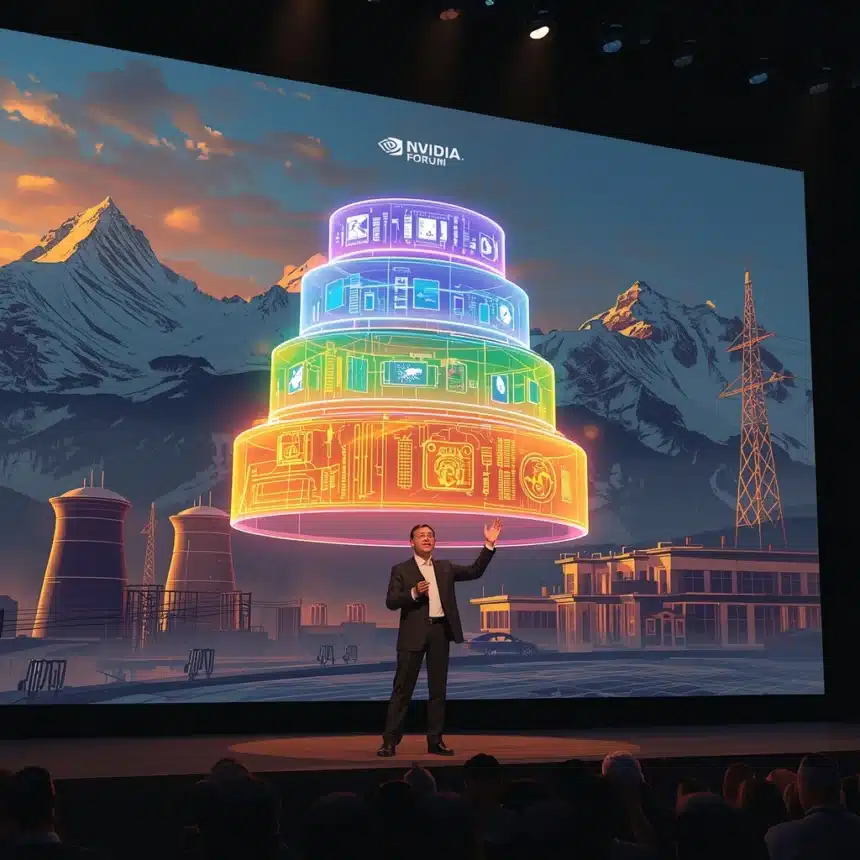
- The Five Layer Cake: AI is viewed as a system of energy, chips, cloud services, models, and apps.
- Job Creation: The boom is driving high paying jobs for electricians and technicians, not just coders.
- National AI: Countries are being urged to treat AI like roads or electricity as a basic public utility.
Why Nvidia’s CEO Says the AI Boom is Only Just Beginning
At the 2026 World Economic Forum in Davos, Nvidia CEO Jensen Huang dismissed fears of an “AI bubble,” calling the current moment the start of the largest construction project in human history.
- Why it matters: Trillions of dollars are being poured into AI, leading some to fear a crash, but industry leaders argue this money is building essential infrastructure.
- Who it affects: Governments, businesses, and even workers in trades like electricity and plumbing, as demand for physical data centers sky centers.
- What to watch: Whether the massive spending on chips and energy translates into real world profit for everyday businesses over the next year.
This article explores Jensen Huang’s “five layer cake” theory of AI and why he believes every country must build its own “AI factories” to stay competitive.
The “Five Layer Cake” of Artificial Intelligence
During a headline talk with BlackRock CEO Larry Fink, Jensen Huang described AI not as a single app or a website, but as a five layer cake. To understand why so much money is being spent, he says you have to look at what is being built from the ground up.
- Energy: The bottom layer. AI needs massive amounts of power to run.
- Chips: The hardware (like Nvidia’s GPUs) that does the actual thinking.
- Cloud Infrastructure: The digital “land” where these chips live.
- Models: The brains of AI, like the systems that power chatbots.
- Applications: The final tools that businesses and people actually use.
Huang’s point is simple: you cannot have the top layers (the useful apps) without building the bottom layers first. This is why the spending looks so large we are currently building the foundation.
Is the AI Bubble Real?
Many experts worry that because tech companies are spending hundreds of billions on chips without seeing equal profits yet, a crash is coming. Huang disagrees. He noted that even older versions of AI chips are becoming more expensive to rent because demand is so high.
”The investments are large because we have to build the infrastructure necessary for all the layers,” Huang explained. He believes we are in the middle of a $100 trillion shift in how the world’s economy works. Instead of a bubble that will pop, he sees a “build out” that will take 15 years to complete.
| Feature | AI “Bubble” View | Jensen Huang’s View |
| Spending | Too much, too fast | Necessary for infrastructure |
| Focus | Stock prices and hype | Factories and energy |
| Jobs | AI will replace humans | AI will need more tradespeople |
| Outcome | A market crash | A new industrial revolution |
Why Plumbers and Electricians are the New Tech Heroes
One of the most surprising parts of the Davos talk was Huang’s focus on blue collar work. He argued that the “AI factory” of the future isn’t just a building full of computers it’s a massive electrical and cooling challenge.
Because of this, salaries for electricians and technicians are skyrocketing. Huang mentioned that people who can build and maintain these “AI factories” are seeing six figure paychecks. He wants his own engineers to stop focusing on the “syntax” of coding and instead focus on solving deep problems, leaving the routine work to AI.
National AI: A New Type of Public Utility
Huang also issued a call to action for world leaders. He believes that AI is now a basic utility, just like roads, water, and electricity. He urged countries to build their own “Sovereign AI.”
The idea is that every nation has its own unique language, culture, and data. If a country doesn’t build its own AI infrastructure, it is essentially exporting its “natural resources” (its culture and data) to be processed by other countries. By building local AI factories, nations can keep their intelligence and jobs at home.
FAQ: Understanding the AI Investment Boom
1. What is an “AI bubble”?
An AI bubble is a situation where the price of tech stocks rises much higher than their actual value, leading to a sudden crash.
2. Why does Jensen Huang say it’s not a bubble?
He argues the money is going toward physical things factories, power grids, and chips that provide real value, rather than just “internet hype.”
3. Does AI use a lot of electricity?
Yes. Energy is the base of the “five layer cake.” This is why AI companies are now investing heavily in power plants and new energy sources.
4. Will AI take away engineering jobs?
Huang believes AI will handle the “boring” parts of coding, allowing engineers to focus on more creative and difficult human problems.
5. What is an “AI factory”?
It is a modern data center designed specifically to produce “intelligence” (data processing) instead of physical goods.
How We Analyzed This News
We reviewed transcripts and reports from the 2026 World Economic Forum in Davos, specifically the sessions featuring Nvidia, Microsoft, and BlackRock leaders. Our focus was on translating high level financial talk into clear concepts like the “five layer cake” to help readers understand the physical reality of the AI boom.
Free Daily Briefing
Get the Daily Briefing
Crypto, AI, and Web3 intelligence. Free, every day.
The Daily Brief by TCB
Crypto, AI & finance intelligence in 5 minutes. Every weekday morning. Free.